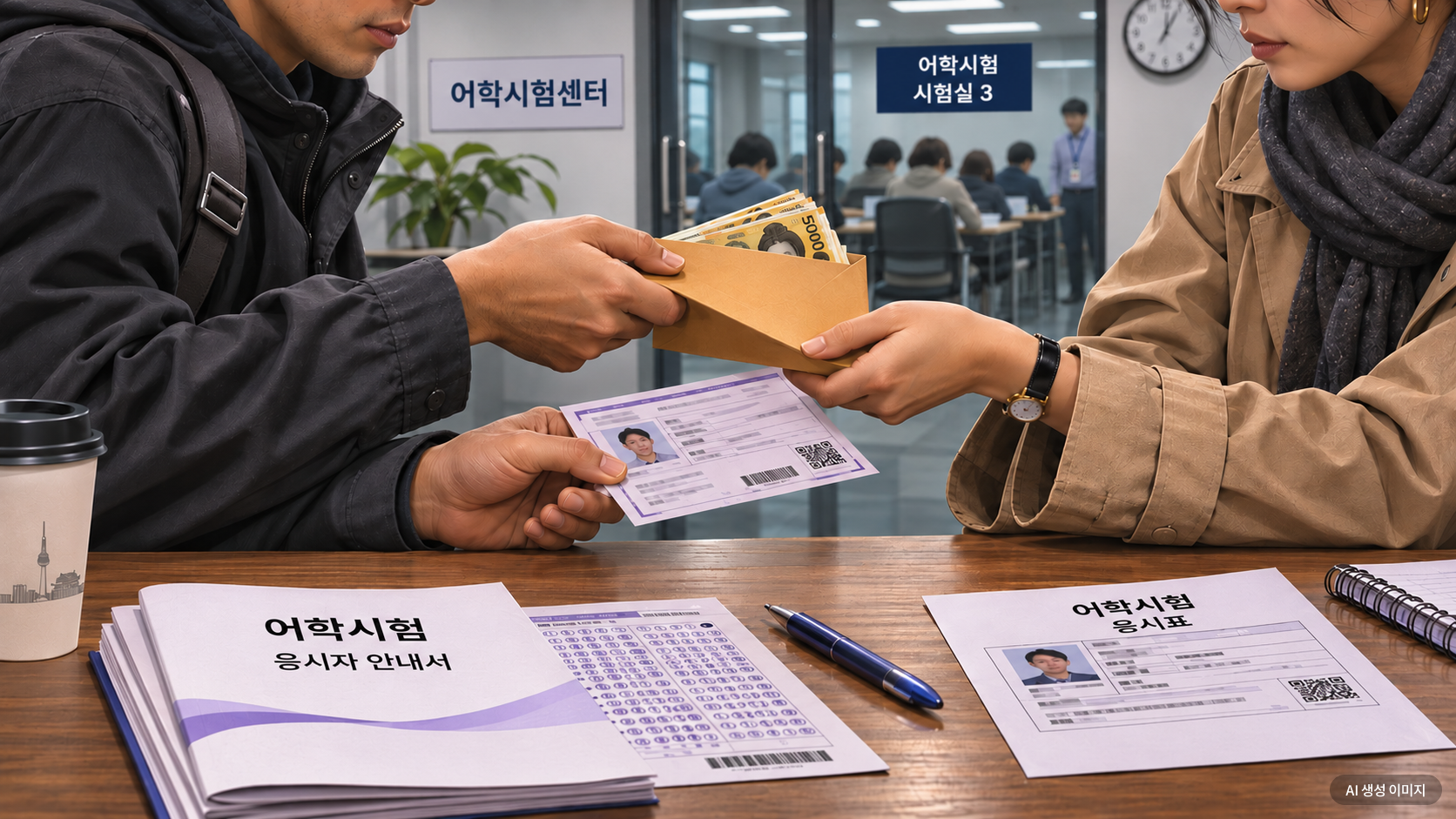
The controversy over the use of artificial intelligence (AI) to cheat on national qualification exams is spreading to language tests such as TOEIC and TEPS. Online, companies have emerged offering to take exams on behalf of candidates for millions of won or forge score reports. The fact that even certified language test scores used for employment, university admissions and promotions can be bought and sold is undermining trust in the entire testing system.

Controversy over cheating with artificial intelligence (AI) in national qualification exams is spreading to language tests such as TOEIC and TEPS. The image was generated by AI to illustrate the article. The Asia Business Daily
원본보기 아이콘Yonhap News Agency reported on the 27th that accounts promoting proxy test-taking for language exams, score report forgery and cheating with advanced electronic devices have recently been active on Telegram.
A proxy test-taking company contacted by Yonhap News Agency on the 26th demanded an upfront payment of 6.5 million won in response to an inquiry about aiming for a TOEIC score in the 800s. Another company quoted 4.6 million won for a score in the 900s. The companies claimed to have extensive experience with proxy test-taking and said there was no need to worry about getting caught. However, it has not been confirmed whether anyone has actually taken an exam on another person's behalf and obtained a score.

At a training session for control center staff assigned to smart glasses ahead of the 2027 College Scholastic Ability Test, held at the Seoul Metropolitan Office of Education in Yongsan-gu, Seoul, a company representative wears smart glasses and reads the "Guide to Preventing Cheating with AI Glasses." Yonhap News Agency
원본보기 아이콘Concerns have also been raised about loopholes in identity verification procedures at test centers. A person with experience proctoring TOEIC exams told Yonhap News Agency that the current method of comparing an ID photo with the test-taker's face may not be enough to completely prevent intentional proxy test-taking. An overseas company was also found promoting forged score reports. A Chinese company demanded cryptocurrency worth about 800,000 won to produce a forged score report.
People who hand over personal information to these companies may also be exposed to secondary crimes such as voice phishing or blackmail. They could be asked for additional money under threat of exposing their attempt to arrange cheating, or their identification documents could be misused for other crimes.
Some companies have also emerged claiming to use advanced technology to facilitate cheating on language tests. A Chinese company that previously claimed that the late Lee Jinwoo, a perfect scorer on the Law School Admission Test (LEET), had used its services also advertised guaranteed high scores on TOEIC and the Test of English as a Foreign Language (TOEFL). The company's Telegram channel was blocked on the 18th for violating South Korean law. It has not been confirmed whether Lee actually used the company's services. As the cheating controversy spreads, language test administrators are announcing countermeasures one after another.
The Korea TOEIC Committee, affiliated with YBM, will implement a strengthened monitoring system to prevent and detect AI-assisted cheating, starting with its regular test on the 29th. Key measures include inspecting all test-takers' glasses and applying security stickers to prevent them from being switched, restricting items allowed on desks, operating metal detectors, introducing additional radio frequency detectors and stepping up efforts to detect cheating after the test. TEPS, administered by Seoul National University, is also taking action, including strengthening searches at test centers and pursuing the use of disposable gowns and aprons.

An exam supervisor places a yellow sticker on a button on a test taker's clothing at Yongsan High School in Yongsan-gu, Seoul, on the 19th, when the 2027 College Scholastic Ability Test was held. Yonhap News Agency.
원본보기 아이콘Some say that more sophisticated verification systems are needed not only to address cheating with advanced devices, but also to tackle traditional forms of misconduct such as proxy test-taking and score report forgery. In particular, proxy test-taking is more than a simple violation of test rules. It can obstruct the normal business of the test administrator and may be subject to criminal penalties.

In 2017, the Busan District Court sentenced a man in his 30s to 18 months in prison for taking the TOEIC and TEPS exams on behalf of others four times in exchange for money, on charges including obstruction of business and forgery of official documents. The court also ordered him to pay 7.7 million won in forfeiture. The court noted that proxy test-taking could create social unfairness in South Korea, where language test scores are directly tied to employment. The image was generated by AI for illustrative purposes. The Asia Business Daily
원본보기 아이콘In 2017, the Busan District Court sentenced a man in his 30s to 18 months in prison for obstruction of business and forgery of official documents, among other charges, after he took the TOEIC and TEPS exams on behalf of other people four times for money. The court also ordered him to pay 7.7 million won in forfeiture. The judges noted that proxy test-taking could create social unfairness in South Korea, where language test scores are directly tied to employment. Under the Korea TOEIC Committee's current rules for handling test misconduct, anyone who takes a test on another person's behalf or arranges for someone else to do so is barred from taking the test for four years. Even after scores have been announced, if cheating is confirmed, the score in question and any scores obtained subsequently may be invalidated.
Language test scores have long been used as a key measure for allocating social opportunities, including corporate hiring, university admissions and various qualification exams. Therefore, scores obtained through cheating do not merely give individuals an unfair advantage; they can also deprive other test-takers who prepared honestly of their opportunities. This is a time to review the entire system for comprehensive test administration.
-
Reporter Bang Jeil zeilism@asiae.co.kr
-
Edit Kim Yumi ymkim91@asiae.co.kr
© The Asia Business Daily. All rights reserved. Unauthorized AI training and use prohibited.