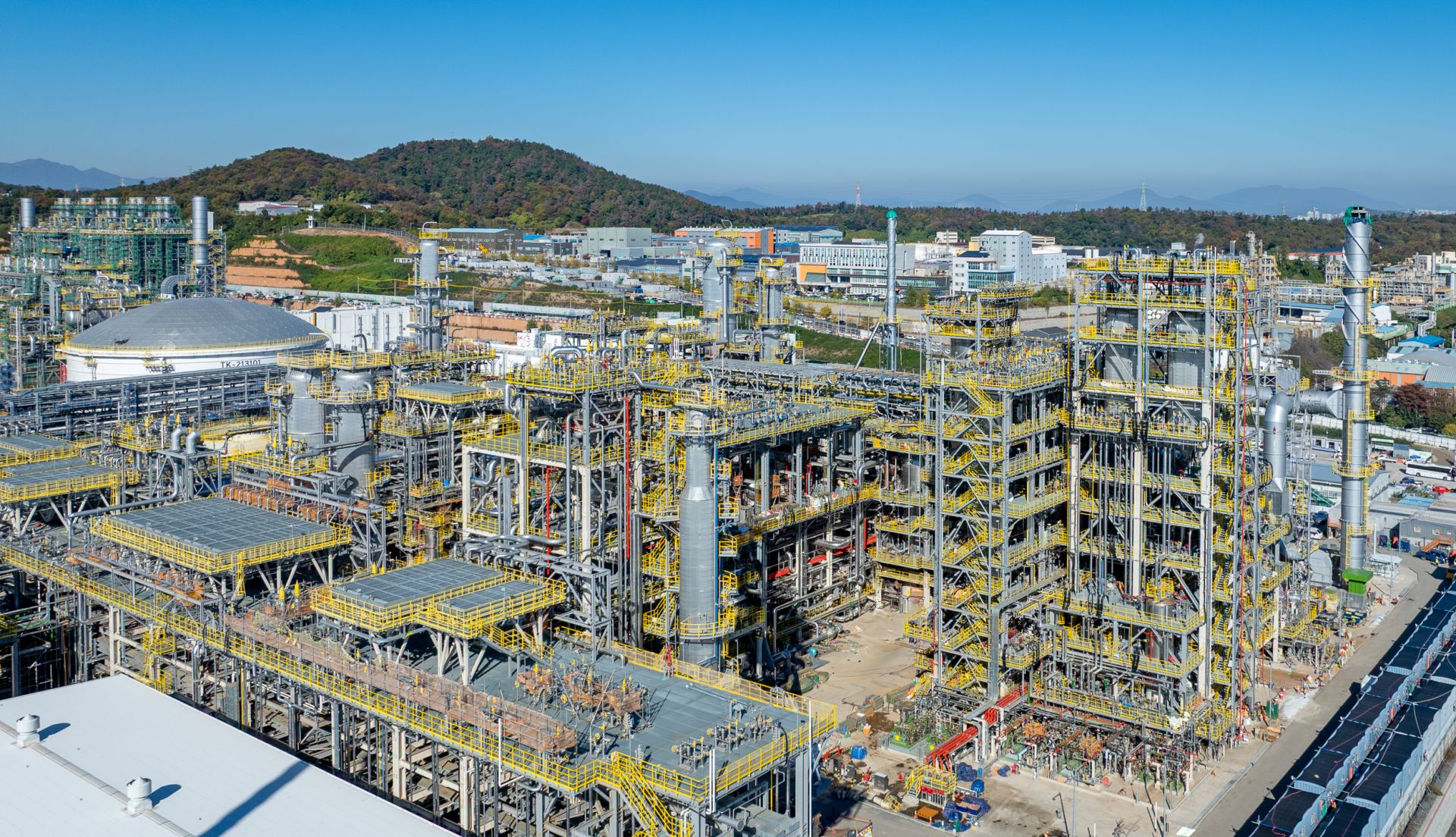
S-OIL completed the Shaheen Project, the largest investment in the history of Korea's petrochemical industry, in the year of its 50th anniversary. Opened in a year marked by continued energy supply uncertainty originating in the Middle East, the project is the fruit of cooperation between Korea and Saudi Arabia. The two governments and Aramco pledged to work together on energy security at the ceremony.
S-OIL Completes Shaheen Project, Largest Investment in Korean Petrochemical Industry
S-OIL held an event at Hotel Shilla Seoul on Nov. 25 to celebrate both its 50th anniversary and the completion of the Shaheen Project. Attendees included Minister of Trade, Industry and Energy Kim Jeonggwan; Saudi Deputy Minister of Energy for Oil and Gas Mohammed Al Ibrahim; Aramco CEO Amin Nasser; and Ulsan Mayor Kim Sangwook.
Participants marked the completion with a ceremony in which they pressed a start button while the event venue was connected in real time to the TC2C, steam cracker and polymer facilities at the Onsan plant in Ulsan.
In his commemorative remarks, Aramco CEO Amin Nasser emphasized energy security. "The geopolitical tensions in the Middle East have caused the most serious energy supply shock of my career," he said, adding that "energy security is economic security." He cited forecasts that energy demand in emerging economies will increase by more than 60% by 2060 as a reason Aramco continues to invest despite the crisis.
Nasser described the Shaheen Project, valued at $7 billion, as Aramco's largest-ever investment project in Korea. "The completion of the Shaheen Project despite the many headwinds facing the global economy is a symbol of the firm commitment to cooperation on both sides," he said.
Minister Kim: "A New Path for the Petrochemical Industry"; Nasser: "A Symbol of Firm Cooperation"
Minister Kim expressed gratitude for Saudi Arabia's crude oil supply. In his congratulatory remarks, he said, "Even amid instability in energy supply chains caused by the war in the Middle East this year, Saudi Arabia promised to give Korea top priority in supplying crude oil and naphtha." He added, "The Shaheen Project will open up new paths and possibilities for the petrochemical industry as it enters a period of transition."

Government, political and business leaders from both countries pose for a commemorative photo at an event marking S-OIL's 50th anniversary and the completion of the Shaheen Project, held at the Seoul Shilla Hotel on Nov. 25. From left: National Assembly member Seo Beom-soo; Ulsan Mayor Kim Sang-wook; S-OIL CEO Anwar Al Hejazi; S-OIL Board Chairman Kwon Oh-kyu; Saudi Arabia's Vice Minister of Energy Mohammed bin Abdullah Al Ibrahim; Minister of Trade, Industry and Energy Kim Jeong-kwan; Aramco CEO Amin H. Nasser; Aramco Downstream President Mohammed Y. Al Qahtani; Fahd Mubarak, Chargé d'Affaires at the Embassy of Saudi Arabia in Korea; National Assembly member Song Ki-heon; and S-OIL union leader Baek Seung-woo. Photo provided by S-OIL.
원본보기 아이콘Deputy Minister Al Ibrahim said that Saudi crude oil accounted for about 40% of Korea's total crude oil imports from January through October this year. "Saudi Arabia will honor its commitment to maintain its trusted relationship with Korea and ensure a stable and continuous supply of crude oil," he said.
The Shaheen Project is a petrochemical complex built on an 880,000-square-meter site in the Onsan National Industrial Complex in Ulsan, at a cost of KRW 9.258 trillion. The site covers an area equivalent to about 123 soccer fields, and the total length of electrical cables laid throughout the plant reaches about 8,300 kilometers. A cumulative 6.5 million workers were mobilized over the construction period, with up to 16,700 people working at the site in a single day during peak construction.
At the heart of the project is its TC2C facility, which directly converts crude oil into petrochemical feedstocks such as naphtha and liquefied petroleum gas (LPG). Unlike conventional refineries, which use only some of the fractions produced by distilling crude oil as petrochemical feedstocks, the facility increases the share of chemical products extracted from each barrel of crude oil.
TC2C is a technology jointly developed by Aramco and U.S.-based Lummus Technology. According to S-OIL, this is the first time the technology has been commercialized anywhere in the world. The feedstocks produced at the facility will be sent to a steam cracker with an annual ethylene production capacity of 1.8 million metric tons. Some of the ethylene will be processed at a polymer plant into polyethylene used in products such as plastic bags and food containers.
KRW 9.2 Trillion Invested in a Site the Size of 123 Soccer Fields; First Commercial Use of Direct Crude-to-Chemicals Technology
After test runs, S-OIL plans to begin commercial operations in 2027. The project will add annual production capacity of about 3.2 million metric tons of petrochemical products, raising the petrochemical division's share of total production from 12% to 25%. S-OIL will use the sales network of Aramco affiliate SABIC to export polyethylene and supply olefins directly by pipeline to petrochemical companies in the Ulsan area.
The Shaheen Project is the culmination, 35 years later, of a partnership that began with Aramco's equity investment in 1991. Since then, S-OIL has expanded its refining and upgrading facilities, increasing its refining capacity to more than 10 times what it was when the company was founded. Following its Residue Upgrading Complex and Olefin Downstream Complex (RUC&ODC) in 2018, S-OIL has invested more than KRW 14 trillion over the past 10 years, including in the Shaheen Project.

A view of the S-OIL Shaheen Project site in the Onsan National Industrial Complex in Ulsan. Courtesy of S-OIL.
원본보기 아이콘In his welcoming remarks, S-OIL Board Chairman Kwon Okyu said, "The Shaheen Project is the starting point of a new leap forward, achieved through the experience and capabilities S-OIL has built over the past 50 years and its spirit of constant challenge."
"If the past 50 years have been a history of friendship in which we helped each other grow, the next 50 will be a history of shared prosperity in which we open up an even greater future together," Minister Kim said. "The government will provide firm support to ensure that investment and cooperation between the two countries lead to even greater achievements."
-
Reporter Seo Miteum faith@asiae.co.kr
-
Edit Lee Kijae happylee17@asiae.co.kr
© The Asia Business Daily. All rights reserved. Unauthorized AI training and use prohibited.