Japan's first multipurpose dome stadium
Designed to accommodate 10-ton trucks
Designed to accommodate 10-ton trucks

by Lee Yiseul
by Choi Yujeong
Published 25 Nov.2026 14:27(KST)
Updated 25 Nov.2026 14:34(KST)

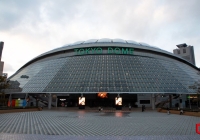
A view of Tokyo Dome in Bunkyo Ward, Tokyo, Japan, on the 25th of last month. Opened in 1988, it was Japan's first indoor domed stadium and is the home stadium of the Yomiuri Giants professional baseball team. Producer Lee Gyeongdo
원본보기 아이콘Rain poured down on Tokyo on October 26. As we entered Tokyo Dome in Bunkyo Ward, Tokyo, the damp air outside was nowhere to be felt. It was warm inside, and the field, covered in blue artificial turf, was comfortable. Above us stretched a vast white roof, while more than 40,000 seats came into view at a glance. There was no baseball game or concert that day. Staff walked around the empty stands, inspecting the facilities and picking up litter. The scene was completely different from when I attended a K-pop concert here about 10 years ago.
After repeated requests and persistent persuasion, The Asia Business Daily became the first Korean media outlet to conduct an exclusive on-site visit inside Tokyo Dome and interview its key executives. We met Satoshi Wakabayashi, head of the Event Planning Department; Hiroki Yamauchi, a section chief; Mitsuhiro Ishizuka, a section chief in the Tokyo Dome Department; Eriko Masaki, head of the Public Relations Office; and Hiroto Genda, a section chief, among others. Guided by them, we toured the field, player facilities, and special viewing rooms. In the interviews that followed, we heard about 38 years of operational experience, from event scheduling and converting the venue to a concert hall to bringing in equipment and renovating facilities.

Opened on March 17, 1988, Tokyo Dome was Japan's first all-weather multipurpose domed stadium. It accommodates about 43,500 people for baseball games and up to 55,000 for concerts. As Tokyo Dome marks its 38th year, how has it managed to host both baseball games and concerts while operating such a large facility?
Professional baseball was the starting point for Tokyo Dome's operations. Built to take over the role of Korakuen Stadium, which opened in 1937, the venue was founded on the steady demand for games by the Yomiuri Giants. The approach is to secure baseball dates first and then book other events.
When we asked department head Wakabayashi whether Tokyo Dome could have been built without the reliable demand from professional baseball, he replied, "It would have been difficult."
"Tokyo Dome was built on the premise that it would host baseball. The previous Korakuen Stadium was a baseball venue, so Tokyo Dome took over that role," he explained. "Its primary use is baseball, with other events held during the remaining time."
Event dates are also assigned according to priority. Section chief Genda said, "The Yomiuri Giants' game schedule is always set first. We finalize the baseball schedule from March through October, then fill the days without baseball with concerts. Even if a concert organizer requests a particular date, we suggest another date if a baseball game is already scheduled. As a rule, we operate the schedule to avoid conflicts."
On open dates, the venue hosts a variety of events, including not only music performances but also combat sports and exhibitions. It has even hosted a snowboarding event, piling snow onto the field. This expands on the multipurpose use of the venue that began in the days of Korakuen Stadium. In its early years, Tokyo Dome raised its profile by attracting performances by global stars such as Michael Jackson and the Rolling Stones.
Before the COVID-19 pandemic, the facility was used for as many as 327 days a year. According to Tokyo Dome's financial statements obtained by The Asia Business Daily, the stadium's utilization rate was 89.6% from February 2019 to January 2020. Baseball-related use totaled 134 days, including 105 days for professional baseball and 29 days for other baseball events. The facility was occupied for 130 days for concert-related activities and 63 days for other events, bringing the total number of non-baseball event days to 193.
One point worth noting is the difference between the number of concert dates and the number of days the facility was occupied. Concert-related events actually took place on 70 days, but the venue was occupied for 130 days, including stage setup and dismantling. In other words, 60 days were spent on preparations and restoring the venue even when no concert was taking place.
In recent years, the number of days hosting non-baseball events has also remained around 100 annually: 96 days in 2022, 99 in 2023, 100 in 2024, and 97 in 2025. These figures count actual event dates, however, and are calculated differently from the facility occupancy days cited above.
The schedule remains packed. Tokyo Dome President Hiroshi Saito said in an interview with Japanese media in October, "The stadium's utilization rate is almost 100%." In some cases, stage setup begins as soon as a baseball game ends, and equipment is dismantled on the night a concert wraps up so players can train the next morning. The stadium is also rented out to the general public, but because the available slots are usually late at night, amateur baseball games are sometimes held from 11 p.m. until the following morning.
One recent development in concert demand that has caught the attention of the management team is the rapid growth of K-pop artists. They find it noteworthy that the time from debut to performing at Tokyo Dome is shorter for K-pop artists than for Japanese artists.
Department head Wakabayashi observed, "Tokyo Dome performances by K-pop artists have increased significantly over the past five to 10 years. The biggest difference is how quickly they gain popularity."
"For Japanese artists, it often takes a very long time from their debut to performing at Tokyo Dome, whereas the period from debut to making it to Tokyo Dome is very short for K-pop artists," he said. "They gain popularity in Japan quickly and build a fan base large enough to perform for two days at a different pace." He added, "One reason they gain popularity so quickly is that they pursue their careers with international expansion in mind, in addition to activities in Korea. With their popularity rising so quickly, competition among artists must also be intense."
The management team also expressed interest in Korean fans traveling to Japan to attend concerts. They asked the reporting team how naturally Korean fans take to traveling overseas to see a Tokyo Dome concert.

(Above) A passageway leading from inside Tokyo Dome in Tokyo, Japan, to the field. (Below) A dugout (players' waiting area) beside the field at Tokyo Dome. PD Lee Gyeongdo
원본보기 아이콘Department head Wakabayashi said, "Japanese fans sometimes feel reluctant to travel to another city, such as Sapporo or Fukuoka, to see a concert. I wonder whether Korean fans feel any such reluctance when they have to travel overseas to see a Tokyo Dome concert."
Standing on the Tokyo Dome field, the scale of the facility felt much greater than it had from the stands. The artificial turf was dense and vivid, much like real grass. The view extended all the way to the scoreboard in the outfield, unobstructed by any structures.
A pitcher's mound rose in the middle of the field. Section chief Ishizuka said, "The mound is retractable. When we hold a concert, it is lowered beneath the floor to make the field level."
The process of converting the baseball stadium into a concert venue begins by lowering the mound and laying protective sheets over the artificial turf. Converting the floor takes four to five hours. With a stage set up in front of the outfield scoreboard and additional seating installed on the field, the venue can accommodate up to 55,000 people. Installing the stage and sound and lighting equipment takes about two days.
Section chief Genda said, "To convert the venue for a concert, we remove the equipment from the field and lay down protective sheets before the work begins. Once the concert is over, we immediately restore the venue so it can be used as a baseball stadium again."
Another facility that supports the quick conversion is a large equipment entrance. A staff member guided a truck's route behind the outfield fence. The entrance is designed to let vehicles carrying stage, sound, and lighting equipment drive into the stadium and unload their cargo.
Large concerts require multiple equipment trucks. The size and location of the entrance affect the workforce and preparation time. Tokyo Dome can accommodate 10-ton trucks driving into the stadium.
The management team explained, "Tokyo Dome was designed to allow 10-ton trucks to drive into the stadium. The trucks can easily enter and exit through the loading entrance. At some older facilities, 10-ton trucks cannot get inside, so they have to be parked outside and staff must carry in the equipment one item at a time. This is extremely inconvenient for concert organizers." They added, "It's important to consider the equipment being brought in so it can be installed and removed in a short time."
The actual needs of concert organizers are also reflected in facility improvements. When Tokyo Dome replaced its large scoreboard in 2022, it determined the screen size with the locations and advertising impact of the 10 existing analog advertising boards in mind.
Section chief Ishizuka advised, "People planning a new dome may want to make the scoreboard as large as possible, but a larger screen also means more time and money are needed to produce the video content shown on it. The size should be decided after carefully listening to the organizers who actually produce and use the videos."
Tokyo Dome does not continue to use the facilities it had when it opened. In March 2026, it completely replaced the artificial turf for the first time in about seven years. This was the first replacement since 2019, and the turf was designed by U.S. company FieldTurf to suit Tokyo Dome's environment. It was made durable enough to withstand repeated stage setups and dismantling, while also allowing players to compete safely.
Because baseball games and concerts take turns using the venue, the field must be maintained to suit both purposes. The floor used for seating during concerts must be restored to playing condition for the next baseball game.

The stands viewed from the field at Tokyo Dome in Tokyo, Japan, on the 26th of last month. The upper section of the seating area displays the historical records of the Yomiuri Giants, a Japanese professional baseball team that uses Tokyo Dome as its home stadium. Producer Lee Gyeongdo.
원본보기 아이콘The roof also requires regular maintenance. Tokyo Dome was built using a membrane structure supported by keeping the air pressure inside higher than the pressure outside. The design drew on U.S. air-supported domes and took construction costs and the construction period into account. Natural light came through the thin membrane, keeping the inside of the stadium bright even on rainy days.
Section chief Genda explained, "We conduct a comprehensive inspection of the facility's condition every year and decide what needs to be repaired. In some years, we work on the roof; in others, we repair facilities such as the artificial turf. We try to carry out construction during the off-season for baseball."
The way power is supplied for concerts has also changed. In the past, the venue used external generator trucks, but its facilities have since been upgraded so concerts can be held using only the stadium's internal power supply.
Tokyo Dome's high utilization rate is not simply the result of filling empty dates with events. It is supported by operations that take into account the time needed to switch between baseball and concerts, routes for moving large equipment, and maintenance schedules. The secret to how a 38-year-old stadium continues to host so many events lies in the facilities and work methods found throughout the field.

Lee Yiseul ssmoly6@asiae.co.kr
Choi Yujeong yjchoi@asiae.co.kr
© The Asia Business Daily. All rights reserved. Unauthorized AI training and use prohibited.