
under one roof"
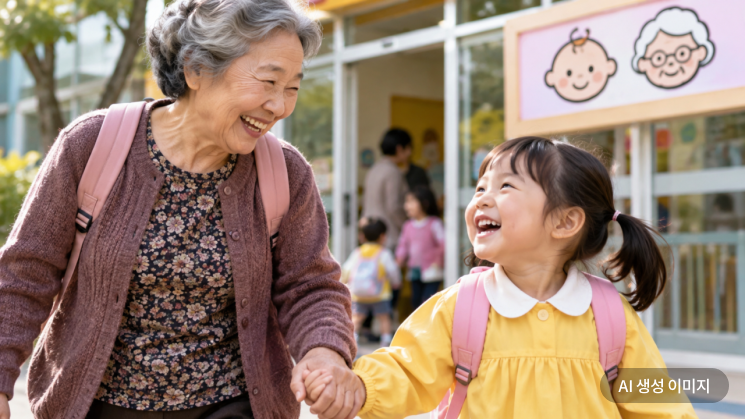
China is moving to establish an integrated care service system for older adults and young children in response to rapid population aging and low birth rates.
According to China's Dashang News on the 23rd, Chinese authorities have decided to significantly expand kindergartens and eldercare facilities that can accommodate children as young as 2 to 3 under the "Implementation Plan for Establishing a Service System for Older Adults and Children (Yilao Yixiao)."
Parenting and care under one roof... "Services tailored to users"
The report said that China's population aged 60 and older has exceeded 320 million, accounting for about 23% of the total population. It noted that the issue has become a serious social problem as low birth rates and diverging population trends across regions occur simultaneously. It added, "The difficulties many families face in supporting older relatives and caring for children have become a challenge for society as a whole, not just individuals." At a press conference, the National Development and Reform Commission also said, "The burden of caring for older adults and children at the same time is indeed immense."
In the past, eldercare, childcare, and education were managed through separate systems and facilities. However, many people said these services were not properly used because of costs and concerns about whether they could trust the facilities with their family members.
now under one roof
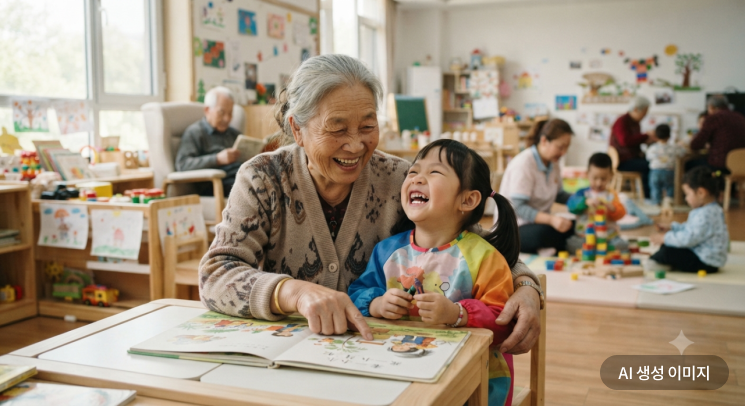
Under the newly announced plan, kindergartens will operate childcare classes for children aged 2 to 3 (12 to 18 months) to ease the burden on dual-income families. Previously, children could enroll only from age 3, but operations are being expanded as childcare shortages and low birth rates have emerged as serious social issues. The plan also calls for the renovation and upgrading of 2,000 aging public facilities, raising the proportion of beds designated for eldercare to around 73%. The biggest change is that eldercare and childcare for infants and young children will be provided in the same place. The authorities intend to expand care services by shifting from simply increasing the supply of facilities to offering services tailored to users' needs.
to be renovated and upgraded
for eldercare
by children under 3
agencies and facilities
The authorities have set a target of increasing the share of children under 3 using childcare facilities by 6 percentage points from last year by 2030, and raising the share of community-based eldercare agencies and facilities to 70%.

more older adults
China's population balance shifts as marriage and births decline
The policy shift is seen as a response to a rapidly changing population structure. According to the "2026 China Statistical Yearbook," recently published by China's National Bureau of Statistics, the old-age dependency ratio reached 23.1% last year, surpassing the child dependency ratio (22%) for the first time. China's old-age dependency ratio rose steadily from 15% in 2016 to 20.8% in 2021 and 22.8% in 2024. It came close to the child dependency ratio of 23% in 2024 before overtaking it for the first time last year. The reversal reflects a growing older population and a sharp drop in births. The BBC reported that China's birth rate fell to 5.63 births per 1,000 people last year, the lowest since the founding of the People's Republic of China in 1949.
The number of marriages also rebounded before declining again. A total of 6.76 million marriages were registered in China last year, up by 657,000 couples from the previous year. However, the number of marriages in the first half of this year was 3.28 million couples, down 7.5% from the same period a year earlier.
in the first half of this year
same period a year earlier
In response, Chinese authorities are rolling out a range of measures to encourage marriage and childbirth. They have held events opening marriage-registration counters in unusual locations such as banks, subway stations, and hospitals, while successively introducing marriage subsidies, bonuses, and childbirth benefits. The authorities have also issued guidelines to reform betrothal gift (caili) and wedding-gift customs, which are considered major financial burdens in marriage. The country is moving to develop broad-ranging support measures, from encouraging marriage and childbirth to providing care for older adults and young children.
caregiver are you?
How would you care for
the people you cherish?
-

Reporter Kim Jinsun carol@asiae.co.kr
-

Edit Eo Kangbi uhkb86@asiae.co.kr
© The Asia Business Daily. All rights reserved. Unauthorized AI training and use prohibited.