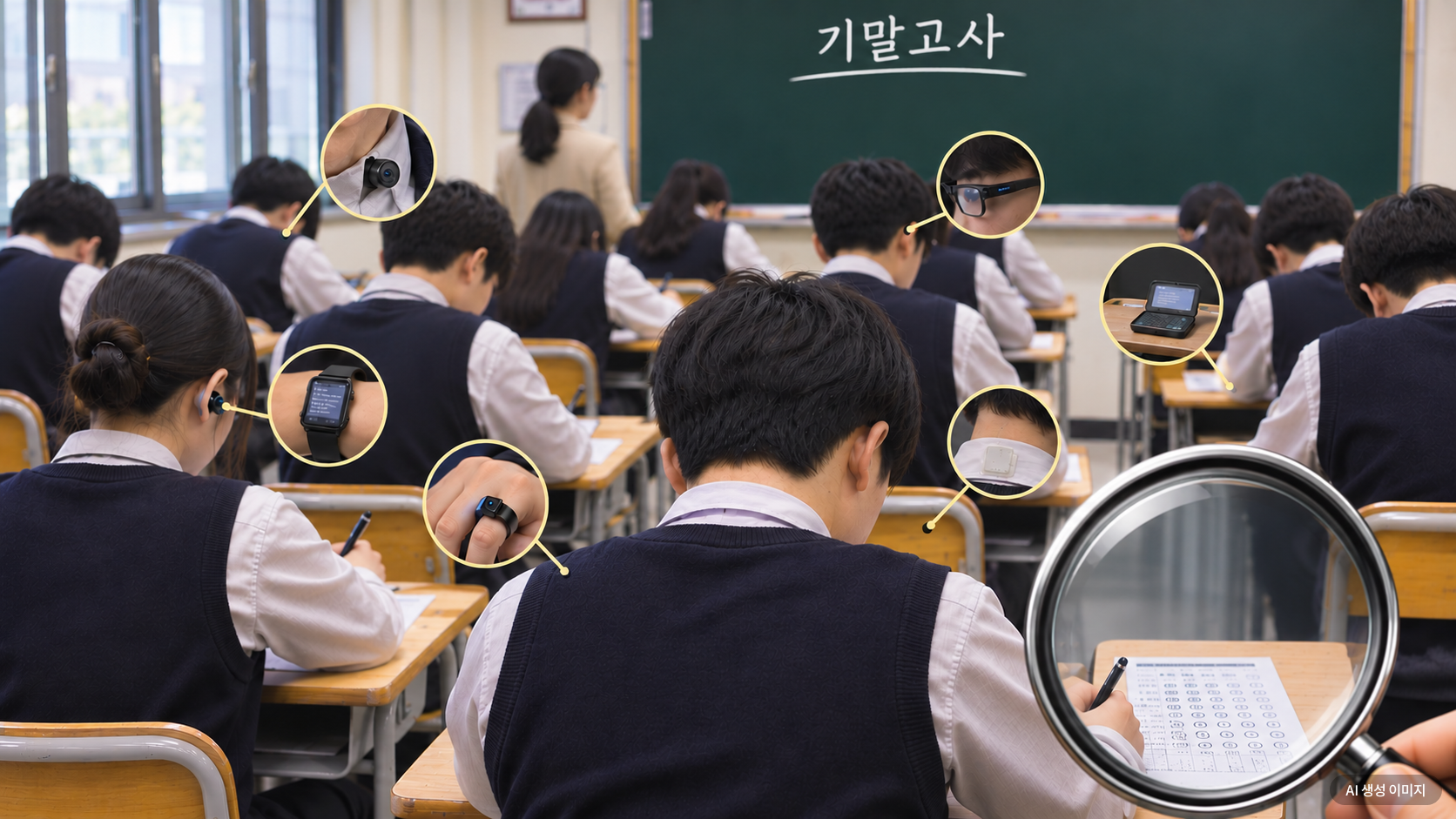


The Ministry of Education believes that schools need to impose stricter disciplinary measures for cheating involving advanced devices. Each school’s academic achievement management regulations set out how cheating is handled.
Cheating Only on the CSAT? We're Worried About School Exams, Too... Education Ministry to Survey All Middle and High Schools in January 2027
Amid controversy over cheating on the 2027 College Scholastic Ability Test (CSAT) using advanced devices such as smart glasses and miniature cameras, the Ministry of Education has decided to investigate whether similar cheating has occurred on school-based exams at middle and high schools. The investigation, which will expand beyond smart glasses to cover a range of advanced electronic devices, is expected to take place around January 2027.
Investigation into Cases Detected After Final Exams; Scope to Expand to Various Advanced Electronic Devices
According to education officials on November 23, the Ministry of Education is pursuing a plan to investigate cases of cheating using advanced electronic devices at middle and high schools nationwide after the final exams for the second semester of 2026.
A Ministry of Education official said, "We plan to investigate cheating involving various advanced electronic devices, including smart glasses," adding, "We should be able to conduct the investigation once the final exams are over and disciplinary proceedings against students have been completed." The investigation is therefore expected to take place in January 2027. Final exams for the second semester at middle and high schools are scheduled to take place sometime between the first and third weeks of December, depending on the school, and disciplinary procedures take one to two weeks when cheating is detected. "It will likely be January 2027 before we can confirm the severity of the disciplinary measures," the official explained.
Earlier, the Ministry of Education investigated cases of cheating with smart glasses at schools through the midterm exams for the second semester of 2026 and confirmed a total of four cases. That investigation focused on smart glasses, and did not separately examine cheating involving other advanced devices, such as miniature cameras.
However, controversy over cheating using miniature cameras and other devices on the tax accountant exam has fueled concerns that similar cheating could occur not only on the CSAT but also on school-based exams. The Ministry of Education plans to review the specific targets and scope of the investigation at a later date.
Attention Also on Whether Performance Assessments Using AI Will Be Included in the Investigation
Attention is also focused on whether the investigation will include cheating on performance assessments using generative artificial intelligence (AI). Recently, at a high school in Yangcheon-gu, Seoul, allegations emerged that around 170 of the 249 students who took a Korean-language performance assessment had used generative AI, prompting a decision to require all students to retake the test.
Accordingly, most schools give students a score of zero on the test in question if they cheat, but some are calling for harsher penalties for cheating with AI.
On the 19th, a parent posted on the Anti-Corruption and Civil Rights Commission’s People’s Idea Box, calling for thorough monitoring of school exams, measures to prevent cheating with AI, and a zero-tolerance policy for those caught. As of 9:40 a.m. that day, the post had received 96 comments in support.
Calls for Tougher School Disciplinary Measures... "Zero Tolerance for AI-Assisted Cheating"
A Ministry of Education official said, "Disciplinary measures must take into account various circumstances at the school, such as whether advanced devices were merely in a student's possession or were actually used, so it is difficult to apply uniform penalties." The official added, "However, disciplinary measures for cheating involving advanced devices such as smart glasses need to be tougher than in the past." The official also said, "We will need to discuss this approach with provincial and metropolitan offices of education."
Meanwhile, Education Minister Choi Kyo-jin offered to resign on November 22, taking responsibility for the confusion during preparations for the CSAT. President Lee Jae-myung accepted his resignation, and the Ministry of Education is expected to be led by Vice Minister Choi Eun-ok in an acting capacity until a successor is appointed.
"Because I'm Old..." Choi Kyo-jin Ultimately Resigns as Education Minister, Taking Responsibility for CSAT Chaos

Education Minister Choi Kyo-jin answers lawmakers' questions during a plenary meeting of the National Assembly's Education Committee on the 16th. Yonhap News
원본보기 아이콘-

Reporter Oh Jooyean moon170@asiae.co.kr
-
Edit Kim Yumi ymkim91@asiae.co.kr
© The Asia Business Daily. All rights reserved. Unauthorized AI training and use prohibited.