
Bukangi,
How Did You Get All the Way Here?
An unexpected visitor has appeared in a channel at Busan's North Port.
Is it a shark that lost its way, or a signal from a changing sea?
A 3-Meter Black Shark Appears in a Busan City Channel
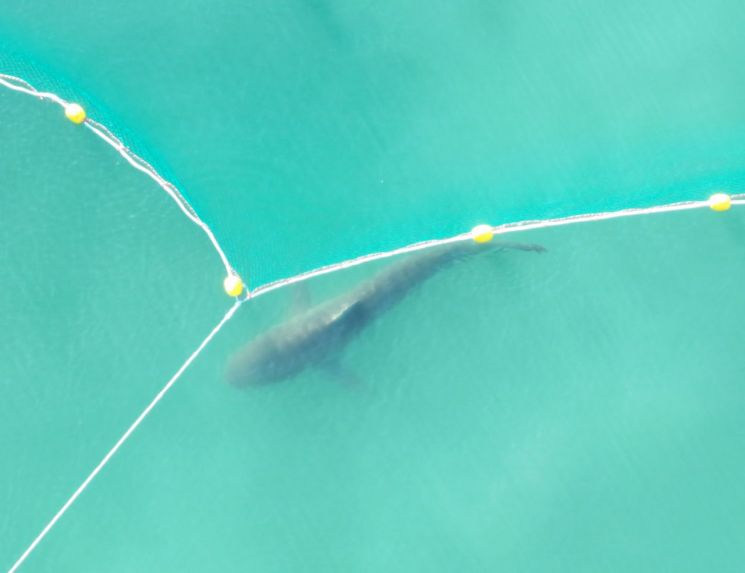
On September 18, 2026, a black shark appeared in an artificial channel at Busan's North Port Waterfront Park. Its name is "Bukangi." On October 6, the National Institute of Fisheries Science confirmed that Bukangi is a female black shark about 3 meters long. More than 800,000 visitors had flocked to see the unusual visitor by early October.
Note: Visitor numbers are as of early October 2026.
Is Something Wrong with the Shark, or Is the Sea Changing?
Choi Jaecheon, a distinguished professor at Ewha Womans University, suggested looking at rising water temperatures and the movement of prey to understand why Bukangi appeared here. Black sharks are known to prefer seas with water temperatures of 18-26 degrees Celsius. The seas around Korea are warming much faster than the global average.
The increase in Korean waters is about 2.1 times the global average. Bar lengths are proportional to the temperature increases.
Source: 2026 Climate Change Report, National Institute of Fisheries Science
Note: This does not mean Bukangi's actual route or the reason it entered North Port has been confirmed.
Does It Swim Around Because It Likes People?
Sharks Have Other Reasons
Because Bukangi swims along the edge of the channel, it has even been nicknamed the "attention-seeking shark." Professor Choi cautioned against this interpretation. The shark may be staying because of the channel's water temperature or food conditions, while repeatedly circling the same spot could also point to health issues or problems with its sense of direction. Its behavior should be understood in terms of the conditions it needs to survive, not the attention it receives from people.
Note: Whether Bukangi has given birth, why it is staying, and whether it has health problems are not confirmed facts; they are possibilities or concerns.
Should It Be Released into the Sea?
Or Should We Wait for It to Leave on Its Own?
The Busan Metropolitan City government has tried twice to release Bukangi into the sea, but neither attempt succeeded. Recalling the 2013 return of Je dol, a southern bottlenose dolphin, to the waters off Jeju, Professor Choi emphasized that wild animals should not be protected or controlled solely according to human standards. His point was that the level of intervention should be determined by observing whether Bukangi returns to the channel.

Let's Look at a Changing Sea, Not Just One Shark
The Busan Metropolitan City government appointed Bukangi an honorary public relations ambassador. Professor Choi, however, cautioned against treating public interest as a fleeting spectacle. If several sharks like this appear in the future, we should think first about the effects of climate change on marine ecosystems, rather than viewing them as unusual visitors. The black shark is classified as Endangered (EN) on the International Union for Conservation of Nature (IUCN) Red List. Quietly observing wildlife is also a way to show respect for it.
Bukangi, I'll listen
to the story of the sea you have to tell.
Let's make sure the visit of one shark does not end as mere entertainment. The question we should ask is not only "When will it leave?" but also "Why did it come here?" Please watch quietly from a little farther away, so Bukangi can swim without its life being disturbed.
The shark illustration is an SVG image for illustrative purposes.







