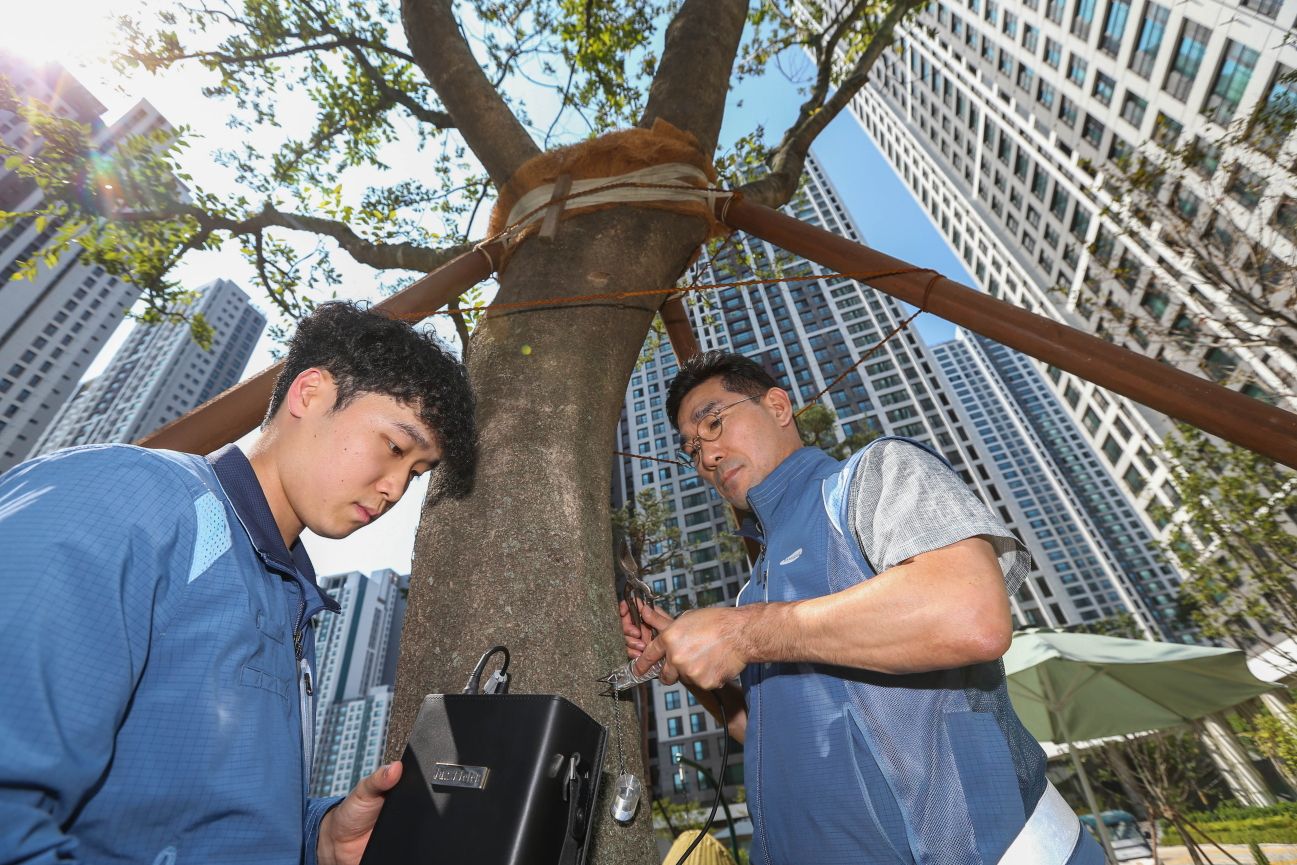
The conditions offered in the actual job market also attract attention. According to the Employment 24 job postings this year, salary conditions of 2.8 million to 3.2 million KRW per month or higher were confirmed, and some sites offered salaries in the range of 3 million to 5 million KRW per month or annual salaries around 45 million to 47 million KRW.
'Tree Doctors' Provide Tree Care in Apartment Complexes and Along Streets
As the 'Tree Doctor' certification exam rapidly gains popularity, particularly among middle-aged people seeking new careers after retirement, the competition has become intense, with the final pass rate remaining in the 23% range.
According to the Korea Forest Disaster Safety Technology Agency on September 15, a total of 708 applicants took the second round of the 12th Tree Doctor Certification Exam, held recently. Of these, 163 candidates ultimately passed, resulting in a 23% pass rate. With these new certifications, the total number of Tree Doctors who have been certified since the system was introduced in 2018 has increased to 1,900.
A Promising 'Second Career' for People in Their 50s and 60s... What Are the Salary Conditions?
The Tree Doctor certification system was established to address issues such as overuse of pesticides and inadequate care provided by unqualified individuals. A Tree Doctor is a specialist who diagnoses and prescribes treatments for tree damage in apartment complexes, parks, schools, along streets, and other urban areas, as well as prevents and treats disease or pest infestations and growth abnormalities.
According to the Forest Protection Act, only tree hospitals staffed by certified professionals such as Tree Doctors or tree care technicians are permitted to control and treat trees in residential areas. Recently, the Forest Service revised related laws to allow periodic inspections of protected trees to be outsourced to tree hospitals, further expanding the range of duties these professionals can perform.

However, actual compensation is variable depending on an individual's experience, work conditions, and responsibilities. The official daily wage rate for Tree Doctors applied to public projects is approximately 326,359 won per day.
A Tough Entry Barrier: Application Requirements and Mandatory Training
With more middle-aged individuals preparing for a "second act" in life, certifications related to forestry and tree care have become increasingly popular. Of all holders of these relevant national technical certifications, 55.9% are aged 50 or older, and the employment rate for those aged 60 and above has reached 69.6%.
However, the path is as narrow as the popularity is high. The pass rate for the first round of the exam last year was 26.2%, and the final pass rate in the second round this year was 23.0%, meaning fewer than one in four candidates succeed.

Applicants cannot simply take the test immediately. They must either have relevant academic credentials or work experience, or possess technical or industrial certifications in forestry, landscaping, or plant protection. Only those who have completed 150 hours of training at a designated Tree Doctor training institution are eligible to take the exam. Experts advise that, even after gaining employment, practical experience in on-site diagnosis and prescription, in addition to holding a certification, is a key factor in determining compensation.
Eligibility Criteria for the Tree Care Specialist Exam
Basic Qualifications
Relevant academic background or practical experience, or
Possession of a technical or industrial certificate in forestry, landscaping, or plant protection
Mandatory Training
Completion of 150 hours of training at a designated Tree Doctor training institution
Meet basic qualifications+Complete 150 hours of training=Eligible to take the exam