No Human Touch
A Visit to Kia's PBV Plant
Transporting parts, welding bodies, and mounting 65kg dashboards: at Kia Hwaseong EVO Plant, robots and data are fundamentally transforming how cars are made.
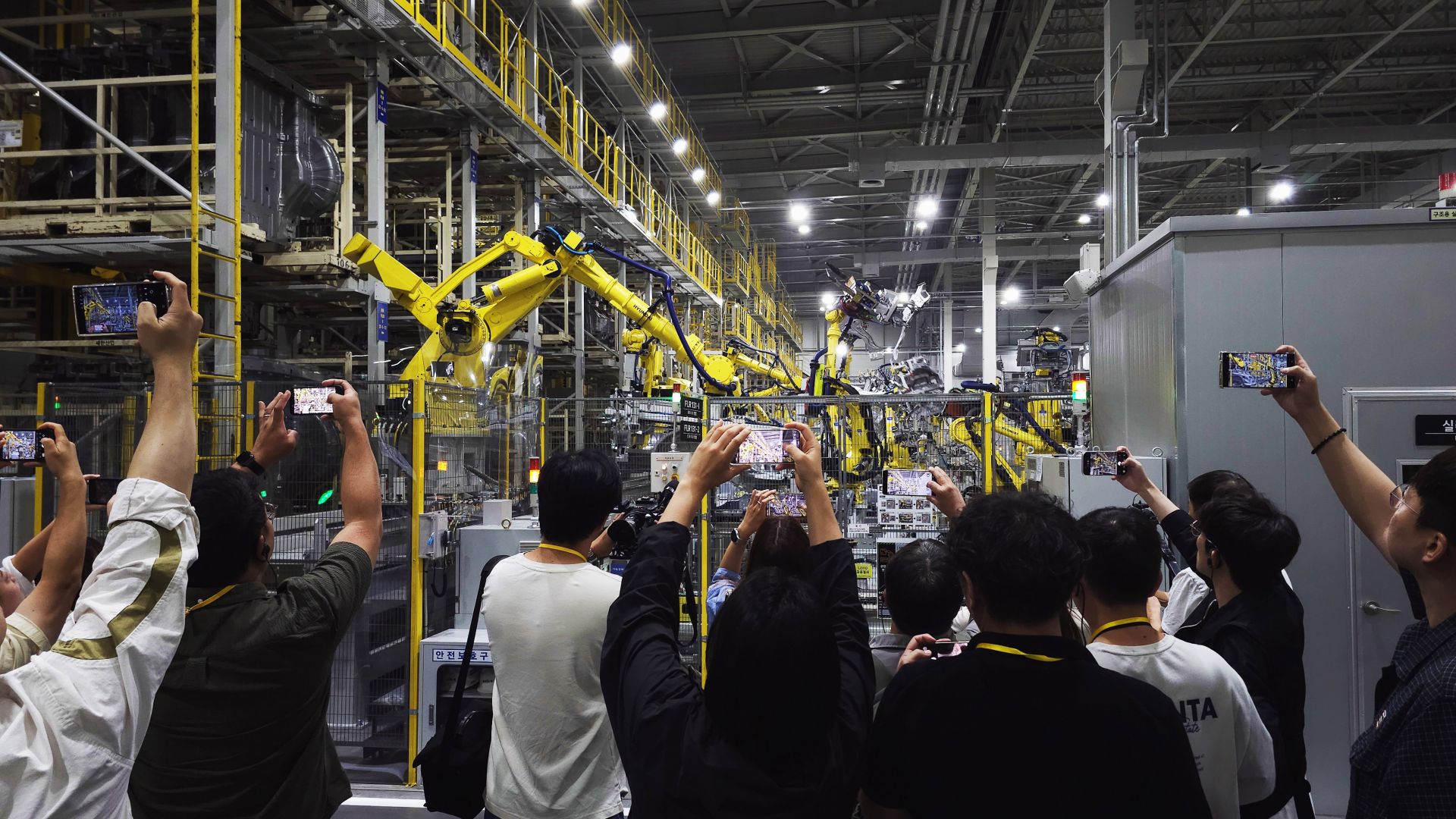
A yellow robotic arm twists its elbow joints and picks up parts weighing several dozen kilograms from a pallet stacked about three meters high. After rotating, it moves the parts to the next process, where another waiting robot receives them. There was no human touch.
On the 8th at Kia Autoland Hwaseong's exclusive PBV factory, 'EVO Plant' in Hwaseong, Gyeonggi Province, the first thing that caught the eye was the robots. On that day, Kia held the 'PBV Production Hub Tech Day' and showcased its robotics technology implemented in assembly, logistics, and inspection processes, the data-driven quality management system, and the PBV conversion infrastructure.
The EVO Plant consists of the East Plant, which currently produces the PV5, and the West Plant, which will manufacture the large electric PBV models, PV7 and PV9, in the future. The West Plant is scheduled to be completed in June 2027. Each plant has an annual production capacity of 100,000 units.
Body Assembly Methods: Fundamentally Different
Upon entering the body shop, robots were forming the vehicle's frame. Kia has implemented the 'Four-Buck Sequential Assembly Method', dividing the process into four sequential steps—Inner Buck, Rail Buck, Outer Buck, and Roof Buck—that collectively assemble the body’s primary frame and exterior components.
Unlike the conventional method of assembling the body in a single main process, this approach enables greater flexibility to accommodate changes in vehicle dimensions and specifications.
The welding process boasts an automation rate of 100%. As robots moved and welded the car bodies, sparks flew throughout the area. For closed sections that standard welding guns can't easily access, the L.S.S (Laser Seam Stepper) welding method using lasers was also adopted.
The method of transferring car bodies is also distinct. Two synchronized robots jointly lift and move the car bodies. This is crucial as PBVs have a different center of gravity compared with ordinary passenger cars, requiring stable transport.
No More Eye-Based Sorting
Not only for car bodies but also for parts logistics, AGVs (Automated Guided Vehicles) are deployed. AGVs capable of carrying up to 1.5 tons supply both car bodies and supplier parts to each process as needed.
A logistics system designed for high-mix production also stood out. For the PV5, there are over 180 configurations at the body shop stage. Instead of having workers visually distinguish and assemble countless parts, data matrix codes are applied to parts, and an automated warehouse system uses QR codes for management.
Smart tags are also used to identify production information and location per vehicle, ensuring work only proceeds when the correct tools and equipment for each vehicle are matched.
Automation does not stop at moving items. When installing movable components like doors, tailgates, or fenders, vision cameras measure the body’s position, allowing robots to automatically adjust the mounting locations based on this data. What workers once inspected—such as panel gaps and misalignment—is now managed by data.
Humans and Robots Working Side by Side
As we moved to the assembly shop, the forms of automation further diversified. The assembly workshop spans approximately 13,900 pyeong (about 45,900 square meters) and operates 122 processes. Because it deals with roughly 600 types of parts, its automation rate is relatively low, in the high 20% range.
Tasks that are difficult for machines—such as handling flexible parts—are still managed directly by workers. However, automation continues to expand rapidly, especially for heavy or repetitive jobs.
A representative example is the automatic installation of the crash pad. Previously, workers had to physically enter the vehicle and fit the crash pad, which weighs about 65kg, but now robots handle everything—from loading to attaching. This not only reduces physical strain for workers but also records torque values and results in the system’s data.
The automatic emblem attachment process was particularly eye-catching. As the vehicle enters, production information is delivered to the equipment, and robots determine which emblem to attach and its position according to vehicle specifications—cargo, passenger, or chassis cab.
Robotic arms pick up the emblems via vacuum suction and remove the release liner on the back. Since cooperating vendors supply emblems with varying amounts of extra liner for easier removal, the robot uses sensors to detect the exact location and length of the liner, ensuring precise detachment every time.
The adhesive location is also determined by the vision system, minimizing even slight misplacements that could occur in manual work. By assigning relatively simple tasks to robots, humans focus on more complex work.
According to Kia, the automation rate in the EVO Plant East assembly shop is in the high 20% range; in the body shop, it's 100% for welding and approximately 80% for parts handling. The overall automation rate for the entire body shop is in the low 80% range.
Compared to the existing Hwaseong plant, the EVO Plant's automation rate is approximately 9 percentage points higher. Kia expects automation to bring about a 10% improvement in efficiency in both quality and operations.
A factory official explained that running in two shifts is not due to technical issues, noting that even the equipment, like workers, needs rest time. Therefore, to ensure quality, the optimal operation method for now is one where workers and machines coexist.
Quality Inspection: From Guesswork to Data
Quality inspections are also shifting to data-driven methods. In the assembly shop, 3D vision cameras scan the entire vehicle and robots adjust the vehicle position. Afterward, gaps and panel fit at 21 points on each side—a total of 42 points—are measured to a precision of ±0.2mm.
The exterior vision inspection system uses 18 cameras to automatically verify specifications for 24 parts, including the outside mirrors, door garnish, fenders, and door handles. For the headlamp aiming process, robots and vision systems automatically adjust light intensity and alignment.
quantify even subtle vehicle differences
Gaps, misalignment, parts specs, and headlamp status—once inspected by eye—are now managed by data.
AI technology is also being applied to production. For tunnel-type exterior vision inspections, advanced AI algorithms are used to enhance exterior quality, and in the body shop, AI-driven welding quality technology is being developed to secure optimal weld quality for various panel types.
The Factory Will Grow Larger
The West Plant of the EVO facility, which will produce the PV7 and PV9, will utilize more advanced production technologies than the East Plant. While the East Plant’s assembly automation is currently in the high 20% range, the West Plant targets an automation rate in the 30% range.
The plan includes building on the proven technologies of the East Plant and supplementing with AMRs (Autonomous Mobile Robots) and further AI-based technologies.
The conversion ecosystem is also a core axis of the EVO Plant. Base vehicles manufactured at Autoland Hwaseong are moved to the nearby PBV Conversion Center, where they are customized to each customer’s requirements. The Conversion Center is equipped with 98 work cells and 14 inspection cells, enabling the production of a variety of models, including PV5 Prime, Open Bed, Crew Van, interior and refrigerated vans.
The Conversion Center's annual capacity is about 40,000 units. It began operation in September last year and is currently focused on initial models like Open Bed. More diverse conversion models, including next-generation PV5 models, are planned for the future.
A support system for external specialty vehicle manufacturers has also been established. Kia supplies donor vehicles to these manufacturers and provides 3D vehicle data, body builder manuals, certification documents, and more via the PBV Conversion Portal. Since sensitive vehicle control information is involved, only specialty vehicle manufacturers authorized for certification work and able to sign a non-disclosure agreement may join the portal at this stage.
Kia has expanded the PV5 lineup to 10 types and will unveil its large electric PBV PV7 for the first time at the ‘IAA Transportation 2026’ to be held in Hanover, Germany, on September 14th. The EVO Plant will also broaden its model range from PV5 to PV7 and PV9, expanding its role as a PBV production hub.
Heavy and repetitive tasks are handled by robots; vast numbers of vehicle specifications are managed by data. Humans focus on more complex work and equipment management. This is an attempt to fundamentally change production methods to fit an era where model types and vehicle uses are constantly evolving, as in the PBV sector.
Source and interview: Kia PBV Production Hub Tech Day-

Reporter Lee Seungjin promotion2@asiae.co.kr
-
Edit Choo Myeonghoon chox2mh@asiae.co.kr
© The Asia Business Daily. All rights reserved. Unauthorized AI training and use prohibited.