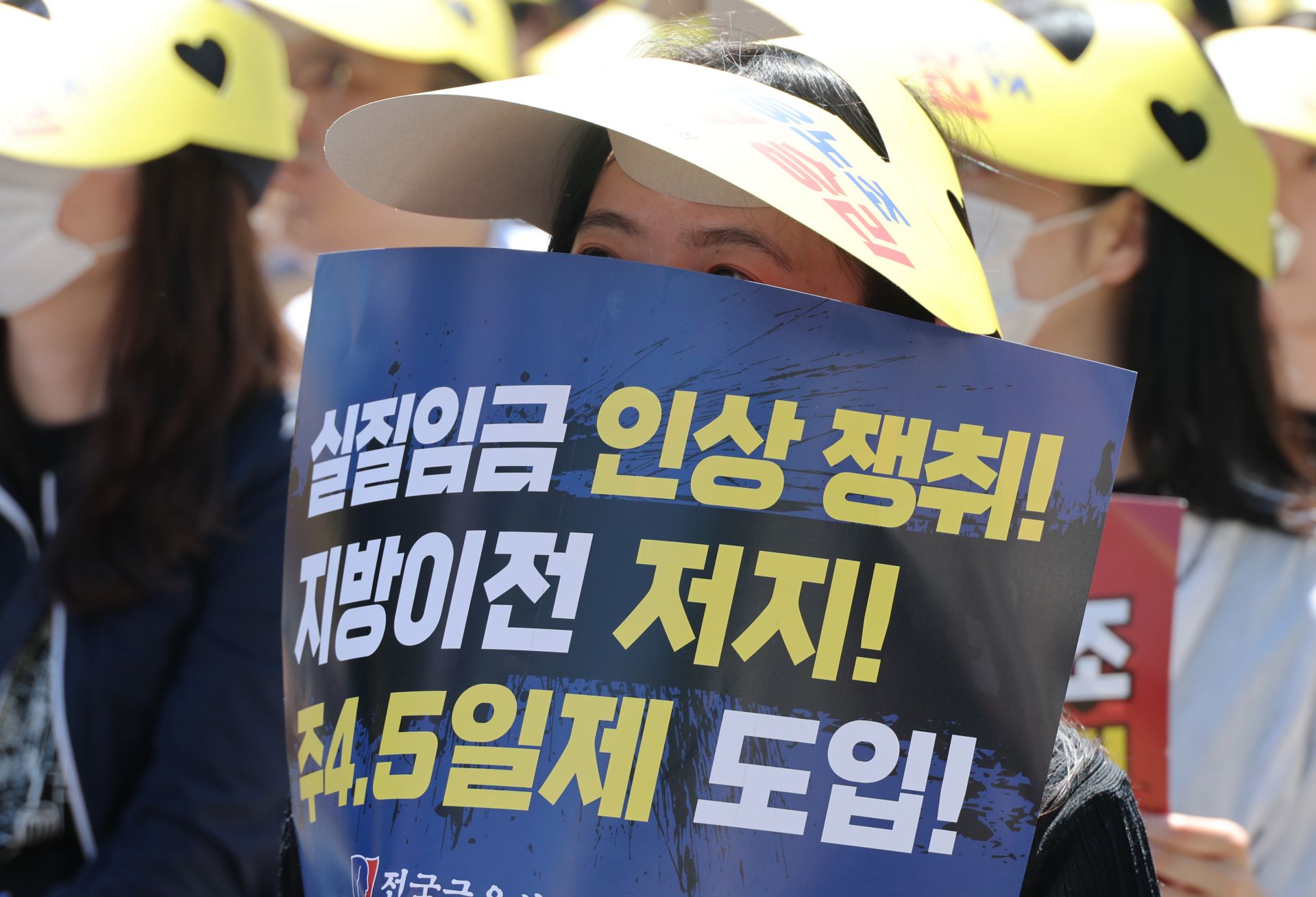
The National Financial Industry Labor Union (Financial Labor Union) launched a general strike on September 4 in protest against the government's plan to relocate national policy banks and other public financial institutions to provincial areas. With the labor and management sides unable to narrow their differences over the introduction of a 4.5-day workweek and a 6% wage increase, and with the government's relocation plans becoming increasingly tangible, the union has taken a strong stance amid concerns about an exodus of professional talent and a decline in the competitiveness of the financial sector.
Differences Remain Between Labor and Management Over 4.5-Day Workweek and 6% Wage Increase
The Financial Labor Union held the first general strike rally at 11 a.m. on the 4th in front of Donghwa Duty Free Shop on Sejong-daero, Gwanghwamun, Seoul. This is the union's first general strike in about a year since September of last year. Union members were seen wearing red headbands reading "General Strike."
The union demanded, among other things, the introduction of a 4.5-day workweek, a 6% wage increase, expansion of youth hiring, and a halt to the relocation of public financial institutions. Yoon Seokgu, head of the Financial Labor Union, emphasized, "By introducing the 4.5-day workweek, we can provide workers with time to recharge, give young people more opportunities, and create a financial industry where all generations can work together."
In particular, as the government pushes for the relocation of public institutions to the regions, the issue of preventing the relocation of national policy banks—including Korea Development Bank, IBK Industrial Bank, and Export-Import Bank of Korea—has rapidly emerged as a major point of contention in this general strike.

Members of the National Federation of Financial Industry Labor Unions are holding pickets and shouting slogans at a general strike rally held on the 4th around Gwanghwamun Station in Seoul, protesting the government's plan to relocate national policy banks to other regions and advocating for the introduction of a 4.5-day workweek system. Photo by Yonhap News Agency
원본보기 아이콘The Financial Labor Union argued that relocating Seoul-based public financial institutions to regional areas would lead to the outflow of skilled personnel and deterioration of the industrial environment, thereby undermining the overall competitiveness of the Korean financial industry. According to the Global Financial Centres Index (GFCI) report released in March this year by Z/Yen, a UK-based consulting firm, Seoul ranked 6th in business environment, 8th in human resources, and 8th in financial industry development, placing 8th overall—ahead of Tokyo (10th) and Shenzhen (9th).
Chairman Yoon pointed out that major financial cities such as New York, London, Singapore, and Hong Kong concentrate financial institutions and skilled professionals. He stressed, "Our reason to stay in Seoul is not political, nor is it simply because we don't want to be separated from our families. It is necessary for the competitiveness of Korea's economy and financial sector."
He also specifically criticized, "There is talk that, before and after the June 3 local elections, the government may push for IBK Industrial Bank to move to Daegu, Export-Import Bank of Korea and Korea Development Bank to Busan and Naju, and Nonghyup Bank to the Honam region. Which country's logic is it to send us off unconditionally without any reasonable rationale?"
The rally was attended by politicians including Lee Hakyoung, Kim Jooyoung, and Lee Yongwoo of the Democratic Party of Korea, Kim Hyungdong of the People Power Party, and Han Changmin, leader of the Social Democratic Party. Assemblyman Kim said in a solidarity speech, "Seeing even the ruling party stand with the Financial Labor Union’s general strike, I believe there are no party lines when it comes to legislation for workers," and emphasized, "The relocation of financial public corporations and public institutions must be approved by the National Assembly."
Assemblyman Lee Yongwoo, instead of specifically addressing the relocation issue, expressed his full support for the union's demand for a 4.5-day workweek.
Relocation of Public Financial Institutions Also a Key Issue... First General Strike in a Year
From the labor sector, both major national labor federations were represented, with Kim Dongmyeong, chairman of the Federation of Korean Trade Unions, and Yang Kyungsoo, head of the Korean Confederation of Trade Unions, in attendance.
The Financial Labor Union includes 43 branches, encompassing major commercial banks, regional banks, national policy banks, and financial institutions such as Korea Credit Guarantee Fund, Korea Technology Finance Corporation, Korea Asset Management Corporation, Korea Housing Finance Corporation, Korea Financial Telecommunications & Clearings Institute, and Koscom. According to police estimates, 15,000 people participated in the strike, while organizers put the figure at 30,000.
In practice, the majority of strike participants were members from Korea Development Bank, IBK Industrial Bank, and Export-Import Bank of Korea whose relocations are under review, so there is not expected to be significant disruption to commercial bank operations. The Industrial Bank of Korea union has about 9,000 members, while the Korea Development Bank and Export-Import Bank of Korea have approximately 2,250 and 1,100 union members, respectively.
The Financial Labor Union said it will monitor the responses of management and the government following this general strike before deciding whether to proceed with a second round of industrial action.