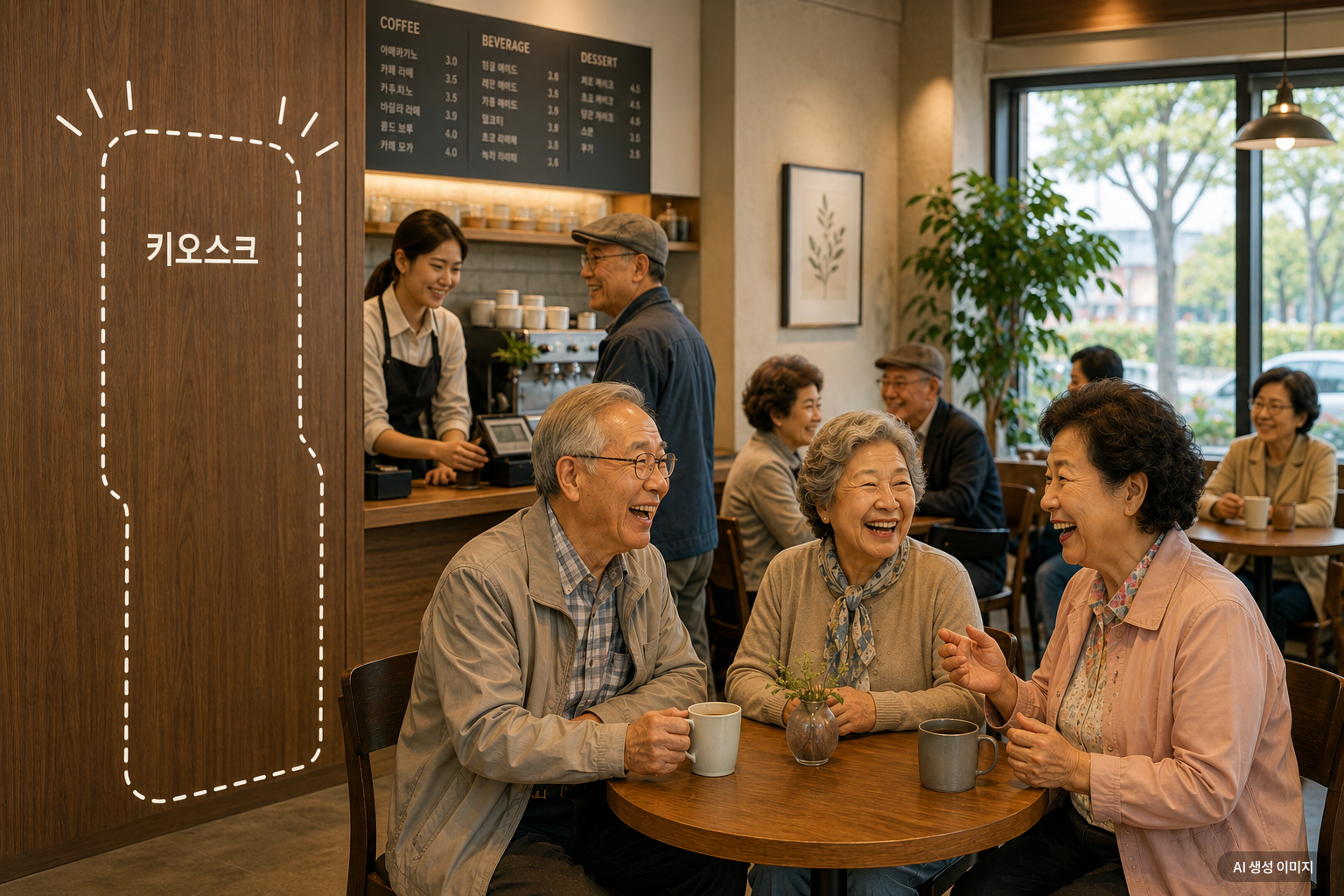
"Sitting there without a computer, I couldn't help but feel out of place, like I didn't belong."
Blocked by Barriers Like Kiosks and Apps... Excluded from Youth-Focused Business Districts
Park Sunhee (79) recently visited a franchise coffee shop near her home, but quickly turned around and left. While she hesitated in front of the unmanned ordering kiosk, adjusting her reading glasses, a man waiting behind her sighed and said, "At least read the instructions before pressing the buttons." Park admitted, "It was disheartening to feel like I was being watched just because I am older."

When the Kiosk Was Removed, Loyal Customers in Their 60s-80s Lined Up... Turnover and Sales Doubled
By contrast, the scene in older alleyway business districts of Seoul is completely different. Kim Sungman (52), who runs a cafe in Jongno-gu, Seoul, recently got rid of the kiosk machine and brought in plush chairs and wooden tables. Soon, a steady stream of regulars in their 60s to 80s began to visit. The air-conditioned cafe, filled with the gentle scent of Ssanghwa tea, has become a cozy gathering spot for seniors. Kim commented, "I appreciate the elderly customers who come every day and check in over a cup of tea much more than the college students who just keep their laptops open all day," and explained, "After shifting our customer target, both our turnover rate and sales more than doubled."

Elderly people are spending time drinking beverages at a coffee shop in Jongno-gu, Seoul. This place, where staff take orders directly without kiosks and sells traditional teas among other drinks, has more than 80% of its customers belonging to the elderly demographic. Photo by Hosoo Park
원본보기 아이콘Seniors Rapidly Emerging as Main Consumers in Offline Business Areas
As digital transformation and ageism have pushed seniors out of everyday life, they are now emerging as a new core customer base in offline business districts. Stores that actively accommodate older customers are seeing an increase in regular patrons, while spaces with high digital barriers remain unapproachable for this demographic.

A restaurant in Jung-gu, Seoul, also removed its fusion brunch menu targeting young office workers and instead highlighted a barley gulbi fish set meal priced in the 20,000 won range. With traditional brass bowls and a neat table setting, the main customer base shifted to men in their 60s and 70s. The owner, Choi (64), said, "Thanks to seniors who frequently choose us for reunions or gatherings, there is now a warm atmosphere in the restaurant." Some cafes in the area have also replaced unmanned payment machines with paper menus and branded themselves as cooling centers to attract silver-age customers.
Small business owners aren't just courting seniors out of kindness. The increased spending power of older consumers has made them an attractive market segment. According to an analysis of personal credit and debit card usage data by KB Kookmin Card, card spending by customers aged 65 and older in 2025 surged by 143% compared to 2019. This is more than four times the 34% growth rate seen among all customers during the same period. The number of senior customers also rose by 102%.

An 82-year-old Mr. Heo is using a vending machine coffee near Tapgol Park in Jongno-gu, Seoul. Mr. Heo said, "Vending machine coffee is still more comfortable than coffee shops where young people go," adding, "I feel awkward when ordering at places with kiosks."
원본보기 아이콘Notably, in the past year (from May 2025 to April 2026), 86% of card spending by customers aged 65 and older was in offline business locations. In terms of transaction count, restaurants (38%) and coffee & dessert shops (10%) represented the largest shares. Choosing to visit stores in person rather than use online shopping or delivery apps, the silver generation has become a major source of steady revenue for small business owners.
Digital Barriers Remain... "Seniors Must Be Seen Not as Objects of Pity but as Equal Consumers"
Despite the growing number of businesses viewing seniors as key consumers, the hurdles they face in daily life remain high. The moment they step outside senior-friendly zones, they confront digital barriers and age discrimination.
Jeong (76), who recently tried to visit a dessert cafe in Seoul with friends, had to turn away at the entrance. As she struggled in front of a QR code display near the door, a staff member told her, "You can only enter if you pre-register through the mobile reservation app." Jeong confessed, "I just couldn't keep up with steps like installing an app or verifying my identity, so I left," adding, "It hurt to see young customers looking at us as if we didn't belong."

Professor Lee Youngae of Consumer Science at Incheon National University emphasized, "Although seniors are establishing themselves as a new driving force in consumption, commercial and leisure spaces are still designed based on the standard of young people," and stressed, "We need to see seniors not as objects of pity but as equal consumers and members of society."
-

Reporter Park Hosu lake@asiae.co.kr
-
Edit Kim Yumi ymkim91@asiae.co.kr
© The Asia Business Daily. All rights reserved. Unauthorized AI training and use prohibited.