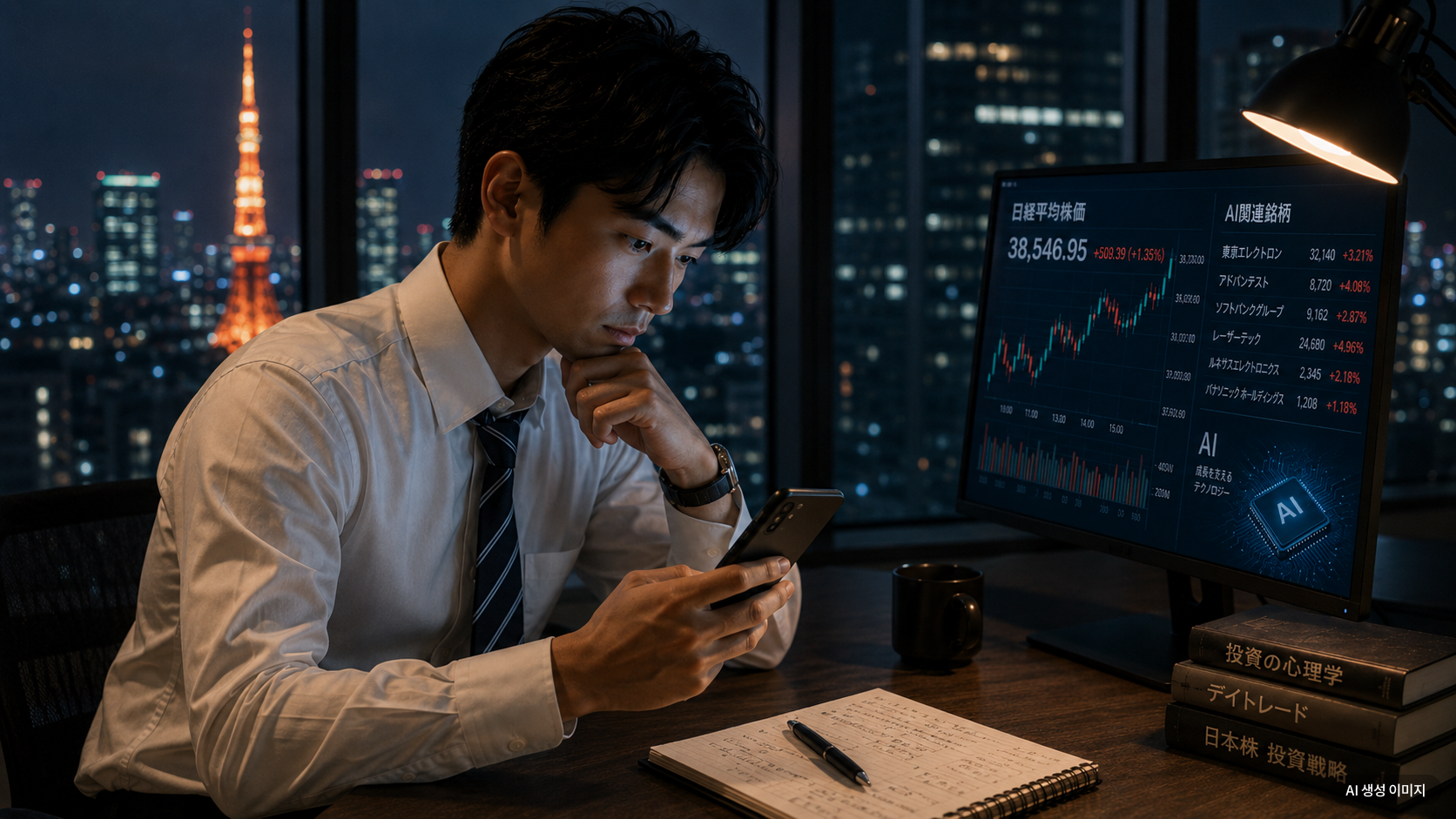
In the Japanese stock market, margin trading—where individual investors borrow funds or stocks from securities firms to trade—
has increased twofold compared to the beginning of the year.
According to the Nihon Keizai Shimbun (Nikkei), as of last month, the volume of margin trading by individual investors on the Japanese stock market reached 123 trillion yen (1,098 trillion won),
a twofold increase in just six months.
This is on par with the record high set in June 2016, when the data was first tracked.
Last month, the proportion of margin trading in the total trading value for individual investors—including cash trades—
jumped to a record high of 83%.
AI 열풍과 빚투
일본 개인투자자 신용거래,
6개월 만에 2배
지난달 기준 123조엔…전체 매매대금 중 83%
🇯🇵 일본 개인투자자 신용거래지난달 기준
연초
약 61조엔
지난달
0조엔
약 1098조원
6개월 변화
2배
2016년 이후
최고 수준
개인 매매대금 중 신용거래 비중0%
역대 최고
Source: Nihon Keizai Shimbun
This sharp surge in margin trading among Japanese individual investors is fueled by the popularity of AI-related stocks.
In particular, stocks with high volatility—such as Kioxia Holdings—
have attracted frequent short-term trading as investors seek quick profits.
WHY?
Japanese Individual Investors Dive In Deep:
The Reason is 'AI Stocks'
Margin trades are concentrated on popular AI-related stocks such as Kioxia Holdings.
1
Popularity of AI Stocks
Investment demand is focused on semiconductor and AI-related stocks, including Kioxia Holdings.
2
Large Capital Required
Many AI-related stocks require significant minimum investment amounts for trading.
3
High Price Volatility
The price swings for popular AI stocks are large, expanding the opportunities for quick trading profits.
4
Active Margin-based Short-Term Trading
As investors borrow money or stocks, margin-based trading has surged as they flip stocks for quick short-term profits.
→→→
Conclusion
AI stock fever is fueling the leverage trading boom in Japan.
As investment funds flow into AI-related stocks, margin trades have rapidly increased as investors borrow money and seek quick in-and-out trades.
Source: Nihon Keizai Shimbun
However, the surge in margin trading does not necessarily mean that individual investors are sustaining greater losses.
The average return rate for margin investors was positive in June,
which was unusual. Even at the end of last month,
the loss margin was smaller than the recent 10-year average.
손익과 한국
Leverage Trading Surged, but Not a Wipeout Yet;
Korea Also Rebounds to 30 Trillion Won
🇯🇵 Japan Margin Investor Profit/LossEnd of last month
Last June
Unusually +
Average return rate: plus
End of last month
0.0%
Current loss status
10-year average
0.0%
Loss margin smaller than average
Loss margin comparison
End of last month-8.4%
10-year average-10.2%
🇰🇷 Domestic Margin Balance TrendAs of Aug 10
0.00조원Compared to high: +793.4 billion won
38.6조
6/24 all-time high
32.2조
7/30
30.02조
8/10
While it remains 22.2% below the all-time high,
the margin balance increased by 793.4 billion won in a single day and has surpassed 30 trillion won again.
Source: Nihon Keizai Shimbun, Korea Financial Investment Association
Meanwhile, in Korea, leveraged investing in stocks is also making a comeback.
On August 10, the balance of margin loans grew by 793.4 billion won in a single day, again surpassing the 30 trillion won threshold.
However, this remains 22.2% below the all-time high recorded in June.
Leverage Simulator
Margin Trading — How Much Can You Earn, and How Much Can You Lose?
Input your principal and leverage to calculate possible actual rates of return for margin trades.
Principal (10,000 KRW units)1,000만 원
Leverage Ratio2.0배
1x (cash)4x
Stock Price Change+10%
-40%+40%
Holding Period30일
If only cash is used (1x)
+100만 원
+10.0%
Margin Trade Result (Selected Leverage)
+189만 원
+18.9% (after interest is deducted)
Assumptions: Annual margin interest rate 9% (average level at domestic securities firms); simplified for demonstration, excluding fees.
Examples Often Seen in Practice
Assumes figures as of article date for illustration only. Actual investment results may differ.
-

Reporter Heo Midam damdam@asiae.co.kr
-
Edit Maeng Jiae mjiae@asiae.co.kr
© The Asia Business Daily. All rights reserved. Unauthorized AI training and use prohibited.