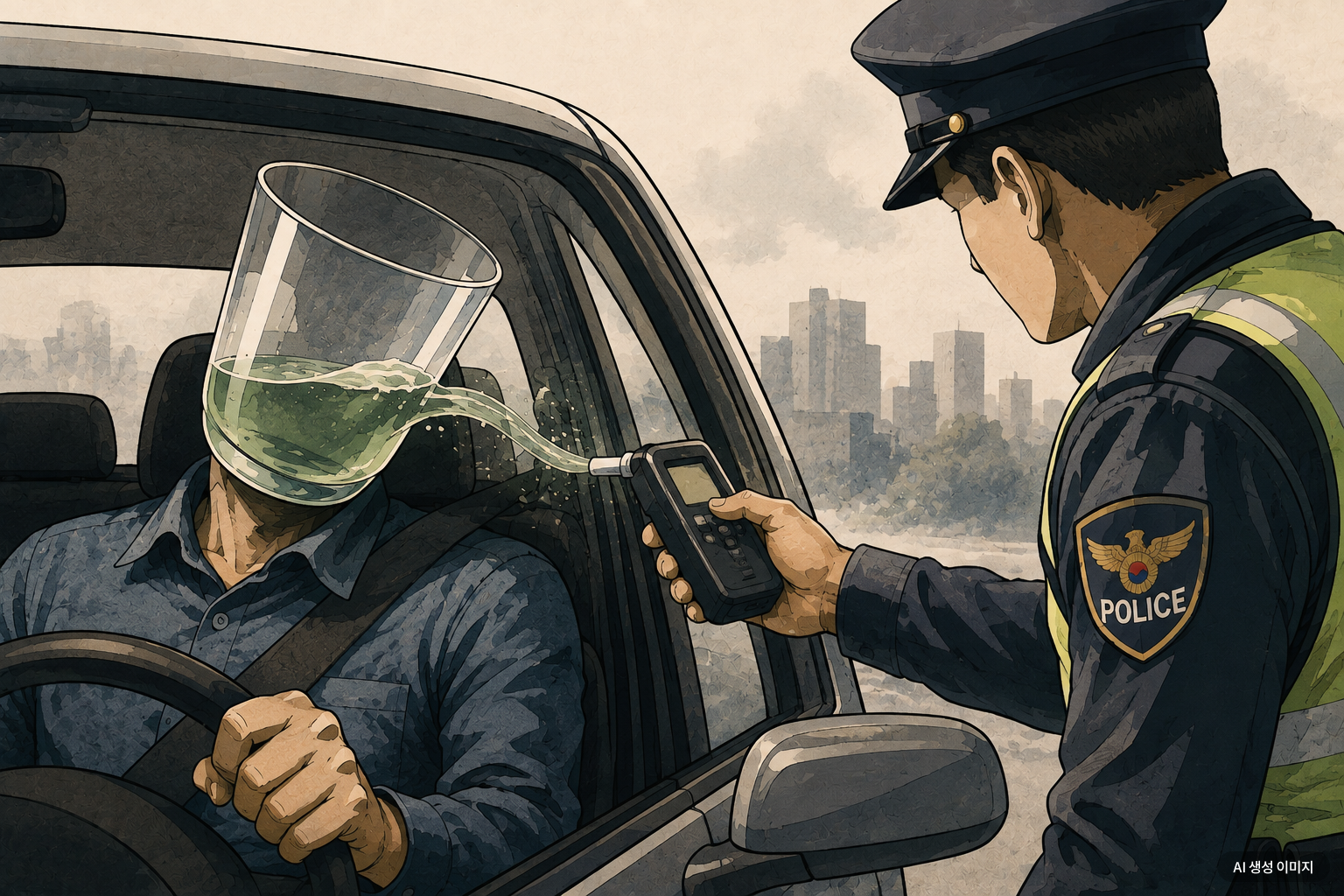

Mr. A drank alcohol at a restaurant in Busan last December and then drove about 1 kilometer. He arrived at his destination at 12:20 p.m. and was resting inside the car when the police, acting on a tip, administered a breathalyzer test. The test was conducted at 12:46 p.m., 26 minutes after he finished driving, and the result was a blood alcohol concentration of 0.03%. This was exactly the threshold for punishment for drunk driving.

The key issue was 'when the measurement was taken.' Typically, after drinking, blood alcohol concentration does not immediately peak but instead rises over a certain period of time. The court recognized the possibility that Mr. A's BAC was still increasing at the time of testing. Therefore, while the BAC was 0.03% at the time of the test, it could not be ruled out that the actual BAC at the time he was driving—26 minutes earlier—was lower than that.

The result of calculating his estimated BAC based on the amount Mr. A claimed to have drunk also influenced the court’s judgment. Using conditions favorable to the defendant and applying the Widmark formula, the court determined that Mr. A's estimated BAC at the time of driving was about 0.027%. This was 0.003 percentage points below the legal standard of 0.03%. Police records showed that Mr. A was slurring his speech and his face was slightly red, but the court found that these alone were not sufficient to objectively prove the actual degree of intoxication at the time of driving.

The fact that Mr. A drove after drinking was recognized. However, in order to impose criminal punishment, it must be proven that the BAC at the time of driving was at least 0.03%, the statutory limit. The court found that it was difficult to conclude that this had been proven beyond a reasonable doubt based solely on the evidence presented by the prosecution. As a result, Mr. A was found not guilty.