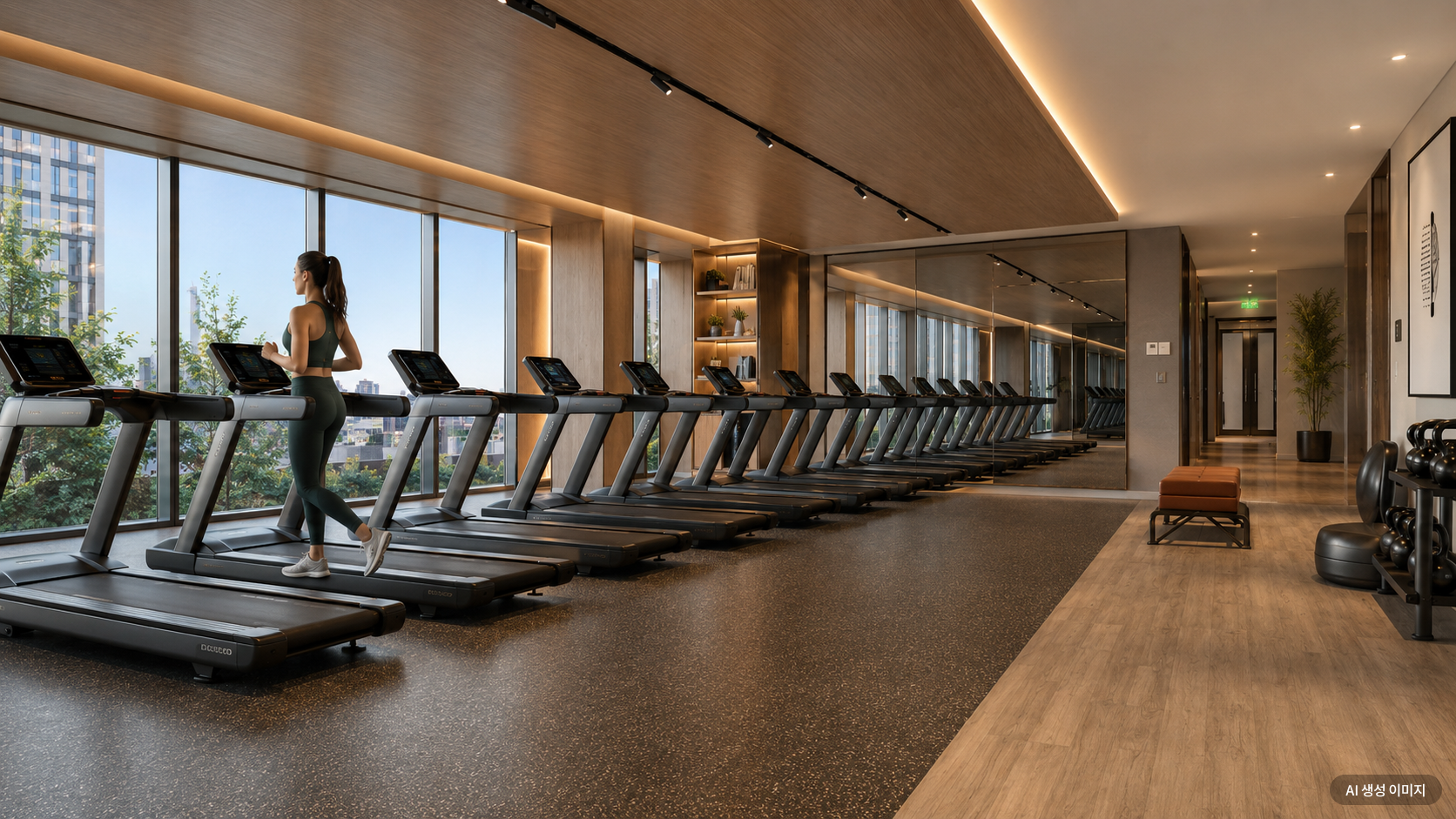
The "hotel-grade community facilities" included in newly built apartments—such as swimming pools, saunas, and golf practice ranges—are sparking conflicts among residents. While these facilities were promoted at the time of sale as enhancements for residential satisfaction and apartment value, following move-in, issues have continually emerged over high maintenance costs, low usage rates, and debates over how costs are shared.

The "hotel-grade community facilities" of a newly built apartment complex, including a swimming pool, sauna, and golf practice range, are becoming a source of conflict among residents. Photo by Dongjoo Yoon
원본보기 아이콘With over half the population now living in apartments, the management and operation of community facilities have become a new source of disputes in multifamily housing. Complexes are increasingly debating whether it is fair to charge operation fees to residents who do not use these amenities. For example, in an apartment complex with around 900 households in Seongdong-gu, Seoul, which was completed last year, community facilities like the gym and golf practice range suspended operations for about three weeks last month. This was the result of a change in management companies and ongoing operational deficits. Every household in this complex pays a standard monthly membership fee of 25,000 KRW, and separate usage fees are charged for additional lessons or excess usage.
Monthly Fees Collected Yet Still Operating at a Loss... Disputes Over Closures and Additional Charges

In May of this year, total income from basic and individual usage fees reached 66.51 million KRW, but expenses—such as labor costs and facility maintenance—exceeded 80 million KRW, resulting in a deficit of 17.15 million KRW. Subsequently, the management office notified residents of an additional charge of 18,000 KRW per household. Some residents responded by protesting the fairness of charging the same amount to households that do not use the facilities, while others complained that the operation of premium facilities, which influenced their decision to move in, had been suspended.
Similar conflicts have cropped up in other areas as well. In an apartment in Goyang, Gyeonggi Province, management is planning to hold a resident vote on whether to impose separate charges on summer and winter sports facility users, citing the burden of heating and cooling costs. In a 4,000-unit apartment complex in Dongnae-gu, Busan, resident opposition continues as community facility deficits are reflected in the maintenance fees. In some complexes, opinions are split on whether facilities should be reserved for residents only, or opened to the public to generate revenue.
A Selling Point During Pre-sale, a Burden After Move-in

The conflict over community facilities is rooted in the drive to upscale new apartment projects. Whereas common amenities used to center around senior citizen centers, daycare facilities, and small libraries, recently, a broader array of amenities have appeared—including swimming pools, saunas, movie theaters, bowling alleys, climbing gyms, music practice rooms, and pet washing rooms. As facilities become more diverse, the burden of staff costs, electricity, water, and heating and cooling expenses also increases. In particular, maintaining water quality and temperature in swimming pools and saunas requires high fixed costs, even when usage is low.
According to data from the Apartment Management Information System, the nationwide average apartment maintenance fee rose by roughly 24%, from 2,442 KRW per square meter of exclusive area in 2021 to 3,033 KRW in 2025. As community facility operation costs are added, the financial burden perceived by residents is growing even greater. However, since community facilities serve as shared assets that enhance living comfort and apartment value, some argue that even households not using the facilities should contribute at least a portion of the cost. Whether operating costs are included in maintenance fees or charged separately to users depends on each complex's management regulations and decisions made by the residents' association.
What is the Estimated Monthly Maintenance Fee?
to estimate your expected monthly maintenance fee.
Actual amounts may vary based on the number of households, usage rate, and contract terms.
Some experts caution that such facilities should not be viewed solely as marketing tools to drive sales. They emphasize the need to analyze projected usage rates and operating expenses during the planning stage, and to establish long-term management plans that include equipment replacement and major repair costs. Transparency is also urged: disclosing facility income, expenses, and usage rates, and sufficiently incorporating residents' feedback before deciding on closures or additional contributions.
Ultimately, sustainable management is more important than grand scale when it comes to community facilities. Without careful review of long-term costs, an amenity intended for the welfare of residents risks turning into an expensive white elephant that only increases maintenance fees and conflict.
-

Reporter Bang Jeil zeilism@asiae.co.kr
-
Edit Kong Sumin hyunhj@asiae.co.kr
© The Asia Business Daily. All rights reserved. Unauthorized AI training and use prohibited.







