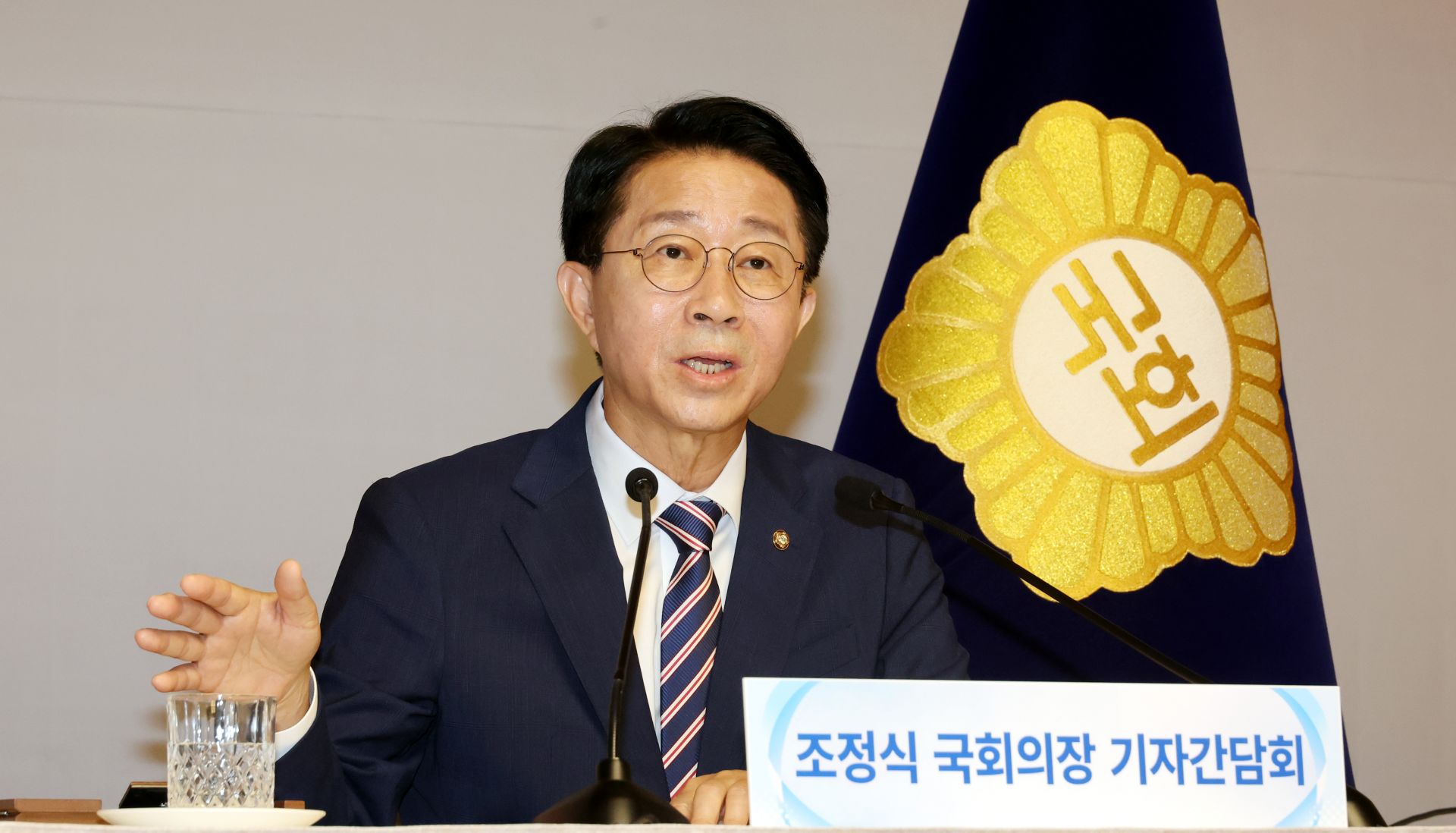

National Assembly Speaker Jo Jung-sik is speaking at a press briefing held for the first time since his inauguration as Speaker in the second half of the year at the National Assembly Sarangjae on July 28, 2026. Photo by Kim Hyun-min
원본보기 아이콘Remarks on Presidential Re-Election Tied to Constitutional Amendment Shake Up the Entire Debate
Speaker of the National Assembly Jo Jung-sik's comments on a "constitutional amendment for presidential re-election" have emerged as a factor shaking up the entire debate on constitutional revision. Regardless of his intentions, the focus of the amendment has shifted from "restructuring the power system" to controversy over "extending the incumbent president's term." Critics argue that the Speaker has actually deepened political distrust at a time when negotiations between the ruling and opposition parties have failed to gain momentum.
On July 28, at his first press conference since taking office, Speaker Jo discussed constitutional procedures, making remarks interpreted as alluding to the possibility of presidential re-election. As controversy mounted, the Speaker's office clarified that he was "simply explaining the constitutional process," and later that night, Speaker Jo posted on social media, saying, "I did not mean to imply an extension of the incumbent president's term."

Opposition Strongly Reacts: "Aims to Become a Dictator"
Nevertheless, the repercussions have grown out of proportion. The People Power Party highlighted Speaker Jo’s background as a former special political aide to President Lee Jaemyung, attacking him by saying, "Isn’t this a constitutional amendment just to extend presidential power?" Independent lawmaker Han Donghoon also remarked, "President Lee Jaemyung is trying to become a dictator, ‘Dokjaemyung.’"
Even Hwang Hyunseon, Supreme Council member of the Rebuilding Korea Innovation Party—considered broadly pro-government—criticized, saying, "(Speaker Jo) has effectively shut the door on constitutional revision himself." This controversy is causing concern that the drive for constitutional amendment could be weakened altogether.

Byungho Han, Acting Leader and Floor Leader of the Democratic Party of Korea, is attending the Supreme Council meeting held at the National Assembly on July 29, 2026. Photo by Hyunmin Kim
원본보기 아이콘Suspicions of "Amendment for Power Extension" Have Hindered Past Efforts
Any constitutional amendment requires support from at least two-thirds of all National Assembly members as well as a national referendum, making agreement between the ruling and opposition parties and national consensus essential. Previous attempts at constitutional reform have time and again faltered because suspicions that they were merely for the purpose of extending presidential power could not be dispelled.
This latest controversy is expected to be a further drag on already sluggish amendment negotiations. While the political community generally agrees on the need for constitutional revision—including a possible four-year presidential term with one re-election, restructuring the power system, and strengthening local autonomy—there remain strong disagreements over the specifics.

Chairman Cho Jung-sik of the National Assembly is attending a press briefing held for the first time since his inauguration as the Speaker of the National Assembly in the second half of the year at Sarangjae of the National Assembly on July 28, 2026. Photo by Kim Hyunmin
원본보기 아이콘Even Within Ruling Bloc: "Need to Resolve the Controversy First"
With this latest controversy, the opposition has secured a justification to question the sincerity of constitutional amendment discussions. Meanwhile, the ruling party now faces the likelihood of expending political capital to dispel suspicions of extending the president’s term.
President Lee has consistently stated that any constitutional amendment must not be linked to extending the term of the incumbent president. On July 29, Acting Democratic Party leader and floor leader Han Byungdo also said at the Supreme Council meeting, "Article 128, Paragraph 2, of the Constitution explicitly states that even if an amendment is made to extend or change the presidential term, it does not apply to the sitting president," adding, "The talk of re-election is nothing more than an unreasonable, baseless claim."
However, a source within the pro-government camp observed, "If controversy over extending presidential power erupts from the outset, it could stall the entire discussion," adding, "Before discussing the necessity of constitutional reform, we must first resolve doubts about motivation."
-

Reporter Moon Hyewon hmoon3@asiae.co.kr
-
Edit Sung Kiho kihoyeyo@asiae.co.kr
© The Asia Business Daily. All rights reserved. Unauthorized AI training and use prohibited.