A post on social networking services (SNS) that disparaged firefighting as a so-called "cushy job" with high annual pay relative to the number of dispatches has been directly refuted by a woman identifying herself as the wife of an active firefighter. There are ongoing arguments that the number of dispatches alone is not an appropriate measure for evaluating the job characteristics of firefighters, as they carry out various rescue, emergency medical, and public safety duties even when there are no fires, and must always be prepared for major disasters that could arise at any time.
On July 19, a post titled "I saw a firefighter with 12 years of service earning an annual salary of 75 million won" was circulated on social media and SNS. The author claimed, "More than half of firefighting teams do not respond to even a single fire on an average day," and asserted that firefighters receive excessively high salaries compared to their actual workload.
Counterargument Comments to the ‘High Pay Relative to Firefighter Dispatches’ SNS Post
Amid the controversy and ensuing rebuttals, a user introduced as the wife of an active firefighter left a comment. She wrote, "As a firefighter’s wife, my immediate response is, 'So what?'" and added, "If you think it’s such easy money, why don’t you take the test and become a firefighter yourself?" expressing her frustration. She continued, "People who know nothing say that firefighters have an easy job and just idle around," and pointed out, "I wish people would try taking even a firefighter civil service exam before making such comments."

She emphasized that a firefighter’s work is not limited to extinguishing fires. "People claim firefighters are just playing soccer or games when there’s no fire, but in summer we’re constantly dispatched to remove beehives," she explained. "We also get called to catch snakes or dogs and respond to cases where someone can’t open their door." She went on to say, "Firefighters also visit the homes of elderly people living alone to install fire alarms," adding, "All day long, firefighters are called out here and there like a punching bag. I wish people would not speak carelessly about things they don’t even know."
"Responding to Fires and Various Daily Safety Calls... Please Don’t Speak Carelessly When You Don’t Know"
In reality, firefighters respond to a wide range of public safety incidents. Even idle hours cannot be considered complete rest, as firefighters must conduct equipment checks, undergo training, and remain on standby to immediately head out if a call comes in. In particular, since the timing and scale of fires, rescue, and emergency calls are unpredictable, critics argue that it's unreasonable to assess the intensity and responsibility of their work by ‘number of dispatches’ alone.
The argument that firefighters’ annual pay is 75 million won is also difficult to compare simply, as it varies depending on an individual's rank, years of service, number of shift rotations, and overtime hours. According to the 2026 salary table for police and firefighters by the Ministry of Personnel Management, the monthly base salary for a level 1 firefighter is 2,133,000 won. With 12 years of service, the monthly base salary is 2,844,100 won for a firefighter, 3,099,500 won for a fire corporal, and 3,475,200 won for a fire sergeant. However, actual years of service and rank depend on factors such as military experience and promotions. If the 75 million won annual salary cited in the post is indeed accurate, it likely reflects gross pre-tax pay, which includes not only the base salary but also various additional allowances and bonuses for night shifts, holidays, overtime, hazardous duties, and rank.
The Claim of a 75 Million Won Salary Also Varies by Rank, Years of Service, and Working Hours
Netizens commented, "Does a fire have to break out whenever you go to work? What sort of country would that be?" "They seem to think that being on standby for fires means just doing nothing," and "Just being on standby not knowing when an accident could occur is itself a huge stressor." Others added, "Working through holidays, day and night, at the risk of your life—how can 75 million won really be considered excessive?" and "If you think it’s easy, try the job yourself," as well as, "Salaries in high-risk professions like firefighting, police, and military shouldn’t be simply compared to other jobs."
The intensity of a firefighter’s work is not limited to physical danger. There are numerous cases in which repeated exposure to handling fatalities, treating cardiac arrest patients, large-scale traffic accidents, and fire scenes results in psychological aftereffects such as post-traumatic stress disorder (PTSD), depression, and insomnia. According to the National Fire Agency’s "2023 Firefighter Mental Health Survey," of 52,802 respondents, 23,060 were found to be at risk for at least one of four major psychological issues: PTSD, depression, sleep disorders, or problematic drinking. This group accounted for 43.9% of total respondents.

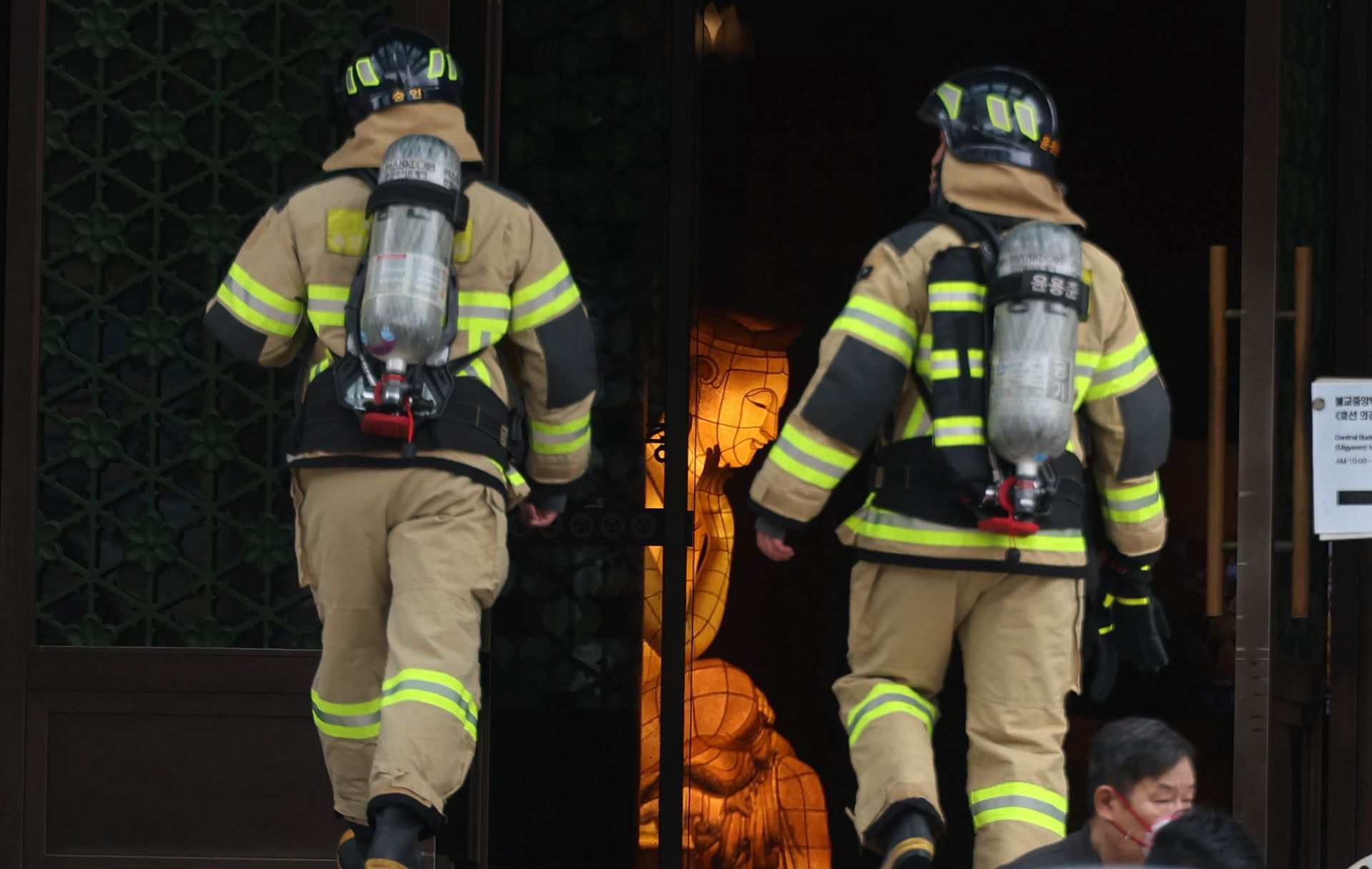
Firefighters exhausted from extinguishing the fire at the Coupang logistics center in Seoknam-dong, Seohae-gu, Incheon, on the 20th are taking a break. Photo by Yonhap News.
원본보기 아이콘By specific issue, sleep disorders were reported by 27.2% of respondents, problematic drinking by 26.4%, PTSD by 6.5%, and symptoms of depression by 6.3%. Those identified as high-risk for suicide numbered 2,587, or 4.9%, and 4,465 firefighters—8.5%—said they had seriously contemplated suicide at least once in the past year.
In the latest 2025 National Firefighter Mental Health Survey, out of 61,517 valid respondents, 6,883 people, or 11.2%, reported experiencing 15 or more traumatic incidents in the previous year. On average, a firefighter was exposed to six traumatic events annually. Among work roles, paramedics, who directly treat patients and handle fatalities, averaged 14.5 traumatic incidents per year—more than twice the overall average.
64% Increase in Firefighters Reporting PTSD Over 5 Years... Netizens: "Try the Job Yourself"
By type of traumatic incident, the most common, at 27.8%, was performing CPR in the presence of family members or responding to cases where the patient was in full cardiac arrest. Encounters with suicide fatalities accounted for 25.6%, and dealing with severely decomposed bodies made up 20.6%. According to the survey, 6.3% of respondents exhibited signs of PTSD, 5.8% signs of depression, and 28.0% reported sleep problems. However, 79.7% of respondents said they had never used "emergency psychological support" services provided after major disasters or distressing incidents.
Mental health indicators for firefighters have worsened over the past five years. An analysis of National Fire Agency data submitted to the National Assembly shows that the number of firefighters reporting PTSD rose by 64.1%, from 2,666 in 2020 to 4,375 in 2024. The number considered at risk of depression jumped 94.2%, from 2,028 to 3,937, and those at risk of suicide increased by 36.5%, from 2,301 to 3,141, over the same period.
-

Reporter Bang Jeil zeilism@asiae.co.kr
-
Edit Lee Kijae happylee17@asiae.co.kr
© The Asia Business Daily. All rights reserved. Unauthorized AI training and use prohibited.