The average price of Samgyetang in Seoul is now 18,154 won
Consumers seeking cost-effective 'health food meal kits' are increasing
Consumers seeking cost-effective 'health food meal kits' are increasing
by Bang Jeil
by Choi Yujeong
Published 15 Jul.2026 14:29(KST)
On July 15, marking Chobok, the beginning of the intense summer heat, citizens began lining up early in front of Samgyetang restaurants in hopes of boosting their health. However, as the price per bowl has climbed to around 20,000 won, the financial burden on consumers has grown significantly.
On July 15, Yonhap News TV reported that the average price of a bowl of Samgyetang in Seoul has surpassed 18,000 won for Chobok, increasing the burden on consumers. In an interview with Yonhap News TV, one citizen said, "A bowl of Samgyetang is 22,000 won," adding, "With restaurant prices so high, it feels burdensome to eat out."
According to "Chamkaegak," the Korea Consumer Agency's price information portal, the average price of a bowl of Samgyetang in Seoul in May this year was 18,154 won. Compared to 14,077 won in 2021, the price has risen by 4,077 won, or about 29%, in five years. At some well-known Samgyetang restaurants, even the basic menu now exceeds 20,000 won. If a family of four eats Samgyetang and orders drinks or additional items, a single meal can cost nearly 100,000 won.

The increase in Samgyetang prices is not only due to higher chicken prices but also rising costs for ingredients such as glutinous rice, garlic, jujubes, and ginseng. In addition, operating costs for restaurants, including wages, rents, and electricity and gas bills, have risen across the board, causing dining-out prices to increase even faster than ingredient costs.
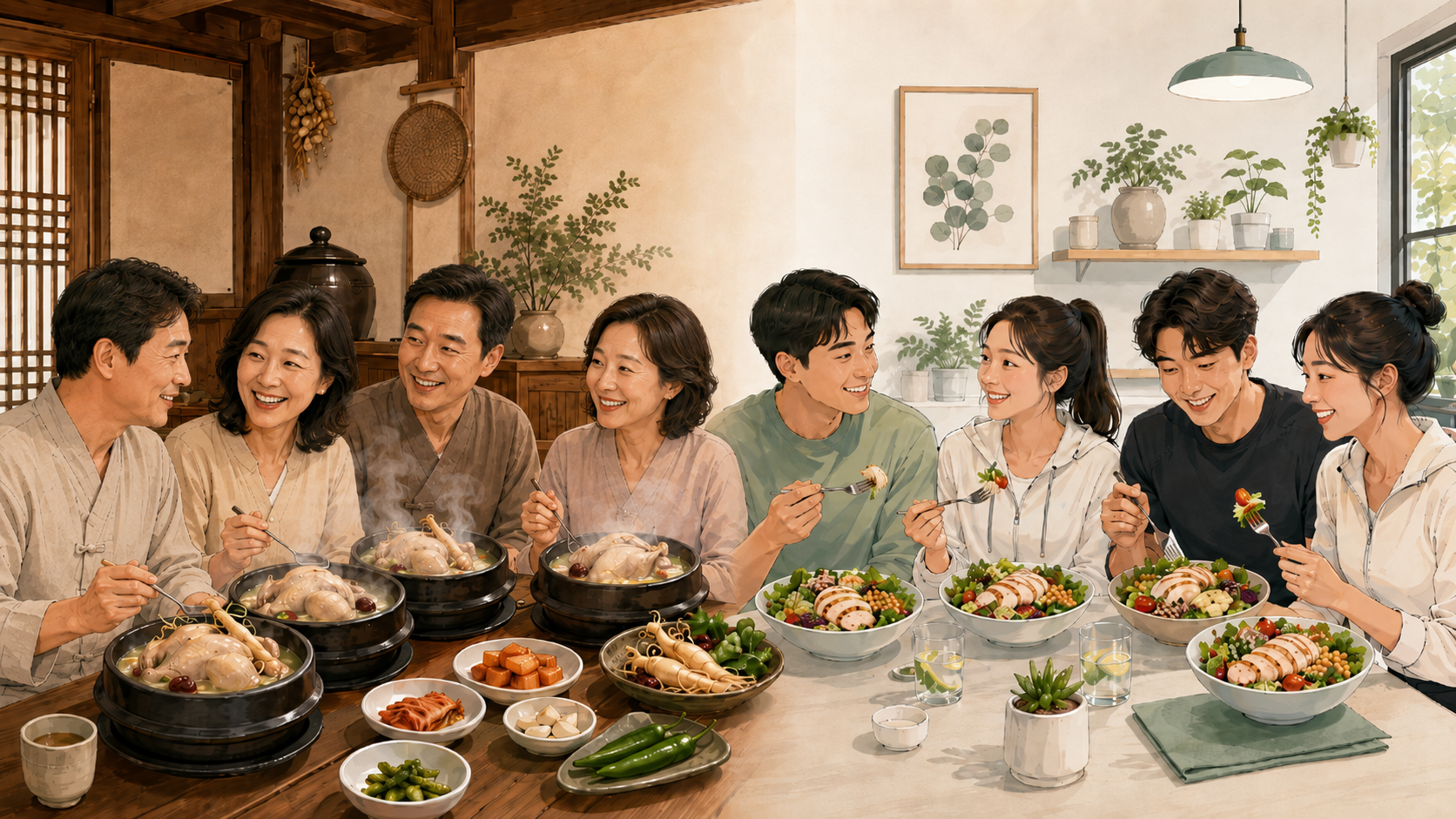
As high inflation coincides with scorching weather, more consumers are opting for ready-to-eat meals or meal kits instead of cooking Samgyetang over a direct flame. Although buying chicken, glutinous rice, garlic, and other ingredients at traditional markets or supermarkets can be cheaper than eating at specialty restaurants, the need for lengthy cooking is seen as a burden. In response, large supermarkets have placed convenient Samgyetang meals, including promotional items priced in the 4,000-won range, prominently at their health food displays ahead of Chobok.
The appeal is that you simply open the packaging and heat it in a pot or microwave, and the cost per meal is less than half that of dining in a restaurant. For single-person households, dual-income couples, and office workers, the appeal also lies in reducing leftover ingredients and dishwashing. Convenience stores are also joining the Boknal specialty market. In addition to their existing chilled Samgyetang and Ban-gye-tang, they are continuously launching reinterpretations of health food ingredients such as eel, smoked duck, and abalone in forms like lunchboxes, triangle kimbap, hamburgers, and sandwiches.

As high inflation coincides with hot weather, more consumers are opting for ready-to-eat meals or meal kits rather than cooking Samgyetang over an open flame. Photo by The Asia Business Daily Database
원본보기 아이콘Meanwhile, among younger consumers, the belief that one must eat hot and greasy food on Boknal is weakening. Instead of expensive Samgyetang, many are choosing relatively light and simple meals such as chicken breast salads, grilled eggs, or protein drinks. When combined with chicken or eggs, salads can serve as a source of protein and can be eaten as-is with no need for cooking, making them a favored meal replacement choice for young professionals and single-person households. Compared to traditional health foods, these options are lower in calories and sodium, and consumers can select ingredients to match their diet and exercise plans.

Among young consumers, the perception that one must eat hot and greasy food on Boknal is also weakening. Photo by Jinhyung Kang
원본보기 아이콘With more Millennials & Gen Z office workers looking to cut lunch expenses in the face of high inflation, the convenience store salad market is also growing. At CU, salad sales rose by 22.5% in 2023, 25.1% in 2024, and 18.8% in 2025, marking double-digit growth for three consecutive years. Sales in 2025 increased by about 48.6% compared to 2023.
As a result, the distribution industry is shedding the old notion that "health food must be hot and expensive." In addition to Samgyetang, consumer choices are expanding to include a variety of products with diverse price ranges and preparation methods, such as Chogyeguksu (cold chicken noodle soup), chicken breast salads, grilled eel rice bowls, and duck lunchboxes.
Boknal is not one of the 24 solar terms but is a special day determined based on the summer solstice, the beginning of autumn, and the Geng-il (day based on the sexagenary cycle). Chobok is the third Geng-il after the summer solstice, Jungbok is the fourth Geng-il, and Malbok is the first Geng-il after the beginning of autumn. In 2026, Chobok falls on July 15, Jungbok on July 25, and Malbok on August 14. The interval between Chobok and Jungbok is 10 days, but the interval between Jungbok and Malbok is 20 days. A year in which there are 20 days between Jungbok and Malbok is called "Wolbok."

Citizens lined up at a Samgyetang restaurant in Jongno District, Seoul, to celebrate the beginning of the hottest period of summer. Photo by Jo Yongjun
원본보기 아이콘Although the forms of Boknal health food are changing, the motivation to maintain one's health during the heat remains the same. Experts advise that rather than consuming large quantities of high-calorie foods at once, it is more important for summer stamina management to maintain a balanced intake of protein and vegetables and ensure sufficient hydration and sleep. Amid soaring restaurant prices, the Chobok dining table this year has become more diverse, ranging from restaurant Samgyetang to ready-to-eat meals, convenience store lunchboxes, and salads. Not only "what you eat," but also price, preparation time, and health are factors that are driving a trend toward more practical consumption, reshaping the landscape of Boknal.
Bang Jeil zeilism@asiae.co.kr
Choi Yujeong yjchoi@asiae.co.kr
© The Asia Business Daily. All rights reserved. Unauthorized AI training and use prohibited.







