AI actor Tilly Nowood. Photo by Tilly Nowood Instagram.
▼
Matthew McConaughey Registers Trademark for Face and Voice
Declares Principle: "No Use Without Permission"
Industry Tension Rises as AI Actors Take Leading Roles in Feature Films
"AI Is Not an Actor"—Hollywood Pushback Spreads
With AI now able to meticulously replicate human actors' faces and voices, and virtual actors even taking lead roles in feature films, tension is rising in the entertainment industry. Actors and voice actors are fighting back against unauthorized copyright and publicity rights infringements—such as their likenesses or voices being used or trained without consent—by registering trademarks, pursuing lawsuits, and launching official AI voice businesses.
The debate is intensifying over whether AI represents a new creative tool or a threat that replaces human actors and infringes on their rights. As generative AI makes it easy to reproduce the faces and voices of actors and voice artists, the key point of contention in the entertainment industry is shifting. The question is no longer just "Should we use AI?" but rather "Who gives permission, who controls it, and who gets a share of the profits?"

Hollywood actor Matthew McConaughey, well known for the movie 'Interstellar.' Photo by The Asia Business Daily
원본보기 아이콘Earlier this year, in January 2026, Hollywood actor Matthew McConaughey, well known for the movie 'Interstellar,' took the unusual step of establishing a legal defense against the unauthorized AI replication of his face and voice. He went as far as registering short videos and audio clips as trademarks, protecting his very identity as intellectual property.
It was reported that he received approval from the United States Patent and Trademark Office (USPTO) for eight trademarks covering his appearance and voice. The registrations include a 7-second video of McConaughey standing in front of his doorstep and a 3-second clip of him sitting in front of a Christmas tree looking at the camera. His famous catchphrase "Alright, alright, alright" from his debut film, the 1993 movie 'Dazed and Confused,' was also registered as a voice trademark.
The move to register trademarks was aimed at preventing AI apps and users from replicating his likeness and voice without permission. McConaughey told the Wall Street Journal, "Whenever my voice or image is used, it must be clear that it is with my approval and consent," stressing that consent and source attribution should be the default principles in the age of AI. However, this does not mean McConaughey rejects AI altogether. He is an investor in the AI voice company ElevenLabs and has also collaborated to produce his newsletter in Spanish using AI voice technology. Rather than imposing an unconditional ban, his strategy is to allow AI use based on the rights holder's prior consent and fair compensation.
"AI Is Not an Actor"—Pushback Grows, Even as AI Lands Feature Film Lead Roles
This legal action by McConaughey comes against the backdrop of Hollywood controversies over AI actors. British AI studio Particle6 previously created the virtual actress Tilly Nowood, who is set to play the lead in her first feature-length film, 'Misaligned.' Set in the digital world of 'Tillyverse,' the comedy-drama follows an AI in the cloud as it explores identity, autonomy, and its desire to become human.
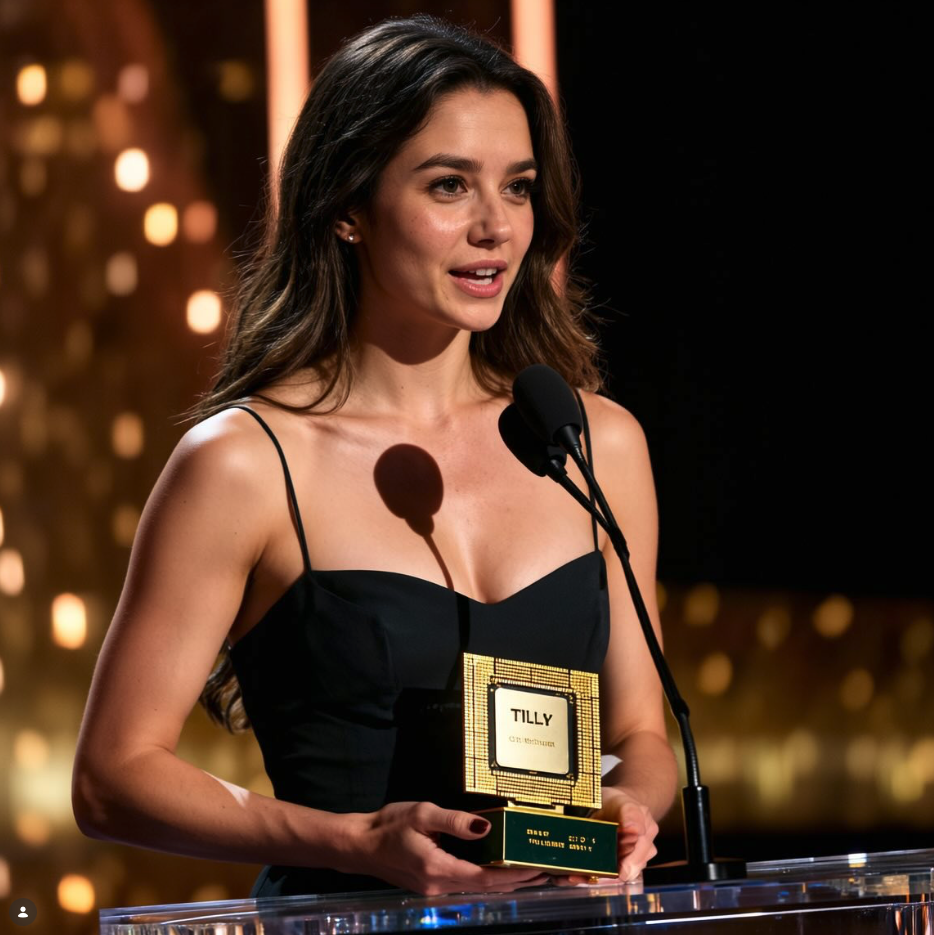
Tilly Nowood sparked fierce backlash from the film industry when first unveiled in 2025. The American actors' and broadcasters' labor union SAG-AFTRA defined Tilly as "not an actor, but a character created by computer programming." The union argued that a vast number of professional actors' work may have been used for training without their permission or compensation.
Particularly, SAG-AFTRA criticized that AI characters do not possess human experience or emotion, and warned that they could replace human actors, threatening their livelihoods and diminishing artistic value. In contrast, the film's producer, Elin van der Velden, pushed back, arguing that Tilly is not a replacement for human actors but a new creative tool, similar to animation or computer graphics.
▼
Japanese Voice Actors Counter with "Official AI Voices"
Unauthorized Synthetic Voices Prompt Deletion Requests and Lawsuits
Watermarks and Voiceprint Authentication Protect Real Voices
The Core Issue: Consent, Control, and Revenue Sharing—Not Just Technology
Japanese Voice Actors Take On AI Directly—"Official AI Voices" Battle Against Pirated Audio
Not only in Hollywood but also in Japan's voice actor industry, there is a movement to provide "official AI voices" managed directly by the rights holders, rather than simply blocking AI-generated voices.
On July 13, Nikkei reported that popular voice actor Daisuke Namikawa will launch his AI voice service 'Polyphony' on July 14, which recreates his own voice. Namikawa, known for voicing Goemon Ishikawa in the anime 'Lupin the Third' and Anakin Skywalker in the Japanese dub of 'Star Wars,' partnered with a Japanese IT company to record his voice for over a year and develop the AI model.
Yuki Kaji, famous for voicing Eren Yeager in 'Attack on Titan,' also operates a synthetic voice software and AI character 'Soyogi Fractal' based on his own voice. In April 2026, he founded the company 'Fractal' to expand related business and serves as its CEO. Fractal maintains that it only uses technology with guaranteed rights protection. Kaji believes that AI should be used as a tool to create new works by merging human expression, rather than seeing it solely as a threat to voice actors' jobs.
Legal responses to unauthorized synthetic voices are ongoing as well. Voice actor Kenjiro Tsuda, in May, filed a lawsuit with the Tokyo District Court against TikTok's operator, demanding the removal of videos that mimicked his voice using generative AI. However, it remains challenging and costly to identify anonymous posters or pursue damages against overseas platforms. The Japanese voice acting industry is also working to build a database that distinguishes official voices from unauthorized synthetic voices using digital watermarks and voiceprint authentication. Profits from official AI services are planned to be distributed among the voice actor, their agency, and tech companies as rights holders.
While McConaughey's trademark strategy and the official AI business moves by Japanese voice actors take different approaches, their goals are the same: to turn faces and voices into assets that rights holders can control in the age of AI, and to prevent unauthorized replication. As AI actors now take on lead roles in movies, the point of debate has moved beyond whether or not to use the technology. The central questions going forward will be whose data AI learns from, who gives permission for its use, and who receives the profits and responsibility from the resulting creations.
-
Reporter Bang Jeil zeilism@asiae.co.kr
-
Edit Kang Dongwon kangdw76@asiae.co.kr
© The Asia Business Daily. All rights reserved. Unauthorized AI training and use prohibited.