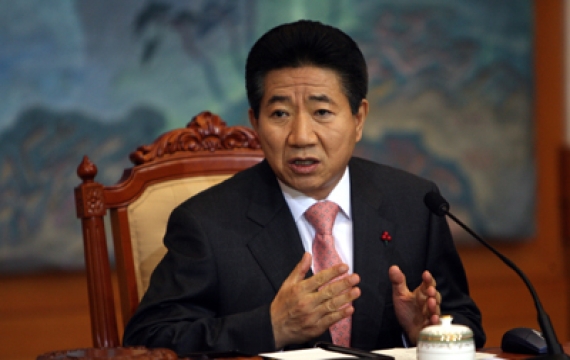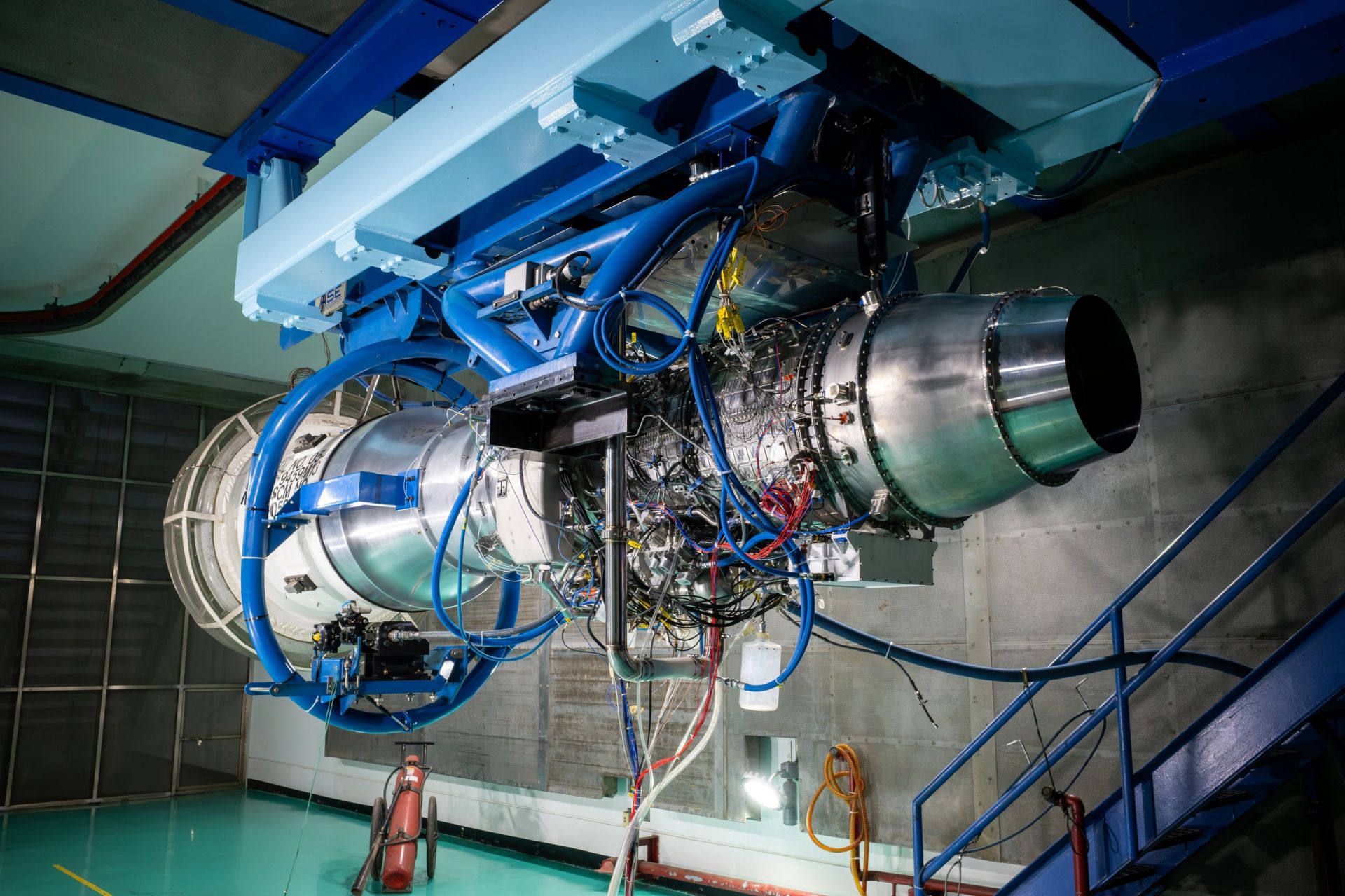
On the afternoon of July 6, at the test facility of Hanwha Aerospace’s Changwon Plant 1 in Gyeongsangnam-do, there was a palpable sense of both tension and excitement, just one day ahead of the ground testing ceremony for the maiden prototype of a domestically developed long-life aircraft engine. Amidst a faint smell of oil, the stars of the event—a 5,500-pound-force (lbf) class turbofan engine and a 1,400-horsepower class turboprop engine—stood impressively on the stage.
Jointly Developed UAV Engines with ADD... Unveiled at Changwon Plant 1
On this day, Hanwha Aerospace, together with the Agency for Defense Development (ADD), unveiled to the press for the first time prototypes of two types of unmanned aerial vehicle (UAV) engines developed with domestic technology. These new Korean UAV engines have already been fully assembled and have entered ground trial operation. The trial runs are conducted over roughly 10 hours, with maximum output maintained for about three minutes. This process is repeated four times to assess the engine’s performance and reliability.
The 5,500-lbf class turbofan engine is scheduled to be installed in the low-observable unmanned wingman aircraft currently under development. The low-observable unmanned wingman will perform reconnaissance, electronic warfare, and attack missions alongside the KF-21 fighter jet. After further trial development, flight tests with the actual system equipped with this engine are planned for early 2030.
Kim Joungho, Head of the Advanced Engine Business Team at Hanwha Aerospace, emphasized, "If we fail to develop the 5,500-lbf class engine, we realistically cannot succeed in UAV development. This will serve as the technological foundation for future unmanned aircraft systems, manned-unmanned teaming, and AI-powered platforms."


The 1,400-horsepower class turboprop engine, also unveiled, will be mounted on medium-altitude UAVs designed for long-duration flights and wide-area surveillance and reconnaissance. Currently, medium-altitude UAVs in operation are equipped with Pratt & Whitney Canada’s PT6 engine. This 1,400-horsepower engine will also undergo trial development and is scheduled for flight tests in early 2030.
5,500-lbf Turbofan and 1,400-horsepower Turboprop... Test Flights Planned for 2030
The significance of these two engines lies in the fact that they are the first long-life (usable for thousands of hours) aircraft engines developed entirely with domestic technology. While there have been previous cases in which domestic companies such as Hanwha Aerospace, led by the ADD, have independently developed and mass-produced expendable aircraft engines for missiles, this is the first time a prototype of a long-life aircraft engine has been completed. An industry official explained, "The criteria for long-life engines vary by type, but Hanwha Aerospace aims for operational capabilities of around 3,000 to 4,000 hours for its long-life engines."
After a two-minute drive from the engine test facility, a smart engine machining plant comes into view—a facility that manufactures parts for commercial airliners such as the Boeing 737 MAX and Airbus A320neo. Upon entering the plant, the presence of robots is immediately noticeable, even before the humans.
From transporting products to machining and final inspection, the entire plant operates as one massive automated system. Automated Guided Vehicles (AGVs) continuously shuttle products and tools along designated routes on the production line. Engineers monitor the machining processes in real time via screens installed throughout the facility and respond to equipment errors as they arise.
Production Process Automated with Robots... Humans Focus on Supervision
The development of these domestic aircraft engines is significant in that it secures core technological sovereignty for the aviation industry and addresses structural limitations on aircraft exports.
Aircraft engine technology is the most challenging among all engine types to develop. The United States, United Kingdom, France, and other leading global defense companies closely guard their technologies, creating high barriers to entry.
The greatest challenge lies in developing materials technology capable of withstanding temperatures exceeding 1,500 degrees Celsius generated by the engine. Unlike industrial gas turbines, no external cooling devices can be used, so the high temperatures from combustion must be managed solely with the engine’s own cooling technologies. Because stable performance must be maintained even under extreme high-temperature and high-pressure environments, core components require ultra-miniaturized and highly precise design engineering.
Moreover, the few countries with complete technologies naturally do not share them. Strict controls are enforced on related technology transfers and exports through regimes such as the Missile Technology Control Regime (MTCR), International Traffic in Arms Regulations (ITAR), and Export Administration Regulations (EAR).

1400-horsepower class turboprop engine. Provided by the Defense Acquisition Program Administration
원본보기 아이콘As a result, when maintaining or upgrading imported engines or exporting aircraft equipped with such engines, approval from the country of origin is required. Currently, if the United States does not consent, it is not possible to export domestically developed aircraft such as the KF-21 and FA-50 using local technology.
If domestic fighter jets are equipped with Korean-made engines, it would be possible to freely expand into global defense export markets without such restrictions. This is why employees here refer to the independent development of aircraft engines as a "groundbreaking transformation."
"Developing Aircraft Engines Independently Is Revolutionary... Next Up: 10,000-lbf Turbofan Engine"
Should the domestic development of "aircraft–engine–avionics–armaments" lead to vertical integration, it would allow for flexible adjustments of prices, performance, and maintenance terms, thereby enhancing export competitiveness. Moreover, long-term added value can be created through Maintenance, Repair, and Overhaul (MRO) businesses involving engine maintenance, parts replacement, and performance upgrades even after aircraft sales.
Hanwha Aerospace is the only company in Korea with comprehensive technological capabilities that span from aircraft engine materials design to manufacturing and maintenance. The company plans to develop a 10,000-lbf class turbofan engine to be installed in stealth UAVs in the future. This engine will undergo selection of a prototype manufacturer this year, followed by full-scale testing.
The company also intends to actively participate in the government-led development of a 24,000-lbf class advanced aircraft engine. Kim Joungho stated, "Among mid-size engines, advanced aircraft engines deliver the highest output and excellent efficiency. If development succeeds, it will provide significant competitiveness in the global market."
-

Reporter Jang Bokyeong jbg@asiae.co.kr
-
Edit Lee Kijae happylee17@asiae.co.kr
© The Asia Business Daily. All rights reserved. Unauthorized AI training and use prohibited.