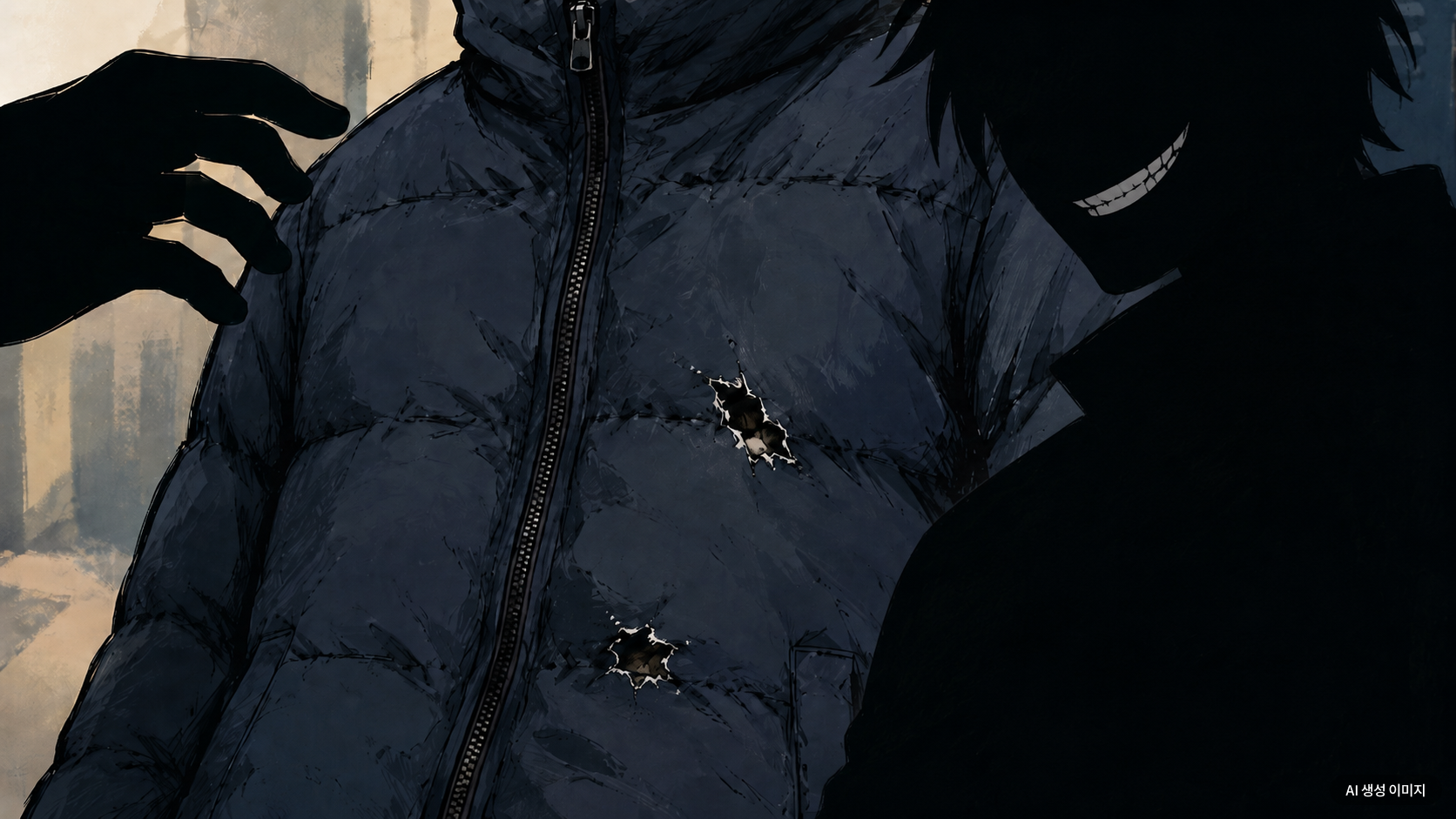

A's photo of his son's padded jacket. It shows a hole that looks like it was pierced with an awl. Screenshot from SNS
원본보기 아이콘On June 4, 2026, a post titled "The Reason My Middle School Son Can't Wear the Padded Jacket His Father Bought Him" quickly spread on social networking services (SNS). The post detailed the experience from the perspective of the victim's parent, describing what their child had endured.
The author, identified as Mr. A, became suspicious after discovering several holes in his son's padded jacket that appeared to have been punctured with an awl. In the process of asking about the reason, he claimed to have learned that the damage was caused by other students.
Mr. A immediately informed his son's homeroom teacher of the situation. The teacher responded that he would call in the accused student to check the facts. However, what followed was not what Mr. A had expected.
According to Mr. A, the teacher reported that the accused student claimed, "The victim said it was okay to make the holes," and stated that it was difficult to conclude that this was school violence based solely on one side's account.
In response, Mr. A argued, "There is no reason for anyone to tell others to make holes in a brand-new jacket." However, it was reported that the teacher withheld a clear judgment on the grounds of 'lack of evidence'.

Afterward, Mr. A requested at least an apology and compensation for the damage. The teacher arranged contact with the perpetrator's parents. However, the perpetrator's parents also denied responsibility, reportedly stating, "There is no way our child would do such a thing." In particular, they responded, "If several children were involved, why should we take all the responsibility?"
Eventually, several days later, Mr. A was informed that the perpetrator had apologized. However, Mr. A claimed, "When I asked my son how he was apologized to, he said the perpetrator told him, 'I only did it because you told me to, but I'm sorry.' The teacher saw this and still told me that an apology had been made."
Mr. A stated, "I'm fed up with the school, the adults, and everyone involved. I'm angry at myself for trying to resolve everything politely with the school and the perpetrator's parents." He added, "The group of perpetrators still act confidently at school." In conclusion, he appealed, "The school violence my son experienced is an unusually serious case of group violence for a middle school student. If publicizing this is the only way to convey the seriousness of the situation, I will seek help in any way from anyone."
Online, criticism continues, with comments such as "How can we trust sending our children to school when this is the response?" and "They are avoiding responsibility despite clear evidence." Some point out that the school violence response system still remains at the level of dispute mediation, and there are increasing calls for more active investigation and the establishment of clearer standards for judgment.
-

Reporter Seo Jiyeong zo2zo2zo2@asiae.co.kr
-

Edit Eo Kangbi uhkb86@asiae.co.kr
© The Asia Business Daily(www.asiae.co.kr). All rights reserved.
!["Don't Get Excited, Crushes Are Exhausting Too: Even Unrequited Love Faces a Recession [World is Z Gold]"](https://cwcontent.asiae.co.kr/asiaresize/323/2026060508335888548_1780616038.png)


![Dongtan Tops Nationwide in Apartment Price Growth as Gap Investment Hotspot... Semiconductor Belt Also Faces Land Transaction Regulations [Real Estate AtoZ]](https://cwcontent.asiae.co.kr/asiaresize/304/2026060512260289179_1780629962.jpg)