
With the acceleration of sea level rise caused by global warming, there are projections that New Orleans, the representative city of Louisiana, USA, could effectively be isolated by the sea or submerged within this century. Experts emphasize that there are clear limits to responding after damage has already occurred, and stress the need for a long-term strategy that includes even a 'planned relocation of the city' starting now.


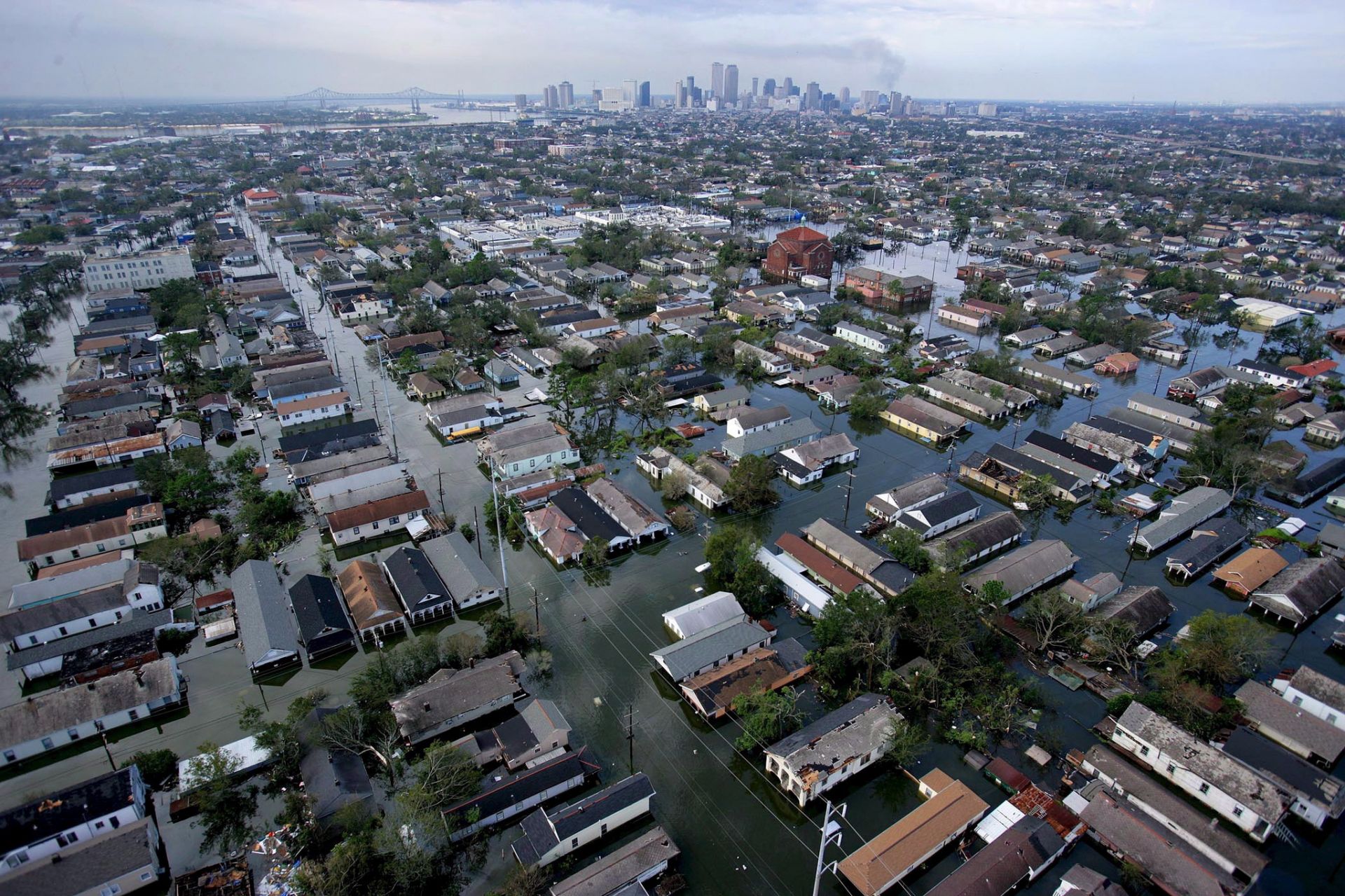
The scene of strong winds and flood damage caused by Hurricane Katrina around New Orleans, Louisiana, USA, on August 30, 2005 (local time). Katrina made landfall in Louisiana on August 29, 2005, leaving massive destruction along the coasts of Louisiana, Mississippi, and Alabama.
Photo by EPA
원본보기 아이콘
On August 29, 2005, in New Orleans, Louisiana, U.S., as Hurricane Katrina made landfall and flooded most of the city, residents were moving along Tulane Avenue. Photo by EPA The Yonhap News.
원본보기 아이콘CNN, citing a study published in the international journal Nature Sustainability, reported that sea levels along the Louisiana coast could rise by 3 to 7 meters in the future.
In this scenario, about 75% of the remaining wetlands would disappear, and the coastline is expected to move inland by up to 100 kilometers. The research team diagnosed that the region is already close to the 'point of no return' and warned that the city could be surrounded by the Gulf of Mexico before the end of the century.

Land loss status and projections for southern Louisiana, USA, through 2050. Areas marked in red represent coastal wetlands that have already been lost or are expected to be lost from 1932 to 2050. Louisiana has lost an average of 34 square miles of land annually over the past 50 years. U.S. Geological Survey (USGS) · LaCoast.gov
원본보기 아이콘
On August 19 last year (local time), Kiruna Church being transported on a special carrier in Kiruna, Sweden. Kiruna is undergoing a city relocation project due to ground subsidence caused by mining development. Photo by AP Yonhap News
원본보기 아이콘New Orleans is located in a basin that is topographically lower than sea level, making it a city inherently at high risk of flooding. In addition, situated in the heart of the rapidly shrinking Mississippi River Delta, the area has long been considered vulnerable to sea level rise and storm surges.
Until now, the wetlands surrounding New Orleans have served as a natural breakwater, protecting the city from hurricanes and storm surges. However, with the continued expansion of development, construction of canals for the oil and gas industry, and the installation of river levees, the supply of sediment that maintains the wetlands has been dramatically reduced. In fact, it is estimated that more than 5,000 km² of wetlands have disappeared from Louisiana since the 1930s.
The research team also presented past geological records as evidence. The ancient coastline formed about 125,000 years ago shows a sea level at least 3 meters higher than today, suggesting that such a scenario could realistically occur in the future.

New Orleans, Louisiana, USA, was flooded on August 5, 2017 (local time). At the time, The Washington Post reported that heavy rain had submerged New Orleans in water, prompting Governor John Bel Edwards to declare a state of emergency in response to the drainage system and other issues. New Orleans also experienced severe damage in August 2005 when Hurricane Katrina struck, causing over a thousand casualties and displacing hundreds of thousands due to drainage system failures. AP Yonhap News
원본보기 아이콘
Heavy rain is pouring down on Canal Street in New Orleans on August 29, 2021 (local time), as the major hurricane Ida made landfall in Louisiana, USA. Photo by AFP The Yonhap News
원본보기 아이콘
The French Quarter of New Orleans, Louisiana, USA, flooded by Hurricane Katrina in 2005. Getty Images Bank
원본보기 아이콘The city's crisis is also evident in the statistics. After Hurricane Katrina, the population of New Orleans decreased by about 25%. Since then, every time a major storm or flood occurs, there has been a recurring phenomenon of "stepwise migration," with large numbers of residents leaving the city.
The problem is that this migration does not affect all social classes equally. While those with financial means can move relatively quickly to safer areas, low-income residents find it difficult to leave the city despite falling property values, rising insurance premiums, and weakened public services.


"Managed retreat" is being proposed as an alternative to respond to this crisis. This is not simply about individuals relocating, but refers to a long-term strategy of gradually relocating city functions and infrastructure in a planned manner.
As a reference case, the city of Kiruna in northern Sweden is often mentioned. To address ground subsidence caused by mining development, the city has been pursuing a plan since a 2004 resident agreement to relocate the entire city to a new location.
The research team views the situation in New Orleans not simply as a regional issue, but as a preview of the future that coastal cities worldwide will face.

-

Reporter Seo Jiyeong zo2zo2zo2@asiae.co.kr
-
Edit Oh Hyunyoung hyun05@asiae.co.kr
© The Asia Business Daily. All rights reserved. Unauthorized AI training and use prohibited.







