Kim Jungkwan, Minister of Trade, Industry and Energy, has signaled a major shift in industrial policy for the second half of the year, prioritizing the Manufacturing AI Transformation (M.AX) and regional strategies. Despite tariff pressures from the United States and supply chain crises triggered by the war in the Middle East, he has chosen a "manufacturing AI transformation" as a breakthrough to boost the competitiveness of the manufacturing sector. Minister Kim has even introduced the term "industrial stratagem" instead of the traditional "industrial policy," indicating his vision to integrate industry, trade, and resources into a unified strategic framework.
Announcing a Major Shift in Industrial Policy Led by Manufacturing AI Transformation and Regional Strategies
At a press conference held on the 27th in Eojindong, Sejong City, Minister Kim stated, "When the administration was launched, we faced tariff issues with the U.S., and now we are also dealing with the Middle East crisis. In the midst of these complex crises, we are pushing ahead with M.AX as a breakthrough to enhance manufacturing competitiveness." He added, "Ultimately, organizations move according to the leader's awareness and direction. The manufacturing AI transformation is also progressing rapidly as both the government and industry are aligned in their goals."
Minister Kim particularly emphasized, "Now, the expression 'industrial stratagem' is more appropriate than 'industrial policy'." He explained, "Calling issues related to industry, trade, and resources merely 'industrial policy' feels insufficient. We need to further intertwine industrial, resource, and trade organizations, and we are considering how our resources can be linked to industrial competitiveness."

Kim Jung-kwan, Minister of Trade, Industry and Energy, is answering reporters' questions at a press briefing held on the 27th in Eojindong, Sejong City. Provided by the Ministry of Trade, Industry and Energy
원본보기 아이콘The Ministry of Trade, Industry and Energy also released its "Key Achievements in Industry, Trade, and Resources on the First Anniversary of the Sovereign Government" on the 28th, presenting the manufacturing AI transformation and regional growth strategies as core initiatives. The ministry assessed, "The past year has been a period of complex crises, with global trade uncertainties, energy and resource supply shocks from the Middle East, and AI-centric industrial hegemony battles unfolding simultaneously. We have managed crises thoroughly while boldly seizing growth opportunities."
Currently, over 1,500 companies and institutions are participating in the "M.AX Alliance," which was launched last September. The ministry plans to roll out more than 200 AI factories—applying AI to manufacturing processes in 12 key sectors such as semiconductors and shipbuilding—by the end of this year. Through this initiative, the ministry expects productivity to improve by more than 30%.
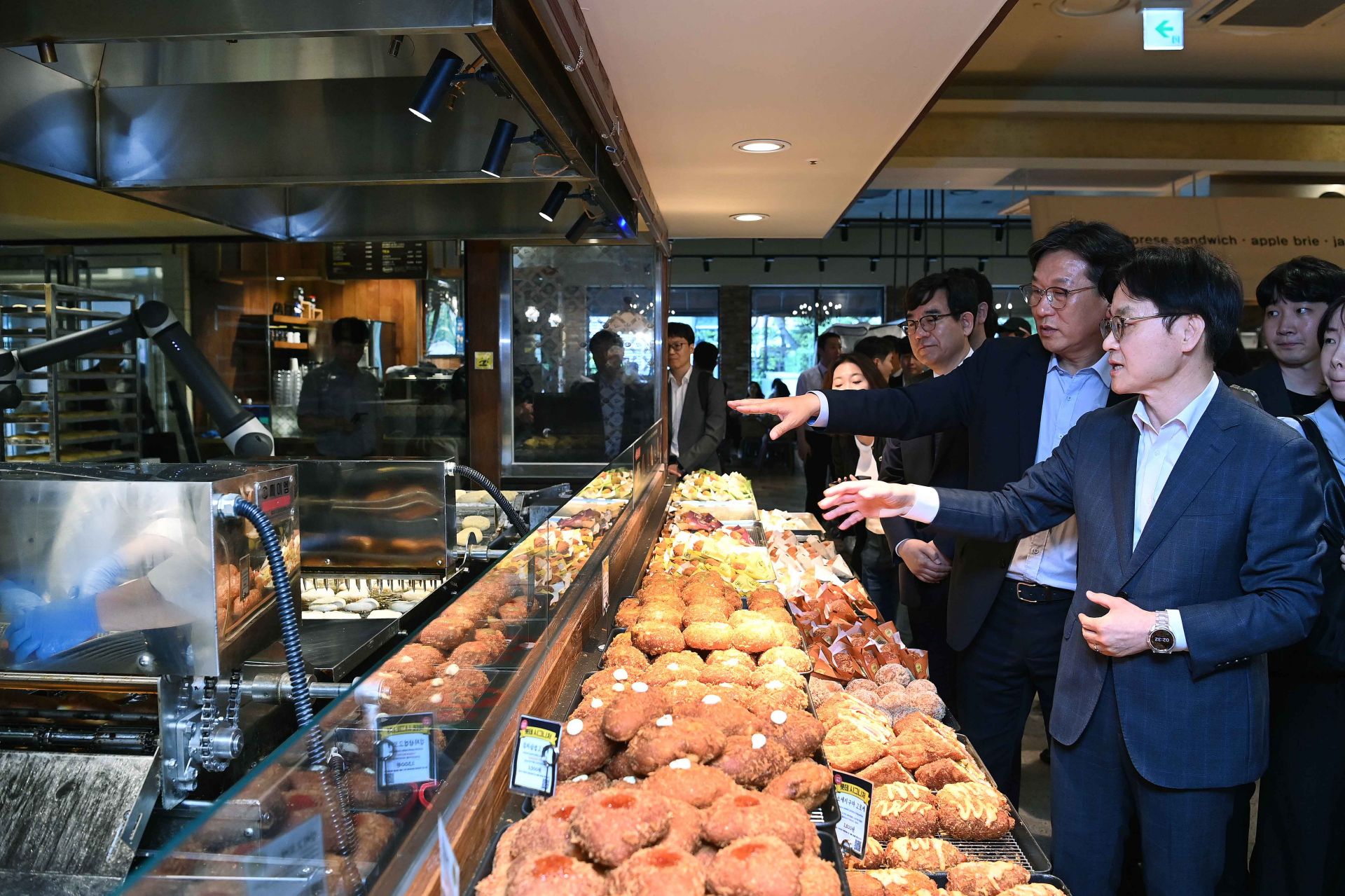
As a strategy to spread the manufacturing AI transformation, Minister Kim introduced the so-called "dot-line-plane strategy." He explained, "If an individual success story like Seongsimdang, which introduced AI into bread production, is a 'dot,' then connecting these dots forms lines, which then expand into planes. AI factory technology is being applied not only in bakeries but also in various settings such as Makgeolli breweries and Jokbal restaurants."
He continued, "If you attach AI sensors to the fermentation process of Makgeolli, there is no need for a person to monitor it 24 hours a day. This is a way to help people with difficult tasks and increase productivity." He also stressed, "There are limits to what government support alone can achieve. True expansion is possible only when companies voluntarily adopt AI and a market is formed."
Regarding the speed of manufacturing AI transformation, Minister Kim remarked, "To be honest, it still feels slow in my heart," but added, "Beneath the surface, changes are progressing very rapidly." He said, "Once the issues related to data are resolved, the pace will accelerate dramatically. There is now a consensus among companies that it will be difficult to survive without transitioning to AI."
The Past Year Was an Era of Complex Crises... M.AX Is the Breakthrough for Enhancing Manufacturing Competitiveness
He also commented, "While Korea did not invent internet technology, it was one of the biggest beneficiaries of the internet era. Securing competitiveness in manufacturing is also crucial in the AI era." He added, "Since only Korea and China have properly established manufacturing bases, we have a strong chance of success."
As tasks facing the domestic AI industry ecosystem, he pointed to "business models, talent, and capital." Minister Kim said, "AI technology itself is rapidly becoming standardized. What matters more than technology is having a sustainable business model." He continued, "The greatest difficulty for AI companies is securing talent, as high labor costs and frequent job changes make it challenging to attract skilled workers."
Regarding concerns about job losses in the process of adopting AI, he drew a clear line, saying, "It's not about replacing people, but about maintaining manufacturing competitiveness." He noted, "The average age of welders is already around 60, and the next generation is not inheriting these skills. The decline of the U.S. shipbuilding industry was also due to a failure in passing down skills."

Minister of Trade, Industry and Energy Kim Jung-kwan, who visited Daejeon Seongsimdang, is talking with Lim Young-jin, CEO of Daejeon Seongsimdang, on the 27th. Provided by the Ministry of Trade, Industry and Energy
원본보기 아이콘He further explained, "In the future, rather than people performing dangerous tasks themselves, they will take on the role of 'robot managers,' overseeing robots. The government needs to play a role in creating systems for retraining and transition education."
The minister also commented on the labor-management conflict at Samsung Electronics. He said, "I think Samsung is at a crossroads, where this situation could either be harmful or beneficial. Labor, management, the board, and employees need to turn this into a stepping stone for enhancing global semiconductor competitiveness."
Regarding the oil price cap, he stated, "If the war ends, the Strait of Hormuz normalizes, and international oil prices stabilize at around $90 per barrel, we may consider ending the cap." On nuclear power exports, he said, "We are in contact with several countries, but as government-to-government negotiations are ongoing, I cannot provide specific details."
Individual Success Stories Like Seongsimdang Must Connect into Lines and Expand into Planes
Regarding the bid for the Canadian submarine project, he emphasized, "Korea possesses real, operational Jangbogo-class submarines, while Germany is still at the design stage. Our price and performance competitiveness is solid." He added, "We have also proposed industrial cooperation packages such as Hyundai's hydrogen vehicles and Hanwha's defense vehicles, and there is growing support for Korea within the Canadian automotive industry."
However, he also noted, "Since Canada is a NATO member, it may consider its traditional relationships with Europe, so we cannot let our guard down." He stated, "I've heard that some suggest splitting the order, with Korea and Germany each getting six submarines. I hope, like Admiral Yi Sun-sin's 12 ships, that we achieve a great result."
He expressed strong confidence in the export outlook. Minister Kim said, "Cautiously, I believe it is possible to surpass $900 billion in exports this year. Exports in not only semiconductors but also other industries are increasing by 14-15%, and SME exports have grown by 10%." He added, "We are pursuing market diversification, focusing on China, India, and the consumer goods sector. Please look forward to export trends in the second half of the year."
-
Reporter Kang Nahum nahum@asiae.co.kr
-
Edit Lee Kijae happylee17@asiae.co.kr
© The Asia Business Daily. All rights reserved. Unauthorized AI training and use prohibited.







