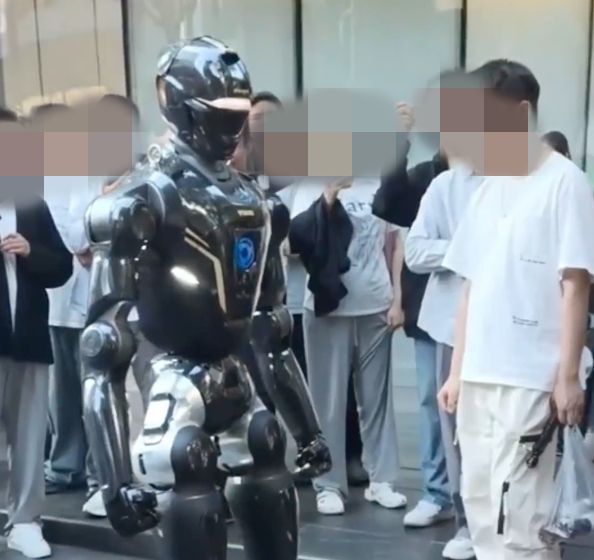
The T800 is known to be named after the model from the movie 'Terminator' and has become a hot topic on social media. Equipped with high-power joint motors, it can perform martial arts moves such as front kicks and spinning kicks, and is reported to be capable of running at a speed of about 10.8 km/h.
As the deployment and commercialization of humanoid robots in public spaces is rapidly expanding in China, controversies surrounding safety and ethical issues are also intensifying. Recently, in Shenzhen, Guangdong Province, the appearance of a humanoid robot police officer patrolling alongside an actual SWAT team attracted significant attention. At a university event in Xi'an, Shaanxi Province, a humanoid robot malfunctioned during a performance and accidentally hugged a student, once again bringing safety concerns into the spotlight.
On May 4, Global Times and other Chinese local media reported that the humanoid robot 'T800,' unveiled in Shenzhen on April 30, became a hot topic after being seen moving alongside SWAT officers, precisely matching their stride and posture. Local reports introduced the robot as 'EngineAI T800,' describing it as 1.73 meters tall, weighing 75 kg, and capable of performing advanced movements such as running and spinning kicks.
Capable of Martial Arts Moves... Potential to Support High-Risk Operations

The battery is reported to last about 4 to 5 hours on a single charge. Whereas the 'PM01' robot police officer, deployed in Shenzhen early last year, was used primarily for promotional and guidance purposes, the T800 is evaluated as having demonstrated the potential to assist in high-risk police operations by working directly alongside officers in the field.
There are also expectations that robots could take on risks in situations where it is difficult for people to intervene directly, such as patrols, crowd control, searches in dangerous areas, and approaching suspected explosive sites. However, public reactions are mixed. Some have praised it as "the beginning of a futuristic policing system," but others have raised concerns about who would be responsible if a robot exercises physical force and to what extent autonomous decision-making should be permitted.

In particular, since police work is directly connected to citizens' physical freedom, critics argue that legal controls and operational standards must be established before merely demonstrating the technology. The core of the controversy lies in the fact that if a robot makes direct contact with people or performs restraining actions in the field, malfunctions or errors in judgment could immediately lead to casualties.
Robot Malfunction at University Event... Accident Where Student Was Hugged
Indeed, debates over the safety of humanoid robots continue in China. At the opening ceremony of a university sports festival in Xi'an, Shaanxi Province, a humanoid robot performing choreography with students left its formation and hugged a nearby female student. A staff member quickly intervened and separated the robot, and the student was not injured. According to Global Times, citing a university official, this action was not pre-programmed but rather the result of an AI software malfunction.

On the 23rd of last month, a performance robot malfunctioned and rushed towards a person at a university in Shanxi Province, China. Photo by Shin Kwe-bo
원본보기 아이콘Online, there have been a series of reactions such as "the robot went out of control," "wasn't it remotely controlled?" and "it appeared to be in an uncontrollable state." The university explained that it was a simple movement error, and the manufacturer also stated that the robot's abnormal behavior was caused by interference from drones operating at the site. The incident has been recorded as an accident potentially caused by a program error due to signal interference.
Meanwhile, both the Chinese central and local governments are promoting the robotics industry as a next-generation growth engine. As manufacturing automation, responses to an aging society, and the drive to secure advanced manufacturing competitiveness converge, humanoid robots are entering various fields such as factories, logistics warehouses, exhibition halls, information services, and security and patrol work.
-

Reporter Bang Jeil zeilism@asiae.co.kr
-
Edit Kim Hyunhee faith100@asiae.co.kr
© The Asia Business Daily. All rights reserved. Unauthorized AI training and use prohibited.