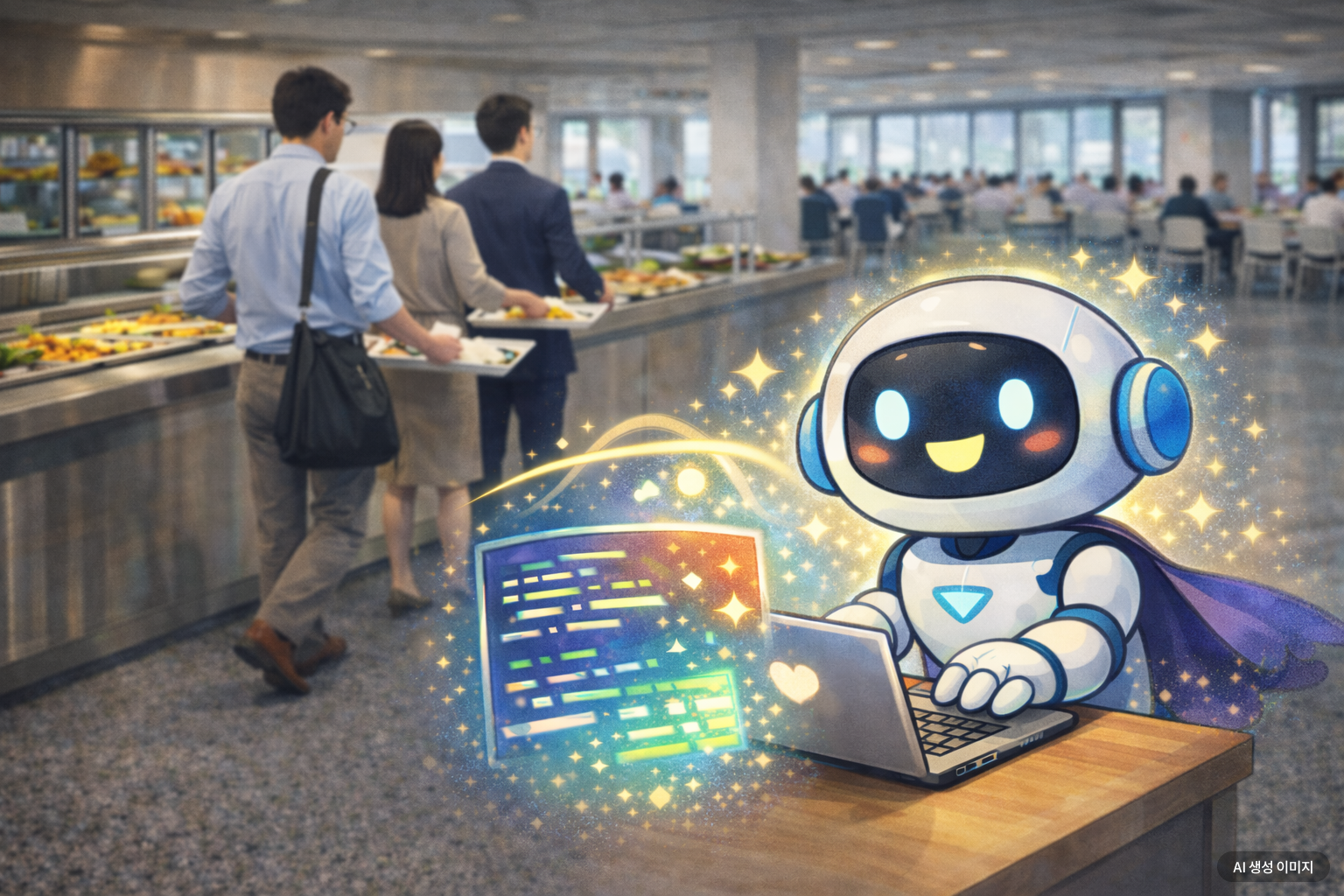
Even non-majors in development welcomed Vibr Coding. Mr. Kim (39, male), who is in charge of product planning at a large corporation, has no knowledge of development. Nevertheless, he is creating platforms such as games and YouTube video analysis through Vibr Coding. Initially, he tried Vibr Coding for self-development purposes.
Editor's NoteWe have entered an era of "Vibe Coding," where you simply describe your idea and artificial intelligence (AI) writes the code for you. This is a stark contrast to the last decade, when developer jobs were in high demand and coding fever swept the nation. While anyone can now code, getting a job in the related industry has become even more difficult, and security issues have grown more serious. How is this rapid shift in the development paradigm changing our everyday lives? The Asia Business Daily explores the sites of industrial transformation brought about by vibe coding.
The dawn of the... Vibe Coding era
At 10 a.m. on March 25, 2026, in a shared office in Seongdong District, Seoul, four members of the company OPark gathered. After exchanging brief greetings, they opened their laptops and started working. The scene was noticeably different from the usual corporate office filled with partitions. The developers spent only a short time typing, then pushed their laptops aside and continued conversations with their colleagues. They had already assigned tasks to Anthropic’s generative AI model, Claude. Even when discussing ideas, they didn’t speak in abstractions; instead, they showed actual code written through vibe coding as the basis for their discussions.
As lunchtime approached, employees sat in front of their monitors, deep in thought. After considering their options, they entered several sentences into Claude and left for lunch. While they were away, the AI began writing code as instructed. No one sat at the computer laboriously coding by hand. Hyerin Kim, CEO of OPark (32, female), said, “Developers use vibe coding to instruct AI to do the programming,” adding, “Although our company doesn’t pursue development solely by AI, it’s natural for developers to become the control tower in this process.”

Kim Hyerin, CEO of Opark, is giving work instructions to AI and then holding a meeting with her team members. CEO Kim said that the AI demonstrated the work capabilities equivalent to about four developers, enabling them to carry out tasks concurrently with other projects. Photo by Dongju Yoon
원본보기 아이콘With a background in electrical engineering, CEO Kim founded the platform development startup OPark in February 2023. The platform OPark is building, called “Toont-M,” offers comprehensive features for ordering construction materials, including search, project management, communication tools for clients, and payment solutions. Although Kim doesn’t have a background as a software developer, she was able to enter the platform development business thanks to AI. Data collection for the Toont-M platform began in August of last year, and the platform was built in less than a year. With just four people handling what would normally require dozens, costs such as labor expenses were significantly reduced.
"Watching the development of AI,
I thought, 'Ah, I could build this while saving money.'
If it weren't for vibe coding,
I wouldn't have even tried developing Toont-M."
As vibe coding takes over the industry, work efficiency has greatly improved. According to the GitHub report “Engineering Leadership in the Age of AI,” developers can complete tasks up to 55% faster using AI coding tools. Vibe coding has also led to better code quality and readability, enhancing the final programming results. As such, it is safe to say that vibe coding now dominates the development field. Market research firm Gartner predicted that although the share of enterprise software developed with AI was less than 10% in 2023, this figure will rise to 75% by 2028.
Vibe Coding, Improving Work Efficiency
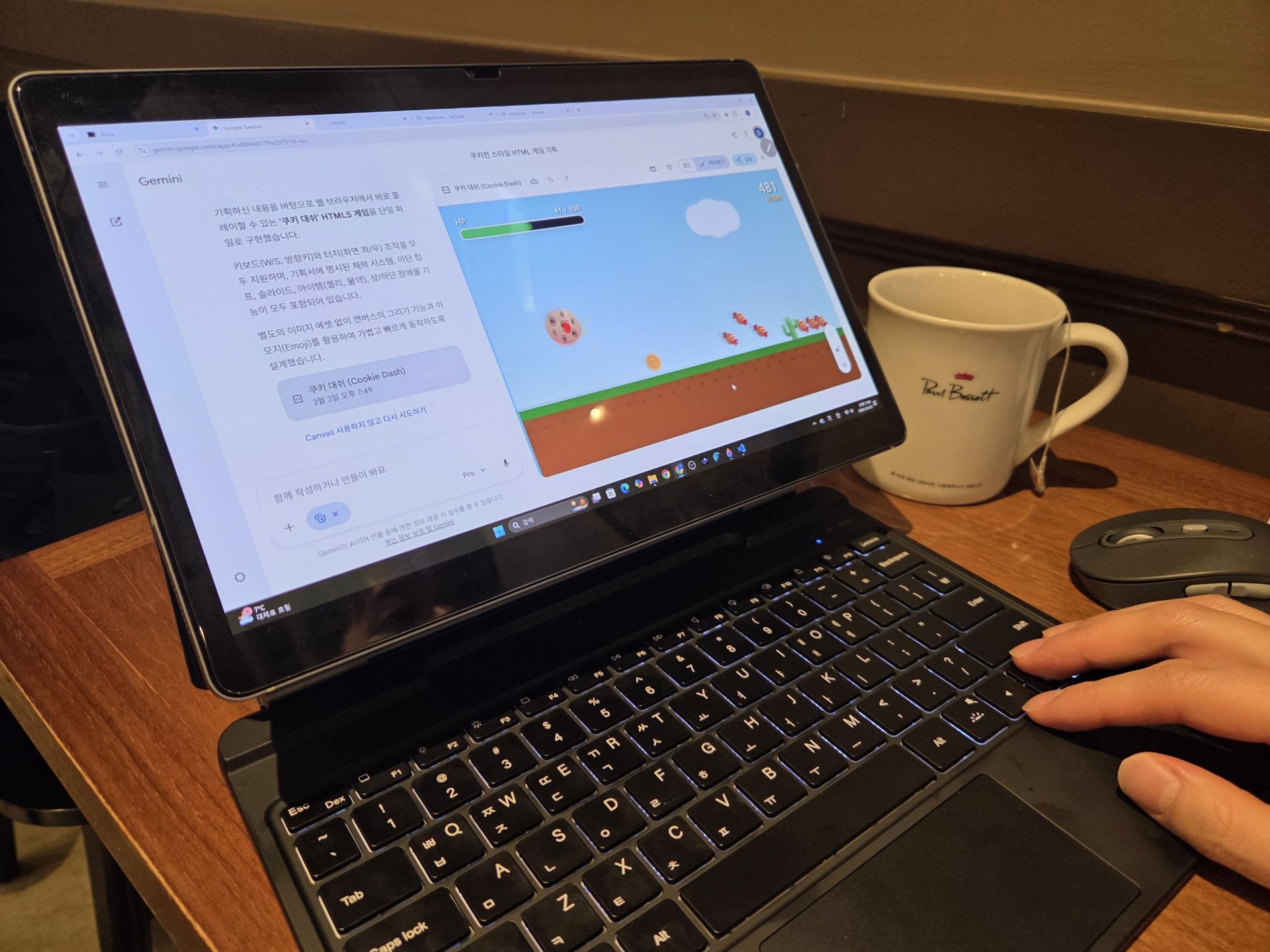
As he repeated the process several times until producing satisfactory results, he became interested and started trying Vibr Coding in various fields. Mr. Kim currently runs a YouTube channel called 'Smart Daddy,' which guides people to easily access Vibr Coding.
Photo by Kong Byungseon
Photo by Kong Byungseon
On March 3, Mr. Kim demonstrated the process of creating a game using vibe coding to this reporter. When he told Google’s generative AI model Gemini, “I want to create a game like Cookie Run by Devsisters. Please write a detailed game design document,” Gemini immediately generated a detailed plan. Then, when he asked, “Based on the plan, please create a playable game right now,” a game where a cookie jumps over obstacles was created in an instant. The entire process took just five minutes. Recently, Mr. Kim even created a game similar to Super Mario for his 8-year-old son.
"There are educational games for children
on the market, but they're expensive.
Now, I can make those games myself.
In the future, I want to continue making things using vibe coding
and show the process of experimenting with new content."
Vibe Coding, Breaking Down Communication Barriers

Hyerin Kim, CEO of Opark (second from the right), is holding a meeting with team members after giving work instructions to the AI. Kim said that the AI demonstrated the capabilities of about four developers, enabling simultaneous work on multiple projects. Photo by Dongjoo Yoon
원본보기 아이콘The most decisive change brought by vibe coding is the removal of communication barriers in the workplace. Yeonsu Jung (33, female), who works on video and design planning at OPark, has no programming background but collaborates with developers to prepare product plans. Since prompts for vibe coding are essential when creating videos or images, she frequently communicates with developers. Jung said, “At first, I didn’t understand computer languages at all, but after using vibe coding, I’ve come to grasp the general workflow. I also have a better understanding of the content developers program.”
CEO Kim also emphasized that vibe coding has made workplace communication much easier. At OPark, there are no separate planning documents. They simply request vibe coding from AI and discuss the output. Feedback on work is not difficult. Since vibe coding reduces the intensity of work, both those giving and those receiving instructions feel less burdened. CEO Kim says that thanks to vibe coding, she has come closer to her dream of entrepreneurship. “I’ve wanted to start a business since high school, and the development of AI made it possible,” she said.
Vibe Coding in Two Hours... A Liberal Arts Reporter Creates an Investment Tendency Analysis Site
It took just two hours for this reporter, a liberal arts graduate with no ability to read computer code, to build a site that analyzes investment tendencies by combining Four Pillars of Destiny with MBTI (Myers-Briggs Type Indicator) personality types. This was made possible thanks to vibe coding, where you write code and program by conversing with AI.
The tools used were OpenAI’s generative AI model ChatGPT and the programming-specialized model Codex. First, I asked ChatGPT, “I want to create a site using vibe coding that combines Four Pillars of Destiny and MBTI to analyze investment tendencies. What do you think of this idea?” ChatGPT responded, “It’s a good idea,” but also pointed out, “It’s risky to use Four Pillars of Destiny and MBTI as investment advice, so you should design it as exploratory content or a supplementary tool.” It also explained how the first screen should be structured and what features could attract users.
I then asked ChatGPT to list the investment tendencies for all 16 MBTI types and each Four Pillars of Destiny category. ChatGPT immediately provided a summary of each MBTI and Four Pillars type’s investment tendencies, strengths and weaknesses, suitable investment styles, and mistakes to watch out for.
Since I didn’t know much about designing UI/UX (user interface/user experience), I told ChatGPT about several sites I wanted to emulate. ChatGPT suggested a simple input and a results screen organized in a chart format. When I asked for a prompt to match this, it created “the final version” of the code. I also requested, “Please organize it so it can be used in Codex,” and ChatGPT modified the code accordingly.
Requested a site, and code was provided instantly... Automatically corrected any missing parts
After that, I moved the code from ChatGPT to Codex. Codex not only writes simple code but also specializes in the entire development process, such as fixing errors and organizing files. I put the code written by ChatGPT into Codex and asked, “Is there anything missing?” Codex responded, “It’s solid enough to build right away, but you should add the range for Four Pillars calculations and clarify the use of gender,” and provided new code.
I asked Codex to create a site accessible to others but without any operating costs. Codex explained, “The easiest method is to deploy it via a site called Vercel.” It also recommended signing up for a site called GitHub. The problem was that I was hearing about Vercel and GitHub for the first time, and the terms were unfamiliar. Codex explained every step, but as a liberal arts graduate, it was difficult to understand. So I started taking screenshots of every screen and asking Codex for help.
Codex’s answers became even simpler. Codex would say, “You don’t have to touch anything else here” or “Click the button on the upper left of the site,” making it easy for beginners to follow. Worried that I couldn’t undo changes if I made a mistake, I took screenshots of the screen every time something changed and asked again, but Codex never got irritated and kindly answered everything.

On the 24th of last month, a reporter from this publication conducted vibe coding using OpenAI's generative AI model 'ChatGPT' and the programming-specialized model 'Codex.' Through vibe coding, a site analyzing investment tendencies by integrating Four Pillars astrology and personality type tests (MBTI) was created.
원본보기 아이콘Even with no prior knowledge, no frustration—and a site was born in just two hours
Following Codex’s instructions, a new link was created. A blue-background investment tendency analysis site, “Your Investment Tendency, Guided by the Harmony of East and West,” was born.

On the 24th of last month, a reporter from this publication was performing Vibe coding through OpenAI's generative AI model 'ChatGPT'. ChatGPT screenshot
원본보기 아이콘After entering my name, date and time of birth, and MBTI, the investment tendency analysis appeared. The result classified me as a “principle-centered analyst.” The site also included a feature for sharing analysis results with others, letting people share their investment tendency with friends. From planning to deploying a new investment tendency analysis site, the process took just two hours. Even a liberal arts graduate with no knowledge of complex computer languages was able to turn an idea into a finished product through vibe coding.
Of course, there were clear limitations. If a fatal error occurred in the AI-generated code, non-technical users could be at a loss to find and fix the cause. There was also some unease about reaching the goal relying entirely on AI’s guidance, without understanding how development tools like Vercel or GitHub actually work. However, it became clear that the ability to plan—what to instruct AI to do and how to design it—has become more important than simply writing code.





![[Report] A 'Second Brain' for a 60-Year-Old Refinery... SK Ulsan CLX's AX Experiment](https://cwcontent.asiae.co.kr/asiaresize/304/2026091510511728722_1789437077.jpg)