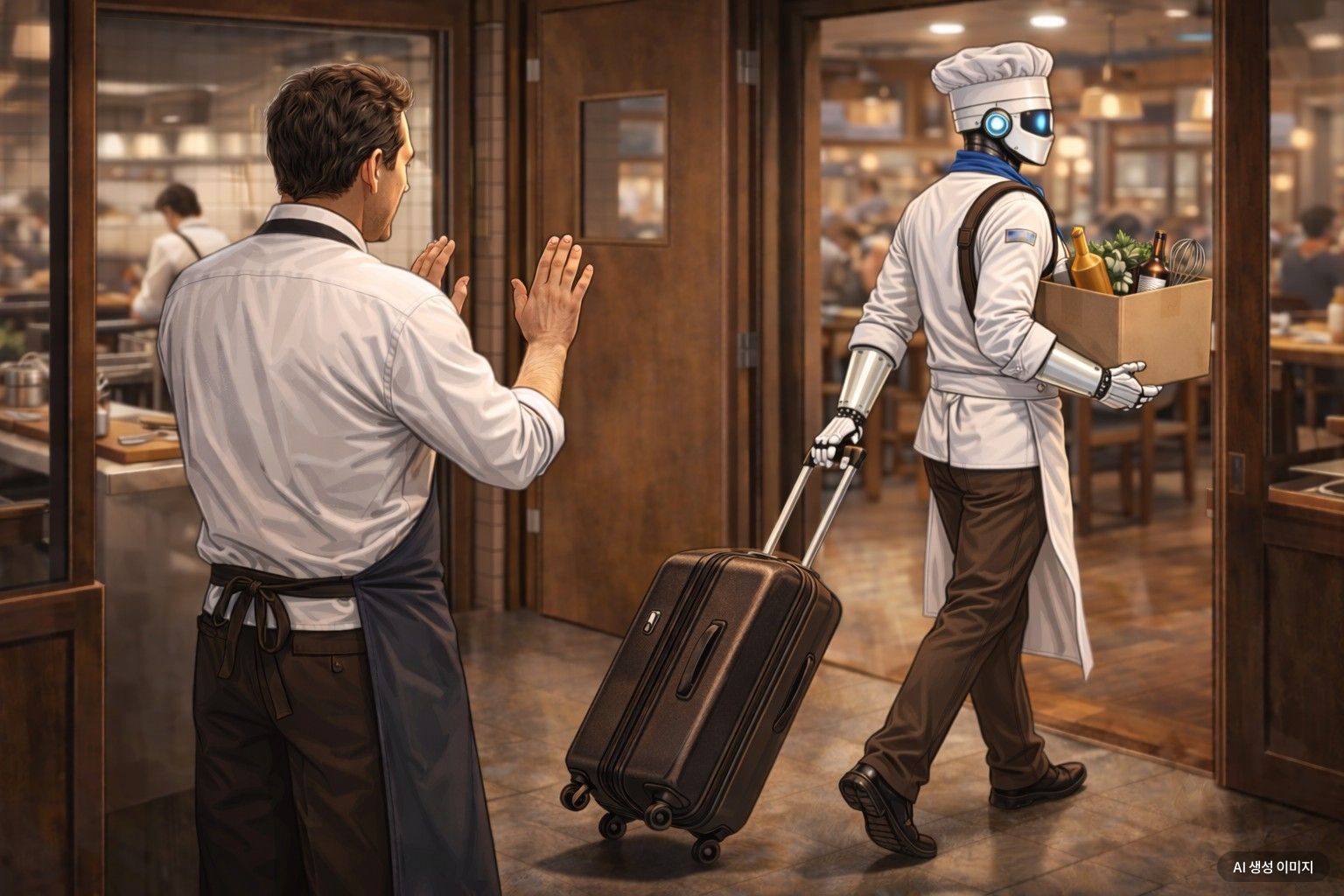
Cooking robots, still in their infancy, clearly represent a market with limitless potential. With rising labor costs, labor shortages, and increasing demand for standardization, there are high expectations that this is the 'future that will inevitably come.' However, the sentiment in the field has been lukewarm. Most small business owners remain hesitant, and even major franchises that have pushed for commercialization have not achieved significant results. In other words, while the technology is promising, the market is far from easy to penetrate.
Small Business Owners: "It's convenient, but... labor costs haven't changed"
Mr. Lee Jaesik (42, male) considered introducing a collaborative robot (a robot designed to directly interact and work alongside people in the same space) in 2023 to help his parents, who have run a Gukbap restaurant in Chungju, North Chungcheong Province, for 30 years. The decision was influenced by his parents' age and the difficulty in hiring staff. After searching through small business owner communities, he even discussed business plans with a collaborative robot company, but it never materialized into actual use.
Lee explained, "At the time, there was no dedicated collaborative robot for Gukbap, so I would have had to buy a robotic arm and then set up separate software." He continued, "Just the robotic arm alone cost between 40 million to 50 million won, and if you add the space required in the kitchen and renovation costs, it was just too much of a burden, so I gave up." As a result, the kitchen staff has remained the same as before.

Mr. Shin, a business owner in his 40s who operates a Mexican restaurant, returned the automatic stir-fryer 'RoboCook' after trying it out. While it was convenient for stir-frying 2–3 kg of meat at a time, as business picked up, it actually became a burden, reducing operational efficiency. Changing the menu required swapping and cleaning the wok, which delayed food delivery during peak times.
The main issue was labor costs. Although RoboCook was convenient, it was not enough to replace staff. Shin said, "After introducing RoboCook, the work became a bit easier, but not to the extent that I could reduce staff," adding, "I didn't see enough labor cost savings to justify spending several million won." On top of that, since the franchise provides a 'one-pack system' (where ingredients are pre-processed and supplied in individual packs), he did not see the need to use RoboCook.
"Commercialization Still Distant..." Cooking Robot Results Remain Minimal
Although the potential market is large, cooking robots have been slow to gain traction as business owners do not perceive a return on investment. The performance of cooking robot developers has also been modest. According to the Korea Fair Trade Commission’s franchise information system, the number of 'Robert Chicken' franchise stores operated by cooking robot company Robot Arte increased from eight in 2022 to nine in 2023, but dropped to six in 2024. As of the 25th, only three franchise locations are listed on the Robert Chicken website. Robert Chicken touts itself as a store that can be run by a single owner using the deep-frying robot 'Robert-E.' The franchise headquarters recorded an operating loss of 3.34 million won in 2022, a loss of 4.28 million won in 2023, and a loss of 1.33 million won in 2024. Attempts to contact Robot Arte for comment were unsuccessful.

Major franchises' utilization of robots is also stagnating. KFC signed a memorandum of understanding (MOU) with Hyundai Robotics in 2020 with plans to introduce a chicken-cooking robot, but nothing has been heard since. KFC stated, "At the time, the collaboration with Hyundai Robotics was to review the efficiency and automation possibilities in store operations, but this did not move to actual application in stores." The company added, "However, we continue to review the possibility of adopting various technologies."

Kyochon Chicken likewise signed an MOU with the robot manufacturer Neuromeka in 2021 to develop a frying robot. The company is expanding by introducing the robot in overseas stores, but performance in domestic stores remains limited. Currently, only 23 domestic locations have the robot installed. According to the DART electronic disclosure system, as of last year, Kyochon Chicken had a total of 1,362 stores, meaning only about 1.69% of stores have adopted the robot.
Experts: "Need to Consider Small Business Owner Environments... Customized Robots Also Needed"
Experts commonly point out that, along with technology, structural and environmental factors need to be addressed. Overcoming the entry barriers for small business owners is the top priority, but the frequent replacement and low skill level of part-time employees make this challenging. Park Suhan, a professor in the Department of Robotics at Kwangwoon University, said, "It's cumbersome and inefficient for part-time workers, who change frequently, to continually learn how to use and maintain cooking robots." He added, "While cooking robots are convenient, they are not yet enough to replace people, so there is little incentive for small business owners to use them."
Cha Namsu, head of policy at the Korea Federation of Micro Enterprises, pointed out, "Securing space and additional costs are required, and since there are still no customized robots tailored to each business, the robots do not meet the exact needs of small business owners."

Quality improvement is also a key issue. Jo Sungkeun, Principal Investment Manager at Capstone Partners, said, "If you look at the spectrum of kitchen robots, they are somewhere between industrial process equipment and home appliances." He continued, "Given the high-quality standards for home appliances, kitchen robots should demonstrate equally high quality." The certification system for hygiene and safety of cooking robots is still in its early stages. Only ten products have passed the certification system in the approximately 16 months since the Ministry of Food and Drug Safety began its pilot project for safety management certification. The safety management standards are based on the internationally recognized NSF standards.
Changing Labor Market in the Service Industry... Concerns Over Polarization Among Small Business Owners
Even if cooking robots eventually overcome various hurdles and become established, a range of issues may arise. There are concerns that changes in the labor market could fundamentally alter the structure of restaurant startups.
First, the number of simple kitchen staff may decline while maintenance and operations staff increase. In this case, it is questionable whether existing staff will simply move to new roles, maintaining labor demand. Kim Sunghyuk, Director of the Korea Labor Institute, pointed out that if the speed and precision of cooking robots improve and adoption increases over the long term, policies for workers who are replaced will be necessary. Kim said, "As robots make jobs less secure, society needs to consider policies to help those affected find new fields or retrain for robot and ICT-related jobs." He added, "Rather than robots replacing humans, there should be social discussions about implementing robots in a collaborative way from the outset."

Additionally, the gap between small business owners may widen further. Unlike in the past, higher initial equipment investment costs will increase entry barriers, while the trend toward standardized and homogenized food could intensify competition among brands. Since brand marketing competition ultimately comes down to spending, concerns about polarization—where businesses start from very different starting lines—remain. Park Sumin, Associate Research Fellow at the Korea Labor Institute, said, "If cooking robots become established after overcoming several prerequisites, polarization of services could occur depending on each store's goals." She added, "If complete automation is pursued, labor could be replaced, but for example, if the robot handles the initial grilling and the human staff provides tableside meat-cutting service, it could justify higher service prices."
IndexHeungbaek Yori Bot
- Labor Replacement? "A Burden"... Robot Chefs Packing Their Bags
-

Reporter Hwang Seoyul chestnut@asiae.co.kr
-

Reporter Park SeungUk ty1615@asiae.co.kr
-
Edit Kim Yumi ymkim91@asiae.co.kr
© The Asia Business Daily. All rights reserved. Unauthorized AI training and use prohibited.