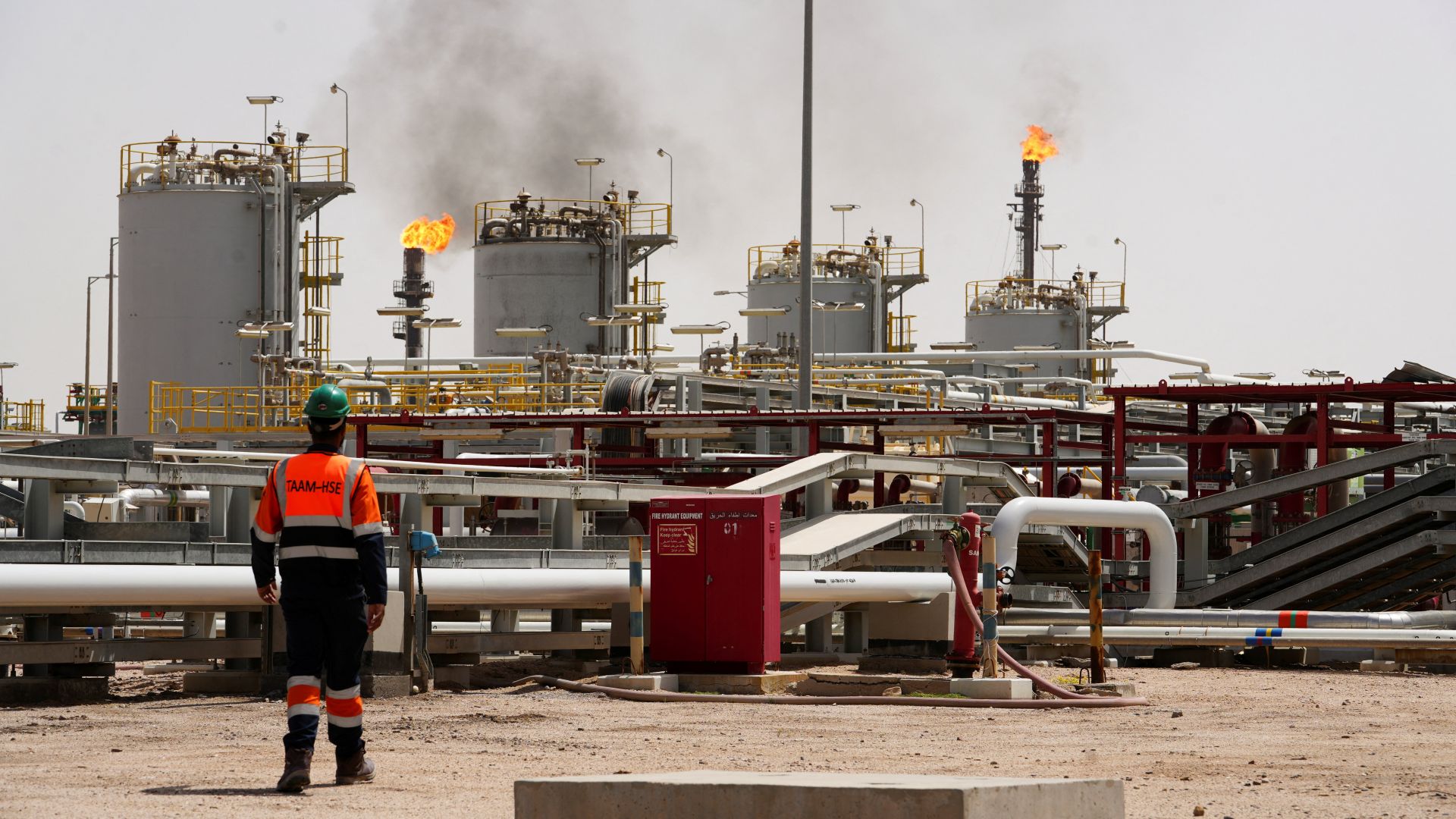
Due to the aftermath of the war among the United States, Israel, and Iran, crude oil production by major members of the Organization of the Petroleum Exporting Countries (OPEC) sharply declined last month.
According to a survey released by Bloomberg on April 7 (local time), OPEC member countries produced an average of 22 million barrels of crude oil per day in March, a decrease of 7.56 million barrels per day. This marks the largest monthly drop since Bloomberg began compiling data in 1989.
Average Daily Production of 22 Million Barrels in March Due to Iran War... Decrease of 7.56 Million Barrels
Numerically, this decline surpasses the reduction seen during the first oil shock in 1973. According to Daniel Yergin, Vice Chairman of S&P Global and a world-renowned energy expert, from October to December of that year, there was an average daily supply loss of 5 million barrels. At that time, however, the overall size of the global oil market was much smaller than it is today, making a direct comparison difficult. In absolute terms, the current decrease is larger, but the impact on the market was greater during the first oil shock.
The survey found that Iraq, which is most dependent on the Strait of Hormuz, saw the largest decrease in production. Its daily output fell by 1.13 million barrels, from 2.76 million barrels to 1.63 million barrels. While Iran announced that Iraq would be exempt from restrictions on transit through the Strait of Hormuz, Bloomberg reported that Iraq has not yet shown any movement to resume passage through the strait.

A customer is refueling at a gas station in Miami, Florida, USA. Photo by Getty Images / Yonhap News
원본보기 아이콘Next to Iraq, Saudi Arabia and the United Arab Emirates (UAE) saw significant decreases in production. Saudi Arabia's daily output dropped by 2.07 million barrels to 8.36 million barrels, while the UAE's production fell by 1.44 million barrels to 2.16 million barrels. However, these countries managed to offset some of the losses by exporting a portion of their crude oil through alternative pipelines that bypass the Strait of Hormuz.
Iraq’s Daily Production Down by 1.13 Million Barrels... Large Drops Also in Saudi Arabia and UAE
On April 5, OPEC and non-OPEC oil producers, collectively known as OPEC+, agreed to increase production starting in May. However, it is expected to take considerable time to resume operations at oil facilities damaged by the war. Additionally, Russia, a key OPEC+ member, is experiencing export disruptions due to Ukrainian drone attacks targeting oil export terminals along the Baltic Sea.
As supply disruptions persisted, Brent crude for June delivery briefly surpassed $118 per barrel last month on the London ICE Futures Exchange.
However, crude oil prices plunged below $100 per barrel as the warring parties, the United States and Iran, agreed on a two-week ceasefire and the reopening of the Strait of Hormuz. As of 9:40 a.m. (Korean time) on April 8, the price of June Brent crude was down 9.41% from the previous session, trading at $95.24. The price of West Texas Intermediate (WTI) crude for May delivery was trading at $97.03, down 14.09% from the previous session.
-

Reporter Oh Suyon syoh@asiae.co.kr
-
Edit Lee Kijae happylee17@asiae.co.kr
© The Asia Business Daily. All rights reserved. Unauthorized AI training and use prohibited.