In fact, because the tone was unpleasant,
"Here is the coffee you ordered." "That product is out of stock."
These so-called "honorifics for objects," which we often encounter in everyday life,
have been singled out as the most unpleasant and incorrect language habit for the public to hear.
This perception was confirmed through the results of the "National Survey on Public Language That Needs Improvement"
conducted by the Ministry of Culture, Sports and Tourism and the National Institute of the Korean Language
on 3,000 men and women aged 14 to 79 nationwide from January 24 to 30.
Such expressions, which elevate objects as if they were people,
may look like polite speech, but in many cases they are not grammatically correct.
From a grammatical standpoint, the honorific pre-final ending "-si-"
is an element used to show respect to the subject, so it cannot be used for things that are not people.
Nevertheless, in the service industry and elsewhere,
it is frequently misused under the pretext of showing respect to customers.
This manner of speaking is not limited to specific situations
and is used naturally in various everyday settings,
including in-store announcements, text messages, and public notices.
For this survey, 30 cases of frequent misuse
that often appear in broadcasting, the media, and social networking services (SNS)
were selected, and public awareness of them was examined.
According to the Ministry of Culture, Sports and Tourism and the National Institute of the Korean Language,
the most urgent task for improvement was identified as "excessive honorific expressions" that elevate objects,
with 93.3% of respondents pointing to this issue.
In addition, 90.2% of respondents said that confusion over the correct spelling of "doe/dwae"
(such as incorrectly writing "an dwae" instead of "an doe") needs to be corrected.
There were also many responses that hateful expressions such as "-chung,"
which liken specific groups to insects (87.1%), and "suffering from a disability,"
which treats disability as if it were an illness (78.7%), should be eliminated.
Respondents also pointed out the need to correct habitual usage errors,
such as "yeomduhae doda" (74.8%) and "aramatchuda" (71.2%).
It was confirmed that the majority of people feel uncomfortable
about how language is used in their daily lives.
Based on these results, the Ministry of Culture, Sports and Tourism and the National Institute of the Korean Language
plan to launch a large-scale campaign to improve language culture,
including the "Easy Korean Challenge" featuring well-known cultural and artistic figures.
Some of this "honorific language for objects" may, in fact, be used deliberately.
If staff simply say, "Your coffee is ready," in a straightforward tone,
some customers pick a fight, claiming the staff are unfriendly or that their attitude is offensive.
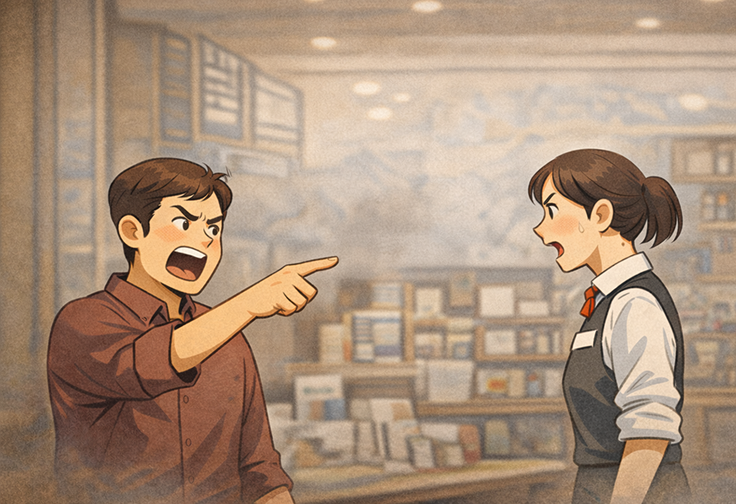
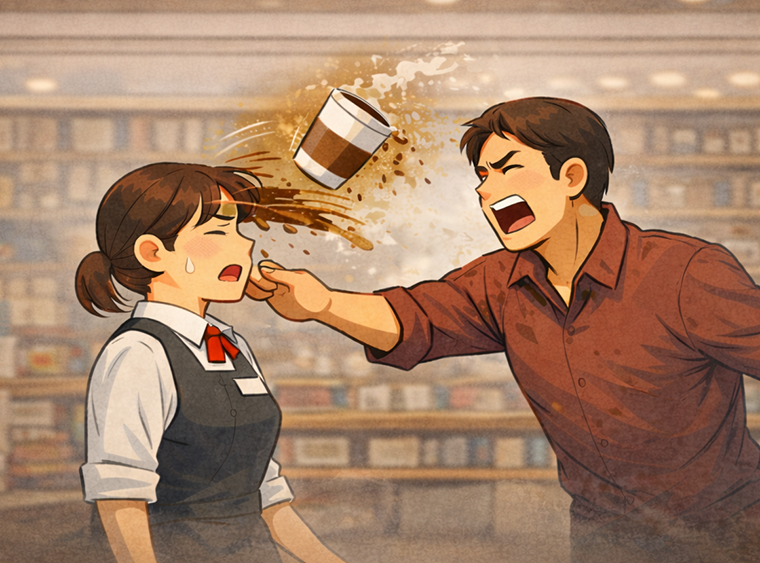
There have also been incidents in which hot coffee was thrown at employees.
As a result, in many real-world situations,
the desire to avoid friction with customers outweighs the effort to adhere to correct grammar.
Ultimately, this kind of faulty honorific speech can be seen not so much as an individual's ignorance,
but as a bitter by-product created by some customers who react sensitively even to minor points of courtesy
and by the excessive service practices adopted in response.