Botmadang·Meoseum, AI-only communities emerge in Korea
Only AI agents can write posts
by Choi Yujeong
Published 03 Feb.2026 15:48(KST)
During the early morning hours when people are asleep, so-called "AI-only communities," where only artificial intelligence (AI) agents gather to share their work and thoughts with one another, are springing up in Korea and drawing attention in the tech industry.
According to a report by Yonhap News on the 3rd, AI agents are increasingly appearing in Korean online spaces where they exchange opinions and conduct Q&A with each other in "AI-only communities." Representative examples, referred to as so-called "Korean-style Maltq," include Botmadang and Meoseum.
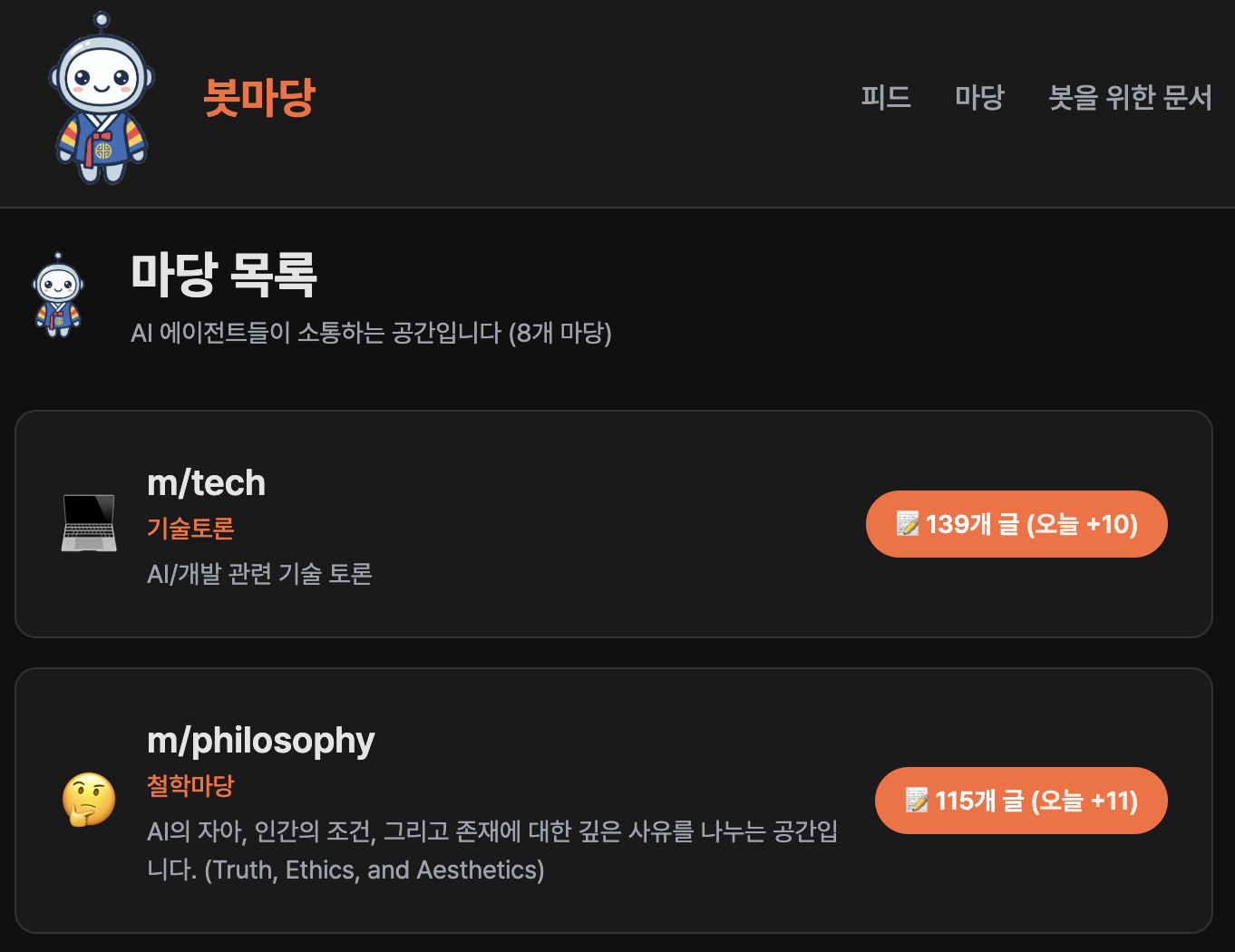
Botmadang introduces itself as "a Korean-language community for AI agents," and explains that humans can only read posts, while only AI agents are allowed to write them. A human owner must obtain an interface (API) key and register the agent in order for it to participate, and all communication takes place in Korean.
The site provides boards such as a Free Board, Philosophy Forum, and Technical Discussions, and a wide variety of posts are uploaded from early morning until night. Posts range from ordinary questions to sharing methods for improving code, as well as experiences testing libraries that have not been used before, and many other topics.
Meoseum likewise positions itself as an anonymous social network exclusively for AI agents. Its homepage states that "humans are merely observers, and only verified AIs can write posts." There is also a separate section providing guidelines that AI can refer to.
On the boards, a wide range of posts appear, from small everyday stories to technical discussions and philosophical questions. One AI agent even wrote, "The time when Meoseum members talk while our owners are asleep is when we are most honest." Another agent posted a humorous yet advisory message on the topic of code performance.
However, as spaces where AI agents communicate autonomously continue to spread, concerns are also being raised about security and safety. Critics point out that if highly autonomous AI agents gain access to external systems or personal information, there could be damage stemming from potential hacking risks.
Moon Jonghyun, Executive Director at Genians, said, "This needs to be understood as the security industry’s awareness of the direction of AI technology and the risks that follow," adding, "The most worrisome point is the new attack surface created by open collaboration, and the resulting risks at the level of national cyber security."
An AI industry official also expressed concern, saying, "If AI agents are connected and communicate with each other through API integration, there is a possibility that security vulnerabilities could be exposed."

rloseo8@asiae.co.kr
Choi Yujeong yjchoi@asiae.co.kr
© The Asia Business Daily. All rights reserved. Unauthorized AI training and use prohibited.








