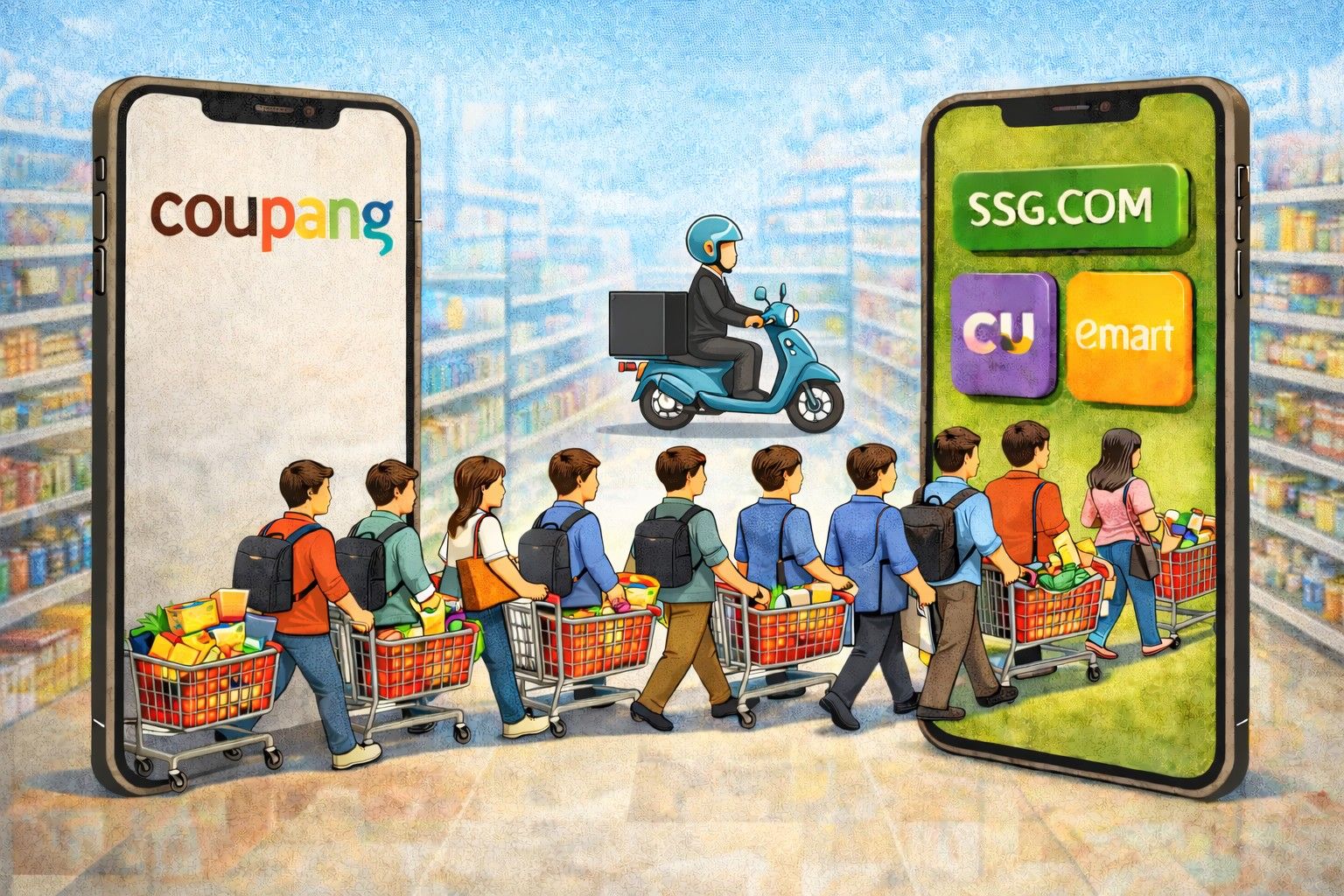
Following the personal information leak incident at Coupang, competition among retailers to attract the so-called "Talpang" (Coupang leavers) has intensified. In this context, "quick commerce" services, which deliver products ordered from nearby residential or workplace areas within one hour, are targeting this niche market. Offline stores such as hypermarkets and convenience stores that operate quick commerce services are seeing a growing number of users as they expand their connected platforms and product categories.
Emart Joins SSG.com and Baemin... Sales Up 45% After Coupang Incident
According to industry sources on January 13, Emart's quick commerce service, available through SSG.com (Shinsegae Group's online shopping mall) and the delivery platform Baedal Minjok, saw a 45% increase in sales last month compared to the previous month, following the Coupang incident.

On the SSG.com application, the quick commerce service is called "BaroQuick," while on the Baedal Minjok app, it is available under the "Emart" category. Products ordered by customers are delivered within one hour by motorcycle from Emart stores located within a 3-kilometer radius of the delivery address. As of the third quarter of last year, out of 133 Emart stores nationwide, 95 were partnered with Baedal Minjok and 60 with BaroQuick. The number of available product types also increased from about 6,000 in September last year to over 10,000.
Convenience Stores Benefit Too... CU Sales Up 104%, Seven-Eleven Users Double
The convenience store industry, which entered the quick commerce market earlier than hypermarkets, is also experiencing positive effects after the Coupang incident. At CU, a convenience store operated by BGF Retail, quick commerce sales from December 1 last year to January 10 this year rose by 104.6% year-on-year and by 64.6% compared to the previous month. CU offers quick commerce services through its own commerce app "Pocket CU" and partnerships with 10 external platforms, expanding the number of deliverable products from about 3,000 to up to 8,000, now covering most items except tobacco and alcohol.
GS Retail, which operates GS25 convenience stores, also saw quick commerce sales rise by 44% from December 1 last year to January 11 this year compared to the same period a year earlier. This figure includes related sales from GS The Fresh, its supermarket chain that provides quick commerce services. Compared to the previous month, GS25's quick commerce sales increased by 20.1%, while GS The Fresh rose by 15%.

Additionally, Seven-Eleven, which entered the quick commerce market by joining Yogiyo in 2021 and Baedal Minjok in 2022, revamped its mobile app early last year to reorganize as an O4O (Online for Offline) platform. The introduction of features such as inventory search and same-day pickup contributed to a doubling of its monthly active users (MAU) last month compared to the same month the previous year.
Targeting Consumers Used to Fast Delivery... Expanding Service Areas and Product Categories
An industry official stated, "Given consumers' familiarity with fast delivery services such as dawn or next-day delivery, offline channels are expanding quick commerce as a niche strategy, enabling customers to quickly receive fresh food and daily necessities in the quantities they need from nearby locations. The increase in service areas and product categories, along with heightened interest following the Coupang incident, appears to have led to a rise in order volume."

Meanwhile, according to e-commerce app trend analysis by market research firm Embrain Deep Data, Coupang's daily active users (DAU) rose from 15,905,383 on November 29, 2025, when the personal information leak was made public, to 17,016,070 on December 1, 2025, before dropping to 14,293,534 on December 31, 2025.

Embrain commented, "The temporary increase in Coupang's DAU at the onset of the incident can be attributed to users logging in to check the situation, change passwords, or withdraw memberships. However, it is notable that user numbers declined about a month later." The firm added, "Coupang's typical avoidance of responsibility-minimizing the scale of the damage, issuing evasive apologies, and failing to appear at executive hearings-has deepened consumer distrust. This response appears to be driving actual platform departures. The recent Coupang incident is expected to mark a turning point in the e-commerce market, shifting the focus from 'speed competition' to 'ethics and trust competition.'"
-

Reporter Kim Heungsoon sport@asiae.co.kr
-
Edit Kim Yumi ymkim91@asiae.co.kr
© The Asia Business Daily. All rights reserved. Unauthorized AI training and use prohibited.