
On the 22nd, at Hanwha Ocean in Geoje, Gyeongnam, the Navy Education Command's traditional Korean music band is taking a commemorative photo at the launching ceremony of the Jang Yeong-sil ship (Jangbogo-III, Batch-II No. 1 ship). The 3,600-ton Jang Yeong-sil ship has an improved underwater operation endurance compared to previous ships and is a world-class diesel submarine. 2025.10.22 Yonhap News Agency
원본보기 아이콘Construction at Hanwha Ocean's Philadelphia Shipyard... "Able to Achieve Both Goals"
With the path opening for the South Korean military to acquire nuclear-powered submarines, the defense industry is expected to become increasingly active. In particular, attention is focused on Hanwha Ocean, as U.S. President Donald Trump has pointed to Hanwha's Philadelphia Shipyard in the United States as the site for building nuclear submarines, raising the possibility that Hanwha Ocean could benefit from this development.

On October 30, industry insiders and experts analyzed that if Hanwha Ocean builds nuclear-powered submarines at the Philadelphia Shipyard, it could achieve both goals: the revival of the declining U.S. shipbuilding industry and South Korea's acquisition of nuclear-powered submarines. Experts predict that, given South Korea's world-class nuclear technology, it could complete the construction of nuclear-powered submarines within a few years, provided it receives formal approval from the United States. With the development of small modular reactors (SMRs), understanding of reactor miniaturization technology has improved, and it is expected that the development period will be significantly reduced compared to the past.

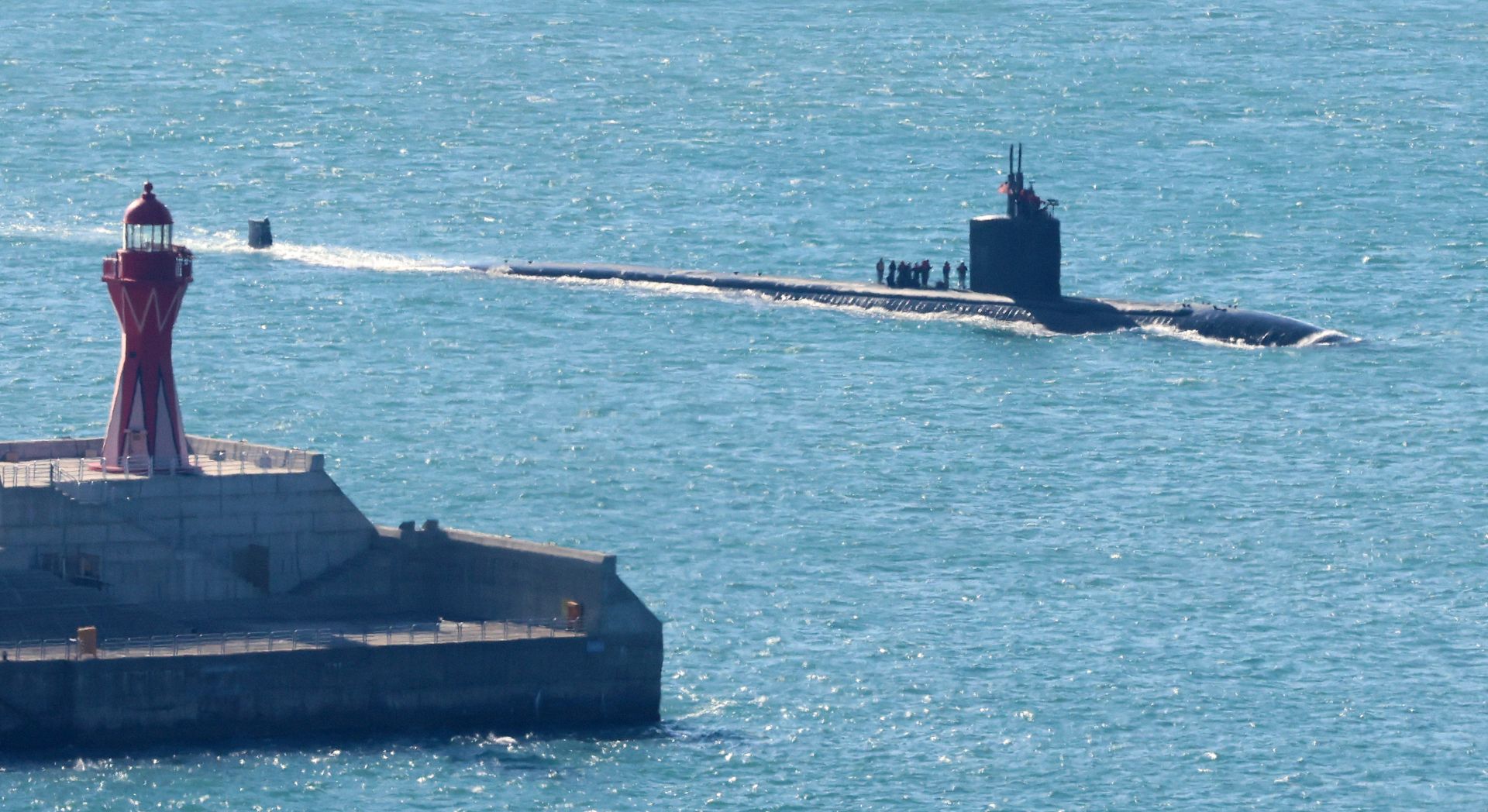
The 2025 Republic of Korea Navy Fleet Review, commemorating the 80th anniversary of the Navy's founding, was held last month off the coast of Busan. The event featured 31 naval vessels, including the Navy's Aegis destroyers (DDG), 3,000-ton submarines (SS-III), large transport ships (LPH), and landing ships (LST-II). Additionally, 18 aircraft from the Navy, Marine Corps, Army, Air Force, and Coast Guard, as well as unmanned surface vessels and unmanned aerial vehicles, participated in the maritime parade and training demonstrations. September 26, 2025. Yonhap News Agency
원본보기 아이콘ADD Has Been Conducting Research for Years, Study to Be Completed by End of Year
The Agency for Defense Development (ADD) has reportedly been conducting research projects related to nuclear-powered submarines in collaboration with domestic shipbuilders for several years. The research results are expected to be finalized as early as the end of this year. As a result, the next-generation submarine acquisition project, "Jangbogo-III Batch-III," planned by the South Korean military, is highly likely to be a nuclear-powered submarine rather than a conventional one.
The military estimates that the cost of building a nuclear-powered submarine will exceed 2 trillion won per vessel. The U.S. Virginia-class nuclear-powered submarine costs about 3.6 trillion won, the latest British Astute-class attack submarine costs 2 trillion won, and the French Barracuda-class (Suffren-class), known as the model for South Korea's nuclear-powered submarine, costs around 1.6 trillion won. A shipbuilding industry official said, "Based on the research results, we expect to design a large submarine of at least 4,000 to 5,000 tons and develop a small reactor as its power source."

The South Korean and U.S. navies conducted tactical maneuvers during a joint maritime exercise in the East Sea last May to establish an immediate response posture against maritime provocations and to enhance joint operational capabilities. From the front left based on the ship's maneuvering direction, the vessels are a submarine (SS-II), the U.S. Navy USS William Lawrence (DDG), ROKS Yulgok Yi I (DDG), ROKS Yang Manchun (DDH-I), ROKS Dae Jo Yeong (DDH-II), ROKS Gwanggaeto the Great (DDH-I), and ROKS Daegu (FFG-II). May 11, 2025. Photo by Yonhap News Agency
원본보기 아이콘The Key Issue Is Revising the South Korea-U.S. Nuclear Agreement... Also Possible to Import Fuel from the U.S.
However, in order to build nuclear-powered submarines, the South Korea-U.S. nuclear agreement must be revised. Article 11 of the agreement stipulates that "any transformation of nuclear material, such as enrichment or reprocessing, must be agreed upon through high-level consultations between the two parties, and only uranium-235 isotopes with less than 20% enrichment may be produced." Furthermore, Article 13 states that "all nuclear material transferred or produced under the agreement shall not be used for research, development, or any military purpose related to nuclear weapons or nuclear explosive devices." This means that it is extremely difficult to introduce nuclear-powered submarines using not only highly enriched uranium but even low-enriched uranium (below 20%), effectively placing a "shackle" on such efforts.

As an alternative to revising the nuclear agreement, there is also the option of receiving the entire fuel assembly used in nuclear-powered submarines from the United States. While U.S.-style nuclear-powered submarines use highly enriched uranium with concentrations of 80-90% or more, it is believed that nuclear-powered submarines can be operated in South Korea using low-enriched uranium with less than 20% enrichment. In fact, France has already deployed nuclear-powered submarines using low-enriched uranium in actual operations.
-

Reporter Yang Nakgyu if@asiae.co.kr
-
Edit Sung Kiho kihoyeyo@asiae.co.kr
© The Asia Business Daily(www.asiae.co.kr). All rights reserved.