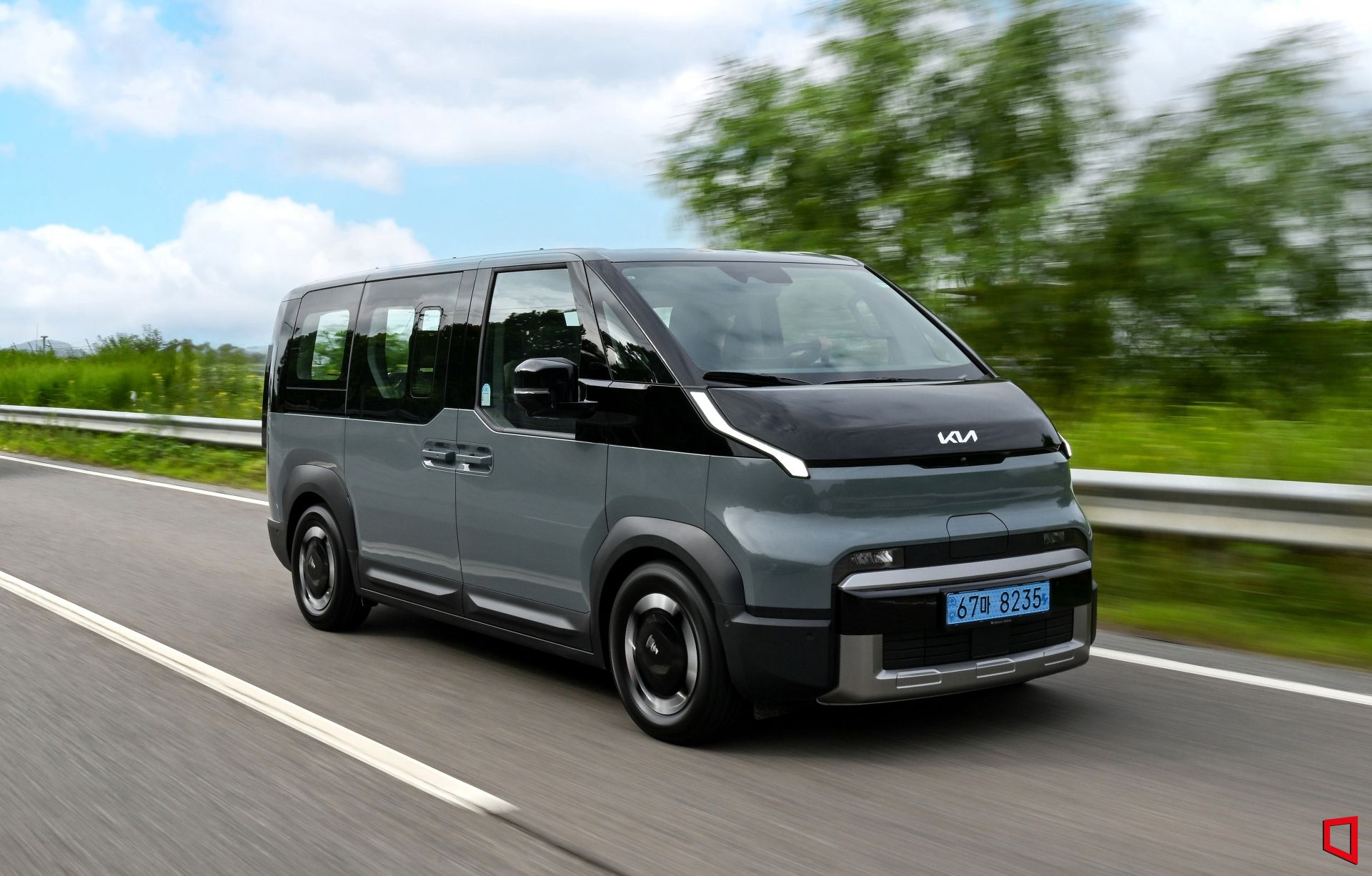
First 'Purpose-Built Vehicle (PBV)' to Be Delivered to Customers This Month
'The Kia PV5,' which Kia will begin delivering to customers this month, is the brand's first purpose-built vehicle (PBV). Its most notable feature is that drivers can customize the vehicle to suit their specific needs. The body, doors, and other components can be assembled like building blocks, allowing for more than 100 different combinations. On August 19, we test-drove the first two models to be released: the five-seater 'Passenger' and the 'Cargo' model with a spacious cargo area.
The exterior of the PV5 resembles other box-shaped vans. With a length of 4,695 mm, width of 1,895 mm, and height of 1,905 mm, it is more compact than the Kia Carnival (5,155×1,995×1,775 mm). It utilizes the PBV-exclusive electrification platform 'E-GMP.S,' resulting in a relatively short front engine bay, but with a lowered floor, making it easier to get in and out of the second row. The height from the ground to the second-row door step is only 40 cm (399 mm).
Kia designed the PV5 so that people of all ages can board and disembark comfortably, and the opening width of the second-row sliding door is up to 775 mm. This makes it convenient to load and unload even large items, and wheelchairs can also pass through.

First, I boarded the 'Passenger' model, which has two seats in the first row and three in the second row. Sitting in the driver's seat, the wide windows provided an excellent sense of openness. The second row also features reclining seats, making it comfortable to sit in. Additionally, there is a footrest behind the first-row seats, allowing second-row passengers to stretch their legs comfortably-a detail that shows thoughtful design.
The trunk capacity of the five-seater is 1,330 liters, which expands to a maximum of 2,310 liters when the second-row seats are folded down. There is ample space for both camping and car camping. Hidden storage spaces in the dashboard and under the first row further enhance space utilization.


When I started the car and pressed the accelerator, it began to drive smoothly, as expected from an electric vehicle. The PV5 is equipped with an electric motor that delivers a maximum output of 120 kW and a maximum torque of 250 Nm, along with a 71.2 kWh battery. This enables a driving range of 358 km per charge (energy efficiency: 4.5 km/kWh). On this day, I drove about 40 km from Ilsan KINTEX to Yeongjongdo, Incheon, achieving an energy efficiency of 5.3 km/kWh.
The driving performance on the highway was also sufficient. The acceleration typical of electric vehicles was evident in acceleration zones, and the wide field of view made driving comfortable.

On the return trip from Yeongjongdo to Ilsan, I drove the 'Cargo' model, which is characterized by a partition separating the driver's seat from the cargo area. The cargo space measures up to 2,255 mm in length, 1,565 mm in width, and 1,520 mm in height, allowing for a maximum load capacity of 4,420 liters. The trunk door opens up to 1,343 mm, making it possible to load pallets (1,100×1,100 mm) used in logistics operations. However, due to the partition, there is no rearview mirror, which made it a bit awkward not being able to check the traffic behind while driving.
The Cargo model will be available in two versions: a long-range model with a 71.2 kWh battery and a standard model with a 51.5 kWh battery. The maximum driving range per charge is 377 km (energy efficiency: 4.7 km/kWh) and 280 km (energy efficiency: 4.8 km/kWh), respectively. On the return trip, the energy efficiency reached 7.1 km/kWh.

Kia plans to introduce 'Kia Genuine Accessories' and 'Kia Addgear' as customization products for the PV5. The Genuine Accessories include tailored items such as a luggage flattening deck for car camping, LED tailgate lamps, and 'L-Track Mounting' systems that allow various items to be installed in the cargo area.
Addgear consists of modular items such as smartphone holders, multi-trays, trash bins, and hooks that can be attached to the vehicle. Both product lines fully embody the concept that consumers can build the car exactly as they want.

The price of the PV5, as the first PBV model, has been set aggressively. The Passenger model (individual consumption tax 3.5%) is priced at 47.09 million won for the Basic trim and 50 million won for the Plus trim. The Cargo model (tax-exempt) is priced at 42 million won for the Standard Basic trim and 44.7 million won for the Long Range Basic trim. After applying electric vehicle tax benefits and government and local subsidies, the Passenger model can be purchased starting in the 30 million won range, and the Cargo model from the 20 million won range. This makes it a highly cost-effective option.
Going forward, Kia plans to supply the PV5 to organizations such as Korea Post, logistics company DHL, pharmaceutical transport company GeoYoung, and Kakao Mobility. The model is perfectly suited to meet the needs of businesses seeking to electrify their commercial vehicles. It will be interesting to see if the PV5 becomes a versatile game-changer, not only for individual drivers but also across various transportation and logistics sectors.