Hyundai Rotem, First Test Drive of 30-ton Class Wheeled Armored Vehicle Revealed by a News Agency
The global defense industry market is witnessing a rising interest in armored vehicles. The primary purpose of an armored vehicle is to safely transport troops. In the early 20th century, armored vehicles were simple?regular vehicles reinforced with steel plates. However, they began to evolve, especially after the outbreak of the war in Ukraine. In June 2023, during an airstrike on the city of Orikhiv, the Ukrainian military deployed the elite M2A2 Bradley infantry fighting vehicle.
Russia responded with a counterattack, planting large numbers of anti-tank mines. Despite mine explosions, Ukrainian troops were unharmed, and footage even showed them walking out of the vehicles on their own. Defense companies around the world accelerated the development of armored vehicle technology, and so did the Korean defense industry. Hyundai Rotem developed a 30-ton class wheeled armored vehicle. To witness the first-ever test drive of this 30-ton class wheeled armored vehicle revealed by a news agency, we visited the Korea Automobile Testing & Research Institute (KATRI) in Hwaseong, Gyeonggi Province.
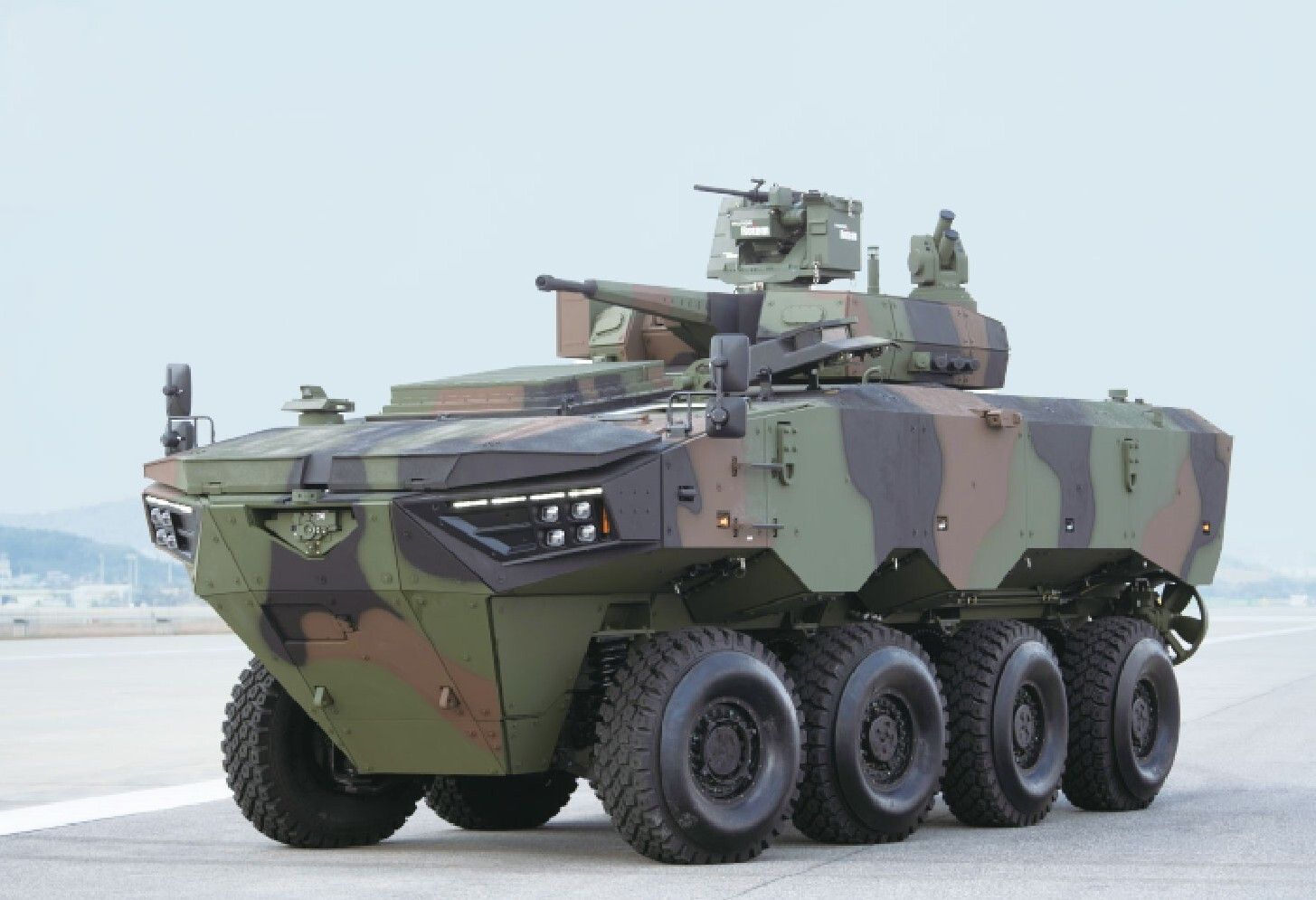
Length 9.3m · Width 3.1m · Height 2.8m Boasts a larger and heavier body than the K808 Equipped with 8 run-flat tires Operates normally even when punctured or on fire Safely passes 60% longitudinal slope and 40% lateral slope
High-performance water propulsion propeller activated Reaches speed of 10 km/h on water
Enhanced protection with 'Ballistic Protection Level 4' Unfazed even when hit by a heavy machine gun in combat
Researcher Jeong Jiseung "European export model Larger vehicle accommodates up to 11 passengers"
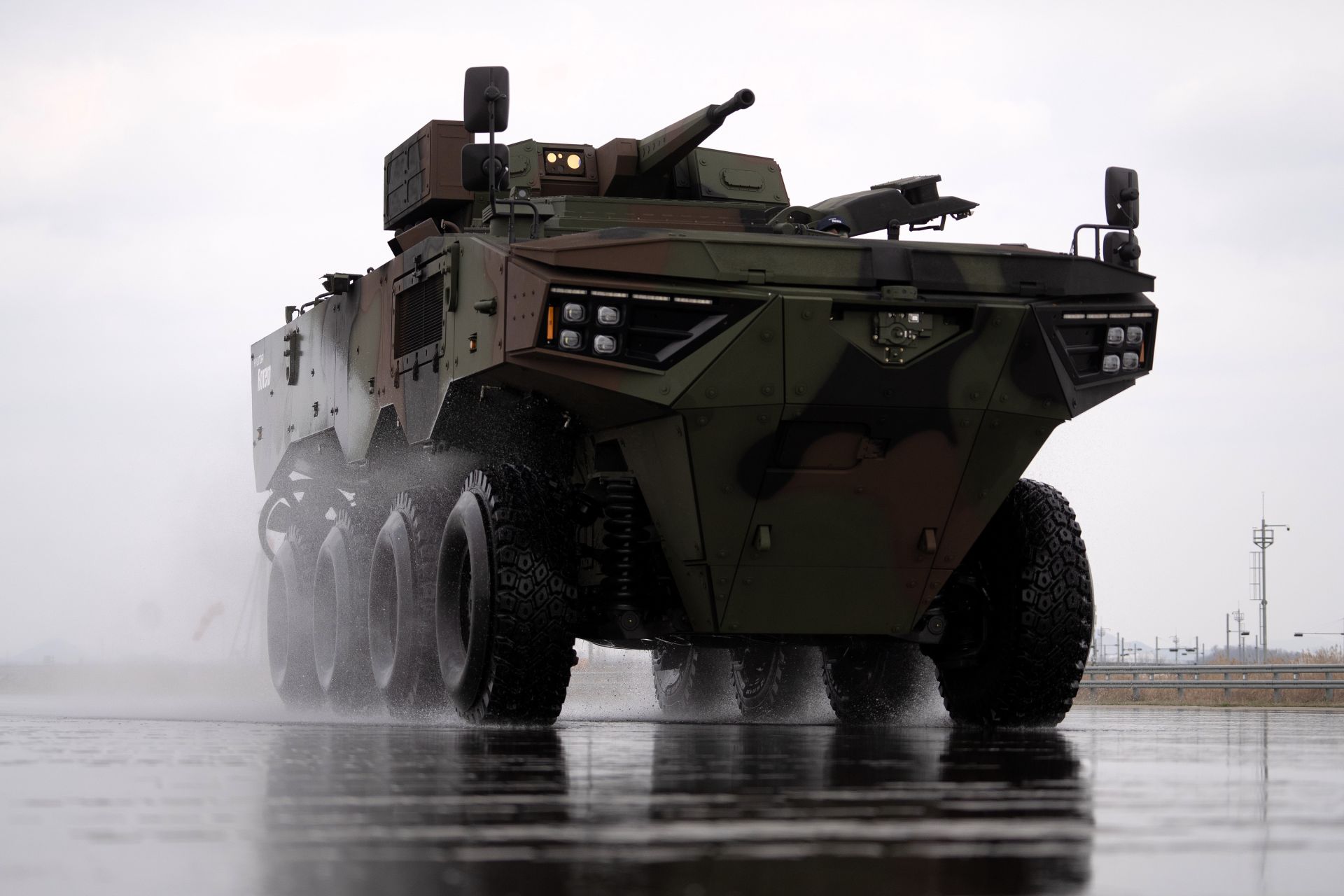
The 30-ton class wheeled armored vehicle was seen on a straight road, boasting a massive and imposing body. Each wheel alone appeared to be over 1 meter tall. The vehicle is equipped with a total of eight run-flat tires. Run-flat tires are specially designed to allow the vehicle to continue driving even if punctured by gunfire. Even if the armored vehicle hits a mine and the tires are damaged, it can travel 50 kilometers at a speed of 50 km/h. The vehicle can also operate even if the tires catch fire. Fire extinguishers are installed above each tire. Even if the drive shaft is damaged, the vehicle remains operable, as each wheel moves with its own independent drive system. This means that even if one or two wheels are severely damaged, the vehicle can still move.
The 30-ton class wheeled armored vehicle began its run. Upon ignition, it safely passed a 60% longitudinal slope and a 40% lateral slope. On flat ground, it easily exceeded a speed of 100 km/h. Observing the stationary 30-ton class wheeled armored vehicle (length 9.3m · width 3.1m · height 2.8m) up close, its size was overwhelming. It is larger than the K808 wheeled armored vehicle (length 7.4m · width 2.7m · height 2.3m) currently operated by the Korean military. The weight is 30 tons when equipped with a 30mm turret, but rises to 35 tons when fitted with a 105mm large-caliber turret for fire support roles. This is why it is called a 30-ton class vehicle. Its basic armament includes a 30mm autocannon and two anti-tank missiles.
The 30-ton class wheeled armored vehicle is also amphibious. While operating on wheels, it activates a high-performance water propulsion propeller when in water deeper than 2 meters. The propeller installed at the rear of the vehicle is designed as a duct fan structure, not exposed to the outside. Using a hydraulic system, it can reach speeds of 10 km/h on water. This is faster than the smaller K808 (27 tons, 8 km/h). The 30-ton class wheeled armored vehicle, clad in armor, also features enhanced protection. According to officials, it remains unfazed even when hit by a heavy machine gun in combat. Its protection level corresponds to NATO Standardization Agreement (STANAG) Ballistic Protection Level 4.
The vehicle can carry a total of 11 personnel, including eight infantry soldiers, a driver, a gunner, and a commander. Inside, monitors are installed above the seats, allowing real-time viewing of the battlefield environment outside the vehicle. In the driver's seat, a steering wheel bearing the Hyundai logo is visible. The driving method is not much different from that of a regular car. The monitors are equipped with front, rear, and side cameras, as well as an around-view function. The driver's seat is spacious, designed to accommodate larger European body types.
Jeong Jiseung, lead researcher of the armored vehicle systems team, stated, "The 30-ton class wheeled armored vehicle is an export model targeting the European market. As the vehicle has grown larger, it can now carry up to 11 passengers and offers improved convenience for occupants."
The Global Trend in the Armored Vehicle Market: Wheeled Vehicles for Rapid Movement on Asphalt
In the past, most armored vehicles were tracked because they needed to transport soldiers through rugged mountains or rough terrain. However, as cities developed, the situation changed. On asphalt roads in urban warfare, wheeled armored vehicles?like regular cars?are more suitable than tracked vehicles. Their weight has also increased. This is because anti-tank missile technology has advanced, requiring enhanced protection to safeguard troops.
According to British military intelligence company Jane's Yearbook, the market size for 30-ton class wheeled armored vehicles is expected to grow from $1.631 billion in 2020 to $7.28 billion by 2028, with an average annual growth rate of 22%. In contrast, demand for tracked armored vehicles has decreased, resulting in the overall armored vehicle market shrinking by -6% by 2028. This is one of the reasons Hyundai Rotem has embarked on the independent development of a 30-ton class wheeled armored vehicle.
Countries around the world are moving quickly. Notable examples include Germany's Boxer (41 tons), Israel's Eitan (35 tons), Finland's latest Patria AMV series (32 tons), and Russia's Boomerang (34 tons). With the shift to wheeled armored vehicles, deployment times to the battlefield have been reduced. In the past, transporting tracked armored vehicles over long distances required special transport trailers. In contrast, wheeled self-propelled artillery can travel hundreds of kilometers on its own. This enables rapid deployment to, and withdrawal from, the battlefield, and makes loading onto transport aircraft relatively easier.
The United States has already deployed next-generation wheeled armored vehicles. BAE Systems is supplying 22 next-generation Amphibious Combat Vehicles (ACV) to the U.S. Marine Corps, with a 2020 contract worth $184 million (approximately 200.9 billion won). This is the largest of the eight-wheeled armored vehicles operated by the U.S. military, accommodating a crew of three and 13 Marines. The weight has also increased to 30 tons, compared to the previous LAV-25 (12.8 tons) used by the Marine Corps. This means that both armor and armament have been enhanced, providing fragment protection armor. Despite the increased weight, speed is not compromised compared to earlier models. Equipped with a 690-horsepower diesel engine, it reaches a maximum speed of 105 km/h on land and 6 knots (11 km/h) at sea.
Israel introduced the Eitan wheeled armored personnel carrier (APC) from U.S. defense company Oshkosh Defense in 2022. The Eitan was developed to replace the M113 tracked armored vehicle, which the Israeli Army adopted in the 1970s. The prototype was produced in October 2015 and unveiled to the public in August of the following year. It is equipped with a remote-controlled turret capable of firing a 30mm autocannon and Spike-MR anti-tank missiles. The Eitan can carry a commander, a driver, an RCWS operator, and nine soldiers. Its engine is a 750-horsepower turbocharged diesel engine from Germany's MTU, with an automatic transmission from Allison in the U.S. The maximum driving speed is 90 km/h, and the maximum range is 1,000 km.
Ukraine has decided to jointly purchase the CV90 infantry fighting vehicle with the Czech Republic and Slovakia, as well as Sweden. The CV90 has been fitted with an additional 5 tons of armor, allowing it to withstand 30mm armor-piercing rounds from all directions. Its protection against anti-tank mines and improvised explosive devices has also been strengthened. Ukraine plans to procure 1,000 CV90 series armored vehicles in the future. Sweden also plans to upgrade the CV90, including the installation of the Israeli-made active protection system 'Iron Fist.'
Poland's new infantry fighting vehicle (IFV), the Borsuk, weighs well over 40 tons. However, following the outbreak of the Russia-Ukraine war, it has become difficult for the Polish military to produce as many armored vehicles as desired, leading to considerations of introducing or jointly developing the 'K Combat Armored Vehicle.' In June 2022, during a meeting of the entire Polish military command attended by President Andrzej Duda, a government official stated, "We (the Polish military) will purchase proven IFVs from Korea." Such remarks were made even before any formal contract had been signed with a domestic defense company, which was regarded as 'unusual' at the time.