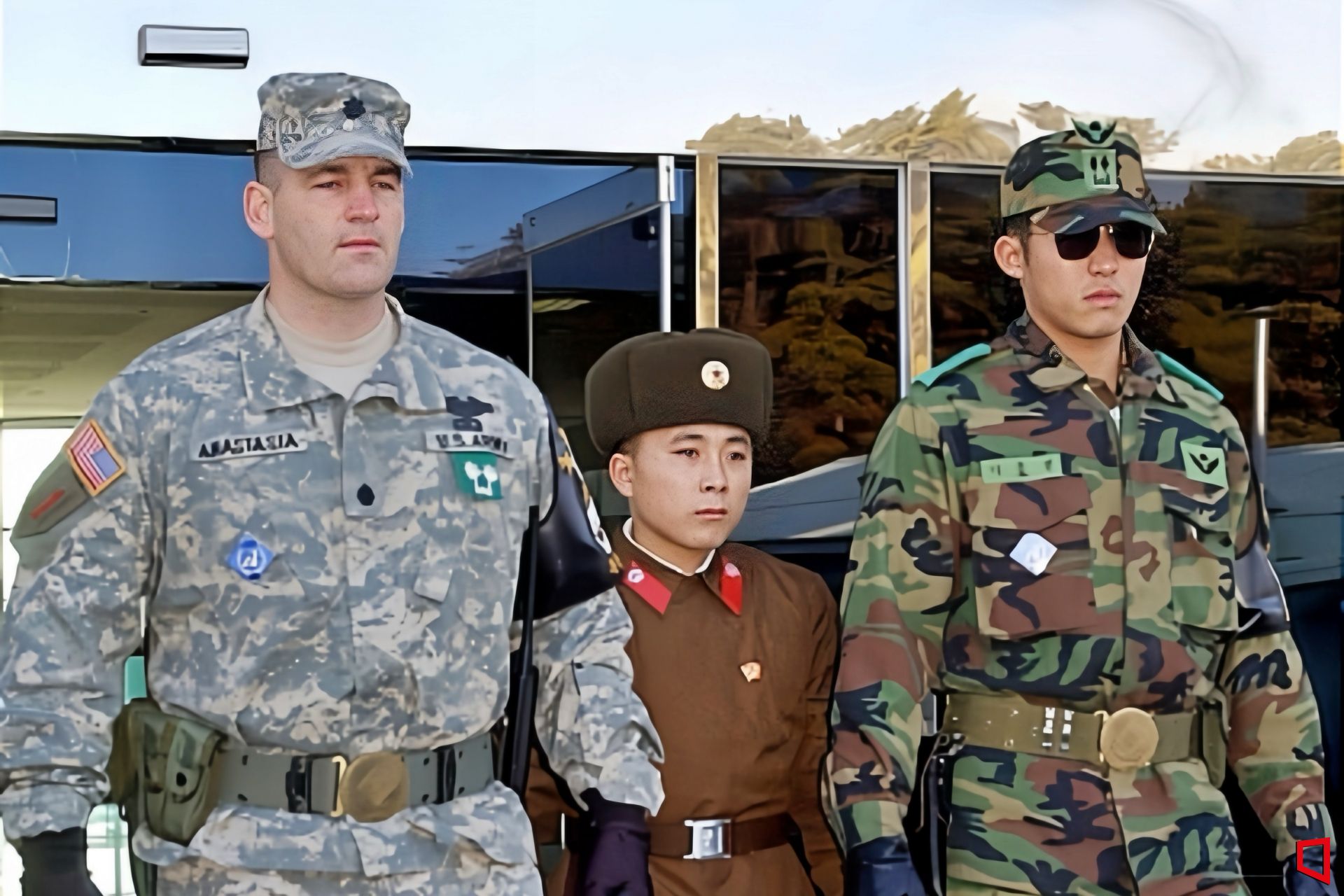
There is a photo from December 2006 that stirred up the internet. At that time, the United Nations (UN) Command repatriated two North Korean soldiers rescued in the East Sea. One of them, whose health was relatively good, walked back to the Joint Security Area (JSA) at Panmunjom, and his noticeably small stature stood out as he stood between US and South Korean soldiers.
There are exceptions, such as North Korea's proud female basketball player Park Jina (born 2003, height 205cm), and the ill-fated football player Han Gwangsong (born 1998, height 178cm), who once played for the prestigious Italian club Juventus. While it is difficult to generalize that "all members of the Jangmadang Generation are small," many studies suggest that growth problems are common.
![Soldiers visiting the Kumsusan Palace of the Sun in Pyongyang to commemorate the 81st anniversary of the founding of the North Korean People's Army in April 2013. [Image source=AP Yonhap News]](http://www.asiae.co.kr/news/img_view.htm?img=2024102815221276237_1730096533.jpg)
Soldiers visiting the Kumsusan Palace of the Sun in Pyongyang to commemorate the 81st anniversary of the founding of the North Korean People's Army in April 2013. [Image source=AP Yonhap News]
원본보기 아이콘Military enlistment height standard lowered to 137cm... Equivalent to a 10-year-old in South Korea
The characteristics displayed by the "Jangmadang Generation" themselves reveal the vulnerability of the North Korean regime. Not only have their mindsets changed, but the average height gap between young people in the North and South now exceeds 10cm.
On the 25th, the Korean Central News Agency posted a slew of staged photos featuring children from the Pyongyang Orphanage, proclaiming, "The orphans of Joseon, who receive the warm love and care of Comrade Kim Jong-un, are truly lucky children." But are the North Korean children, said to be under the leader's care, really growing up well? The North Korean authorities do not disclose any information about the average height, weight, or other physical statistics of their people. Even when international organizations request health data, the regime provides absurd figures, making it impossible to use them as reliable statistics.
The most telling indicator is the military enlistment standard. According to data released by the National Intelligence Service in 2005, North Korea changed its military exemption standards in the mid-1990s. Previously, those under 150cm in height or 48kg in weight were exempt from conscription. After the change, the standards were lowered to 148cm and 43kg. However, as the Jangmadang Generation, born during the "Arduous March," were too small to fill the ranks, the standard was lowered even further. According to Free North Korea Radio, the enlistment height standard was reduced to 137cm in 2010.
In South Korea, various health conditions are considered when determining military service eligibility. According to the "Military Service Physical Examination Regulations," anyone under 159cm is given a grade 4 or lower, regardless of weight. Looking at the minimum standard alone, the height gap between North and South Korean soldiers is at least 22cm?almost the size of a head. In South Korea, the average height surpasses 140cm by age 10. This means there are North Korean soldiers shorter than elementary school students.

Vulnerable North Korean regime breaks even biological laws
The process of changing the enlistment standard in North Korea reflects problems of food shortages and resulting growth disorders. This vulnerability has even broken the "biological law" that people in northern regions tend to be taller.
In the early 20th century, the Korean Peninsula was a poor and hungry land. For half of the past 100 years, the North and South were one, and for the rest, they have lived under different systems for over 70 years. South Korea has become the country with the largest average physique in Asia and is recognized worldwide as the country whose people have grown the most in height over the past century.
What about North Korea? Traditionally, it is common sense that people living in the north are taller on average than those in the south. In the West, this is explained by the "Bergmann's Rule" of German biologist Carl Bergmann: mammals and other warm-blooded animals tend to be larger in colder climates and smaller in warmer ones. In East Asia, this is known as the "Bukgo Namjeo" (north high, south low) phenomenon. Japanese anthropologist Obama Motoji studied residents of Jiangsu and Shandong provinces in China and reached the same conclusion in a 1938 paper.
However, in North Korea, even this common sense collapsed during the "Arduous March," when the Jangmadang Generation emerged.

Park Soon-young, a professor at Seoul National University's Department of Anthropology, announced in June 2004 the results of a comparative analysis between 2,384 North Korean defectors since 1999 and the average height of South Korean adults published by the Korea Research Institute of Standards and Science in 1997. According to the study, the average height of male defectors in their 60s was 164.4cm and females 151.8cm, similar to or even taller than the South Korean averages (males 164.1cm, females 151.2cm). However, among defectors in their early 20s, the average height was 164.9cm for men and 153.9cm for women, about 6cm shorter than the South Korean averages (males 170.8cm, females 160.6cm).
Professor Park predicted, "Due to North Korea's food crisis since the 1990s, the height gap between South and North Korean adults will widen further in the future," and added, "If the nutritional status of North Korean children improves, some height increase may occur, but if nutrition improves after the mid to late teens, weight gain is more likely than height increase."
Height gap between South and North Korean youth exceeds 11cm
North Korea continues to maintain a vulnerable system, and food shortages persist. This means the height gap between young people in the North and South is likely to widen further, raising concerns that the "racial code" could change.
Professor Jung Woojin's team at Yonsei University analyzed the expected height of North and South Korean youth at age 25, based on those born in 2000. As of 2025, South Korean men are expected to average 177.9cm, while North Korean men will average 166.3cm?a gap of about 11cm. For women, South Korea is projected at 163.6cm and North Korea at 157.5cm. This means the average height of a 25-year-old South Korean woman is similar to that of a 25-year-old North Korean man.


In the end, it is not an exaggeration to say that the height of North Koreans remains at the level of the Joseon Dynasty. According to a 2011 study by professors Hwang Youngil and Shin Donghoon of the Department of Anatomy at Seoul National University College of Medicine, the average height of our ancestors during the Joseon Dynasty was estimated at 161.1cm for men and 148.9cm for women. This analysis was based on femur bones collected from the remains of 116 people (67 men and 49 women) from the 15th to 19th centuries.
An intelligence official commented, "This is a cruel result akin to a 70-year-long human experiment," and pointed out, "It shows how the Kim family's dictatorship has exploited the people to the point that the races of North and South could become different."
Lee Ilgyu, a former political counselor at the North Korean Embassy in Cuba who defected in November last year, also emphasized this "physical difference" in a media interview. He testified, "When I took my children abroad and returned to Pyongyang, the difference was clear. My children were 5 to 10cm taller and had different skin tone compared to their classmates who had only lived in North Korea." He added, "I believe it is because they lived a life enjoying freedom."
Series Order
②A 'Vulnerable Regime': Could North and South Become Different Races?
③After Defection: Why a Former State Security Officer Dreamed of Joining the South Korean Army
④Beards and Ripped Jeans: North Korean Girls Are Shaken
⑤Expert Advice: The Potential of the Jangmadang Generation
IndexJangmadang Generation
- "Did the Suryeong Ever Give Us Even a Bowl of Rice?"... North Korea's MZ Generation Experiences Capitalism
- North and South Korean Youth Have 11cm Height Gap... At This Rate, They Could Become Different Races
- A North Korean Security Officer Who Defected Dreamed of Becoming a South Korean Soldier
-
Reporter Jang Heejun junh@asiae.co.kr
-
Edit Sung Kiho kihoyeyo@asiae.co.kr
© The Asia Business Daily(www.asiae.co.kr). All rights reserved.

!["Don't Get Excited, Crushes Are Exhausting Too: The 'Crush Recession' Among Gen Z [World is Z Gold]"](https://cwcontent.asiae.co.kr/asiaresize/323/2026060508335888548_1780616038.png)