In Depth
The Empty Stage of K-pop's Homeland
-
1
-
2
- Is a 50,000-Seat Dome the Answer? Concert Venues' "Full-House Shortage"
-
Audiences attending the large-scale K-pop festival FANOMENON, scheduled for December 2027, will have to travel between Seoul and Gyeonggi Province. The event will involve South Korea’s four major entertainment agencies—HYBE, SM, YG and JYP Entertainment. Major concerts and award ceremonies are set to take place at Seoul Arena in Chang-dong, Seoul, while other music performances and events will be held at KINTEX in Goyang, Gyeonggi Province. A total of 520,000 people, including 200,000 foreign visitors, are expected to attend over 11 days. Expanding performance venues and urban infrastructure to support large-scale K-pop events is emerging as a challenge. The solution to the shortage of concert venues does not necessarily lie in building super-sized domes. Mid-sized venues with several thousand seats, arenas with around 20,000 seats and domes with roughly 50,000 seats each serve different artists and audiences. Larger venues can accommodate more people, but they also carry a greater bur
-
3
- Lower the Pitcher's Mound with a "Whoosh" and the Baseball Stadium Turns into a Concert Venue... Tokyo Dome Runs at Full Capacity for 327 Days [The Empty Stage of K-pop's Homeland 3]
-
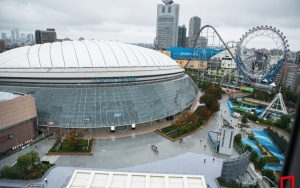
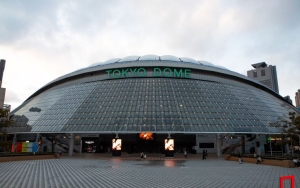
Rain poured down on Tokyo on October 26, 2026. But once inside Tokyo Dome in Bunkyo Ward, Tokyo, the damp air outside was nowhere to be found. The interior was warm, and the field, covered in blue artificial turf, was comfortable. The vast white roof overhead and more than 40,000 seats came into view at once. It was a day with no baseball game or concert. Staff walked around the empty stands, inspecting the facilities and picking up trash. It was a completely different scene from when I attended a K-pop concert here about 10 years ago. After repeated requests for interviews and extensive discussions, The Asia Business Daily became the first domestic media outlet to conduct an exclusive inside report at Tokyo Dome and interview its key executives. We met on site with Satoshi Wakabayashi, general manager of the Entertainment Planning Department; Hiroki Yamauchi, section manager in the same department; Mitsuhiro Ishizuka, section manager of the Tokyo Dome Department; and Eriko Masaki, dir
-
4
- Even Without Baseball Games or Concerts, This Hot Spot Is Bustling: "A Whole Other World with a Hotel, Spa and Amusement Park"
-
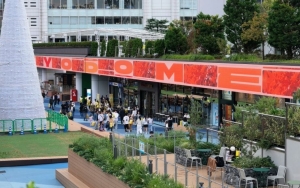
After checking into the Tokyo Dome Hotel in Bunkyo-ku, Tokyo, Japan, I opened the curtains in my room. The night view unfolded before me, with the vast roof of Tokyo Dome and the lights of the surrounding buildings and amusement park blending together. The 43-story hotel is a five-minute walk from the stadium. Nearby are shopping malls, restaurants, an amusement park, and LaQua, which has hot springs and spa facilities. The area encompassing Tokyo Dome and these facilities is known as “Tokyo Dome City.” The next day, heavy rain poured down on Tokyo. Although there was no baseball game or concert, the commercial facilities were busy. Local residents who came in to escape the rain ate at restaurants and spent time sitting in cafes. During the two days of reporting, the longest line I saw was at a Korean restaurant. In the evening, residents in workout clothes ran along the outside of the Dome. Tokyo Dome executives cited the expansion of facilities outside the stadium as the biggest turn
-
5
- "Why Is Korea Building a 50,000-Seat Dome? Based on Baseball Attendance?"... The Question Posed by Tokyo Dome Management
-
"I am curious why Korea is planning a dome with a capacity of 50,000. I would like to know whether the figure is based on the number of baseball spectators or on the audience size for other sports." When the Tokyo Dome management team was briefed on Korea's plan to build a 50,000-capacity multipurpose dome, they responded with a question of their own. They wanted to know why Korea had settled on that size. Their point was that planners should first consider what the facility will be used for and whether there is sufficient demand in the area. On October 26, the management team, whom we met at Tokyo Dome in Bunkyo City, Tokyo, Japan, advised that plans for a large dome should take into account not only the interior of the stadium but also the surrounding rail network, residents' daily lives, and the existing urban environment. Tokyo Dome can accommodate about 43,500 people for baseball games and up to 55,000 for concerts. It is a facility where tens of thousands of spectators gather in
-
6
- "Only 20-25 Artists Could Fill a 20,000-Seat Venue"... K-Arena's Winning Bet to Become No. 1 in the World [K-Pop's Empty Stage in Its Homeland (6)]
-
"In fact, there was no solid evidence that demand would be sufficient. When we were considering the project, there were only around 20 to 25 artists in Japan capable of filling a 20,000-capacity venue. We expected that even if all of them performed here, there would not be many concert dates each year. We started the project with a great deal of uncertainty." Those were the words of Tsuyoshi Tamura, president and CEO of K-Arena Yokohama, whom we met locally on October 27. Asked whether there was enough demand to justify building a 20,000-seat music venue, he began by describing the uncertainty surrounding the project in its early stages. Japanese real estate company Ken Corporation took on that risk, investing private capital from land acquisition through construction. Since opening on September 29, 2023, K-Arena has risen to No. 1 worldwide in arena ticket sales in just two years. According to figures compiled by U.S. music industry publication Pollstar, it sold 2,047,530 tickets in 2
-
7
- Ceiling Can Hold Up to 120 Tons of Equipment... K-Arena Also Factored in Concert Production Costs
-
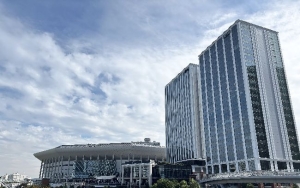
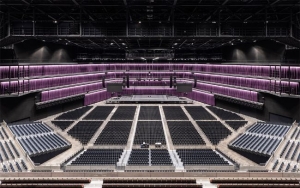
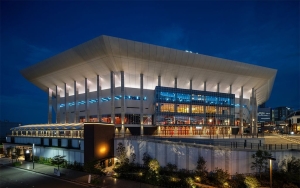
On October 27, 2026, in the Minato Mirai 21 district of Yokohama, Japan. I took a JR train from Tokyo Station and arrived at Yokohama Station about 25 minutes later. As I exited through the east exit, large commercial facilities such as Sogo Yokohama and high-rise office buildings with glass exteriors came into view. The streets, lined with new buildings, reminded me of Pangyo Techno Valley in South Korea. After walking for about 10 minutes between the buildings, a massive venue appeared along the waterfront: K-Arena Yokohama, a 20,000-seat music venue. Next to the venue stood the 26-story Hilton Yokohama and the 21-story K Tower office building. The hotel and venue were connected by an enclosed walkway, and a waterfront pedestrian deck stretched toward Yokohama Station. Together, the venue, hotel, and office building form a mixed-use complex called Music Terrace. Inside the venue, I saw 480 points on the ceiling above the stage where lighting equipment, speakers, and large video scree
-
8
- One in Five K-Arena Shows Is K-Pop... TREASURE Sells 87,000 Tickets for Five Shows
-
One in five performances held at K-Arena, a 20,000-seat music venue in Yokohama, Japan, is a K-pop show. With performances by Korean singers becoming a major source of demand, the operator has even hired Korean staff. Speaking locally on October 27, 2026, Tsuyoshi Tamura, president and representative director of K-Arena Yokohama, said, "K-pop shows account for about 20% of the performances held in 2025 and 2026." He said, "We don't expect a venue in Japan to host only Japanese artists and attract only Japanese audiences. The number of Korea-related shows is also growing. That's why we hired Korean staff. We take care to ensure that visitors from Korea can enjoy performances without any inconvenience." 87,000 Tickets Sold for TREASURE's Five Shows... K-Pop Fills the SeatsK-Arena hosts world tours by Japanese and international artists, as well as performances by virtual YouTubers (VTubers) who perform as virtual characters. Venue bookings are made through local Japanese concert promoters