Roh So-young Rejects 'Settlement' Despite 944 Billion Won Offer; Brief Explains Why
"The court must have the final say in this case")
Art Center Nabi Director Roh So-young reportedly rejected SK Group Chairman Chey Tae-won's request for a court-recommended settlement because she wanted to bring the long-running litigation to a close with a court ruling.

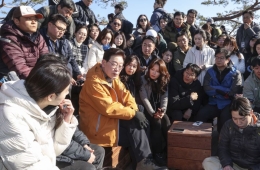
SK Group Chairman Chey Taewon (left) and Art Center Nabi Director Noh Sohyoung head to the courtroom to attend the second hearing in the retrial on remand of their property division case at the Seoul Central District Court in Seocho-gu, Seoul, on June 26. Yonhap News
View original imageAccording to Yonhap News on November 30, the opposition brief submitted by Roh's side to the request for a court-recommended settlement reportedly described the course of the litigation to date and the emotional pain Roh experienced during the process.
The brief was submitted on November 25 to the Supreme Court's Second Division, with Justice Kim Seong-su presiding, two days after Chey's side requested a court-recommended settlement, saying it would pay in full the 944 billion won in property division set by the remanded appeal court. A court-recommended settlement is a procedure in which the court encourages the parties to a lawsuit to reach an agreement. If neither the plaintiff nor the defendant objects within two weeks of receiving the decision, it has the same effect as a final judgment.
In a section titled "The court must have the final say in this case," Roh's side said, "This case began entirely with Chey Tae-won's unilateral decision and notification." It added, "Worried that it could harm the management of SK Group, she endured the situation for a long time with their three children without revealing the family's pain to the outside world." It then recalled, "But Chey Tae-won's own choices brought everything to light before the entire nation." In 2015, Chey sent a letter to a daily newspaper, revealing that he had a child outside his marriage and stating his intention to end the marriage.
Roh's side also took issue with Chey's actions following the remanded appeal ruling. In August, Chey filed a further appeal, challenging the ruling. He later submitted an application to narrow the scope of his appeal, saying he would not contest 700 billion won of the 944 billion won in property division and would challenge only the remaining 244 billion won. In response, Roh's side questioned whether Chey had applied consistent standards, saying, "Chey filed a further appeal in a surprise move just one minute before the deadline expired." It added, "After filing the further appeal, he narrowed the scope of his challenge, saying he would contest only the amount exceeding 700 billion won in property division, but less than three months later, he suddenly sought a court-recommended settlement, saying he would pay the entire amount."
Roh also explained that she did not file a cross-appeal in response to Chey's further appeal because she wanted to end the long-running dispute through a court ruling. Her side said, "We cannot compromise on how the dispute is concluded simply because it needs to end," and described the proposal as "a unilateral compromise made solely for convenience." It added, "The weight of 37 years of marriage and the time Roh So-young endured during it cannot be resolved through a hasty compromise or a unilateral proposal."
The provision barring additional lawsuits was also cited as a key reason for opposing the settlement. Roh's side argued, "We suspect the provision may be intended to block a future claim for additional property division if hidden assets are discovered."
When submitting the brief, Roh also issued a statement saying, "If Chey is sincere about resolving this matter early, I urge him to withdraw his appeal immediately."
Hot Picks Today
 "Two Spend 500,000 Won in a Flash, Yet Wait Two Hours?" ... 'Dreamland' Shunned by Kids and Foreign Tourists
- The Era of Getting 200 Million Won After 30 Years Is Over... A Japanese Bank's "Perpetual Department Head" Who Just Clocked In Cries Out
- Spain Hit by Its Worst Tragedy... Lee Kangin, Moreno and Real Madrid Join Soccer World in Mourning
- They Said, “Make It Your Home for Life” - Then Suddenly Kicked 200 Passengers Off... What Happened to the Around-the-World Cruise?
- "130 Rice Bowls Sold Out in a Day"... 'Unfiltered Face' Adds 8 Million Won to Night Market Sales: China's Bungeunwoo
Meanwhile, after nine years of litigation, Chey and Roh's divorce was finalized in October 2025, but they have continued to dispute the division of their assets. In July 2026, the court hearing the remanded appeal reflected the Supreme Court's reasoning while also including Chey's SK shares in the assets subject to division. It set the division at one-third for Roh and two-thirds for Chey.
© The Asia Business Daily. All rights reserved. Unauthorized AI training and use prohibited.