'The Field Itself Is a Place of Practice'... Mugunghwa Medal Posthumously Bestowed on Late Grand Master Myeongjin
Choi Hwiyeong presents medal at Venerable Myeongjin’s 100th-day memorial service at Bongeunsa
Boosted trust in Buddhism through order reforms and disclosure of temple finances
Practiced compassion and solidarity throughout his life on the front lines of labor and human rights
The Order of Civil Merit, Mugunghwa Medal, has been posthumously awarded to the late Venerable Myeongjin, who led reforms in the Buddhist community, stood by socially vulnerable people and practiced compassion.

The late Grand Master Myeongjin pictured before his passing last August. On the 29th, the government posthumously awarded him the Mugunghwa Medal of the Order of Civil Merit in recognition of his dedication to the development of Korean Buddhism and solidarity with socially disadvantaged groups. Yonhap News
View original imageThe Ministry of Culture, Sports and Tourism said on the 29th that Minister Choi Hwi-young presented the Order of Civil Merit, Mugunghwa Medal, on behalf of the government at the 100th-day memorial service for Venerable Myeongjin, held at Bongeunsa Temple in Gangnam-gu, Seoul. The Mugunghwa Medal is the highest of the five classes of the Order of Civil Merit, awarded to people whose contributions to improving public welfare and advancing national development are recognized as outstanding.
Born in 1950 in Dangjin, South Chungcheong Province, Venerable Myeongjin, whose secular name was Han Gi-jung, entered Baengnyeonam Hermitage at Haeinsa Temple in 1969. After serving in the Vietnam War, he received the novice monk precepts in 1974 under his mentor, Venerable Tanseong. He later devoted himself to Buddhist practice at Songgwangsa, Haeinsa and Bongamsa temples.
In 1994, he spearheaded reforms within the Jogye Order of Korean Buddhism. As a member and vice chair of the order’s Central Council, he worked to democratize its administration and improve its institutional framework.
During his tenure as abbot of Bongeunsa Temple from 2006 to 2010, he changed how the temple was run, including by making its finances public and allowing lay followers to participate in temple administration meetings. He also underscored the importance of a practitioner’s calling by continuing a thousand-day prayer during which he performed 1,000 bows every day without leaving the temple grounds.
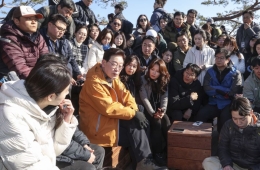
Beyond the temple, he stood with socially vulnerable people. He visited the sites of some of the deepest wounds in Korean society, including the Yongsan Tragedy, the Ssangyong Motor crisis and the Sewol ferry disaster, and listened to workers and bereaved families. He also worked for peace on the Korean Peninsula and social solidarity, serving as head of the Jogye Order’s National Community for Korean Unification and as chair of the board of the Peace Road Foundation.
He also faced hardship for his outspoken criticism of the order’s leadership. He clashed with then-Executive Chief Director Jaseung and other leaders over the issue of converting Bongeunsa Temple into a directly managed temple. He continued his criticism even after completing his term as abbot and was expelled from the order in 2017. He later won both the first- and second-instance rulings in a lawsuit challenging the disciplinary action. After both sides decided not to appeal early this year, he regained his monastic status after nine years.
On August 22, Venerable Myeongjin died after an accident at sea near Haye Port in Seogwipo, Jeju. He was 76 years old and had been a monk for 52 years. Last month, the Jogye Order posthumously bestowed on him its highest monastic rank, Grand Master.
Hot Picks Today
 "Two Spend 500,000 Won in a Flash, Yet Wait Two Hours?" ... 'Dreamland' Shunned by Kids and Foreign Tourists
- The Era of Getting 200 Million Won After 30 Years Is Over... A Japanese Bank's "Perpetual Department Head" Who Just Clocked In Cries Out
- Spain Hit by Its Worst Tragedy... Lee Kangin, Moreno and Real Madrid Join Soccer World in Mourning
- They Said, “Make It Your Home for Life” - Then Suddenly Kicked 200 Passengers Off... What Happened to the Around-the-World Cruise?
- "130 Rice Bowls Sold Out in a Day"... 'Unfiltered Face' Adds 8 Million Won to Night Market Sales: China's Bungeunwoo
The ministry said it awarded the decoration in recognition of his contributions to building trust in Korean Buddhism through sustained reform and spreading the values of equality and compassion in Korean society through solidarity with socially vulnerable people.
© The Asia Business Daily. All rights reserved. Unauthorized AI training and use prohibited.