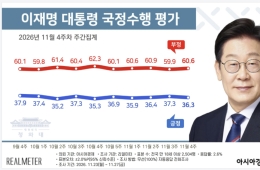
President Lee's Job Approval at 36.3%, Falls for First Time in 3 Weeks [Asia Business Daily-Realmeter Poll]
Democratic Party support at 31.8%, lowest in 4 years and 10 months
People Power Party support at 42.6%, Rebuilding Korea Party at 8.5%
President Lee Jae-myung’s job approval rating fell for the first time in three weeks, to 36.3%. The Democratic Party of Korea’s support dropped to the low 30% range, widening its gap with the People Power Party to more than 10 percentage points.
A regular public opinion poll conducted by Realmeter on behalf of The Asia Business Daily and released on November 30 found that President Lee’s job approval rating was 36.3%, down 1.0 percentage point from the weekly survey conducted the previous week (the third week of November). Of those surveyed, 23.8% said he was doing a very good job and 12.5% said he was doing a fairly good job. The poll was conducted from November 23 to 27 among 2,504 voters aged 18 or older nationwide, using an automated response system and randomly generated mobile phone numbers. The margin of error was ±2.0 percentage points at a 95% confidence level, and the response rate was 2.6%.

Negative ratings rose 0.7 percentage point to 60.6% (50.4% said he was doing a very poor job and 10.2% said he was doing a fairly poor job), putting the gap between positive and negative ratings at 24.3 percentage points, outside the margin of error. “Don’t know” responses accounted for 3.1%. In the daily tracking survey, calculated using two-day totals, the approval rating closed at 37.7% on November 20, rose to 37.9% on November 24, and then fell to 34.5% on November 27.
By demographic group, support fell 7.2 percentage points among people aged 18 to 29 (from 33.1% to 25.9%) and 6.6 percentage points in Busan, Ulsan and South Gyeongsang Province (from 38.3% to 31.7%). By occupation, support fell 6.8 percentage points among students (from 31.5% to 24.7%) and 4.5 percentage points among self-employed people (from 39.2% to 34.7%), while it rose 4.6 percentage points among sales, production, manual labor and service workers (from 36.2% to 40.8%).
A Realmeter official said, “Amid controversy over the expertise of nominees in a Cabinet reshuffle involving five ministries, disputes over a special counsel bill on fabricated indictments, and factional conflict within the Democratic Party, a sharp stock market decline and interest rate hikes have increased the burden on households and uncertainty about economic conditions. We believe this has led to greater losses in support among economically vulnerable groups, including people in their 20s, students and the self-employed.”
A party support poll conducted from November 26 to 27 found that support for the People Power Party stood at 42.6%, up 0.1 percentage point from the previous week, while support for the Democratic Party fell 3.8 percentage points to 31.8%. The survey was conducted among 1,003 voters aged 18 or older nationwide using an automated response system and randomly generated mobile phone numbers. The margin of error was ±3.1 percentage points at a 95% confidence level, and the response rate was 2.9%.

The People Power Party therefore led the Democratic Party by 10.8 percentage points, outside the margin of error, widening the gap from 6.9 percentage points the previous week. The party has maintained a lead outside the margin of error for three consecutive weeks. Based on Realmeter’s weekly tracking, the Democratic Party’s support of 31.8% was its lowest since the second week of January 2022, when it stood at 31.3%, a low not seen in four years and 10 months. The People Power Party last led the Democratic Party by more than 10 percentage points about four and a half years ago, shortly after the Yoon Suk Yeol administration took office: in the first week of June 2022, the People Power Party had 49.8% support and the Democratic Party 39.2%.
Support for the Rebuilding Korea Party rose 0.7 percentage point to 8.5%, the Reform Party fell 0.4 percentage point to 2.5%, the Progressive Party rose 1.1 percentage points to 2.0%, and other parties stood at 2.7%. The share of respondents without a party affiliation rose 1.6 percentage points to 9.8%. Among moderates, the unaffiliated share increased 3.3 percentage points, from 12.0% to 15.3%.
By region, the People Power Party had greater support than the Democratic Party in five of the six regions with sufficient respondents, excluding Jeonnam-Gwangju and North Jeolla Province. Gangwon Province and Jeju Island were also excluded because of the small number of respondents. In Seoul, the People Power Party led with 49.0% to the Democratic Party’s 27.9%, a gap of 21.1 percentage points. In Daegu and North Gyeongsang Province, the parties stood at 50.5% and 20.4%, respectively, a gap of 30.1 percentage points. The gap was around 15 percentage points in Busan, Ulsan and South Gyeongsang Province (47.2% for the People Power Party and 31.8% for the Democratic Party) and in Daejeon, Sejong and Chungcheong (46.4% and 31.3%, respectively). In Incheon and Gyeonggi Province, the People Power Party had 38.8% support and the Democratic Party 33.3%, a gap of 5.5 percentage points. In Jeonnam-Gwangju and North Jeolla Province, the Democratic Party led with 50.4%, compared with 25.8% for the People Power Party.

By age group, support for the People Power Party among people aged 18 to 29 rose 11.0 percentage points, from 44.9% to 55.9%, while support for the Democratic Party fell 13.8 percentage points, from 30.0% to 16.2%. This widened the gap between the two parties among people aged 18 to 29 to 39.7 percentage points. Among people in their 30s, Democratic Party support fell 9.0 percentage points, from 26.8% to 17.8%. Among those in their 40s, Democratic Party support rose 11.2 percentage points, from 40.0% to 51.2%, while People Power Party support fell 7.1 percentage points, from 26.9% to 19.8%. Among people in their 50s, Democratic Party support fell 5.5 percentage points, from 46.1% to 40.6%.
By gender, Democratic Party support among women fell 7.4 percentage points, from 40.6% to 33.2%. Over the same period, support for the People Power Party rose 1.2 percentage points, from 38.2% to 39.4%. By ideological leaning, People Power Party support among conservatives fell 7.2 percentage points, from 80.7% to 73.5%. Democratic Party support fell 5.0 percentage points among moderates, from 36.9% to 31.9%, and 2.7 percentage points among progressives, from 56.5% to 53.8%.
A Realmeter official said, “The People Power Party appears to have remained largely unchanged. It gained some support among people in their 20s and the self-employed, benefiting from backlash against internal discord within the ruling bloc and livelihood-related headwinds such as falling stock prices and rising interest rates. However, the conflict over alleged fabricated disciplinary proceedings between party leader Jang Dong-hyeok and former leader Han Dong-hoon drove some conservatives away, offsetting those gains.”
The official added that the Democratic Party’s support had fallen among people in the Honam region, moderates, progressives and those in their 20s and 30s. “Controversy over allegations that Shincheonji members joined the party and conflict between pro-Lee and pro-Chung factions over disciplinary action against Supreme Council member Choi Min-hee have come to the fore. These issues coincided with economic and livelihood-related headwinds, including disputes over the impeachment of Supreme Court Chief Justice Jo Hee-dae and a sharp stock market decline,” the official said.
Hot Picks Today
 "Two Spend 500,000 Won in a Flash, Yet Wait Two Hours?" ... 'Dreamland' Shunned by Kids and Foreign Tourists
- The Era of Getting 200 Million Won After 30 Years Is Over... A Japanese Bank's "Perpetual Department Head" Who Just Clocked In Cries Out
- Spain Hit by Its Worst Tragedy... Lee Kangin, Moreno and Real Madrid Join Soccer World in Mourning
- They Said, “Make It Your Home for Life” - Then Suddenly Kicked 200 Passengers Off... What Happened to the Around-the-World Cruise?
- "130 Rice Bowls Sold Out in a Day"... 'Unfiltered Face' Adds 8 Million Won to Night Market Sales: China's Bungeunwoo
For further details on the polls, visit the website of the National Election Survey Deliberation Commission.
© The Asia Business Daily. All rights reserved. Unauthorized AI training and use prohibited.