“Next Year’s Grants to Fall KRW 9.5 Trillion Short”... Education Superintendents Urge Maintaining Domestic Tax Linkage System
Pushback Against Government’s Grant Calculation Reform Plan
Five Key Demands Submitted, Including Adjustment to Grant Calculation Baseline
Education superintendents across the country are pushing back against the government’s move to abolish the system linking local education finance grants to domestic tax revenue, warning that it would “lower the quality of education and widen regional education gaps.”
Under the government’s proposed reform, next year’s grants are estimated to fall about KRW 9.5 trillion short of the minimum required amount. Calls are growing louder to maintain the current linkage rate to ensure stable school operations.

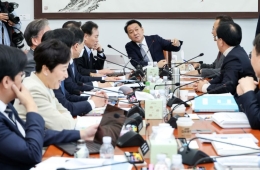
The National Council of District Education Chiefs and the Korea Council of Superintendents of Education called for stable funding for local education and urged the government and the National Assembly to develop measures to ensure reliable education funding. Provided by the Korea Council of Superintendents of Education.
View original imageThe National Association of Education Office Superintendents, comprising superintendents of education support offices nationwide, issued a statement on November 27 calling for stable local education funding and urged the government and the National Assembly to develop measures to secure it.
“The system linking local education finance grants to domestic tax revenue, which has been in place for the past 55 years, has guaranteed educational opportunities for all students and contributed to stable school operations and narrowing regional education gaps,” the association said. “We are concerned that the ongoing push to abolish the system and calculate grants based on economic growth and changes in the school-age population could undermine the stability of education funding and constrain educational activities in schools.”
The association stressed that a decline in the school-age population cannot automatically lead to cuts in education spending. Even if the number of students falls, fixed costs required to operate schools do not decrease at the same rate. Meanwhile, public education is taking on an expanding role in ensuring basic academic skills, providing special education, supporting students from immigrant backgrounds, promoting students’ mental health, providing care and educational welfare, and offering integrated, tailored support.
It also identified maintaining small schools in farming and fishing communities and continuing investment in future education suited to the age of artificial intelligence transformation (AX) as priorities. The association expressed strong support for the “Education Finance Win-Win Plan” proposed by the Korean Council of Superintendents of Education and asked the government and the National Assembly to address five key issues.
Specifically, the requests are: ▲maintaining the current domestic tax linkage rate of 20.79% and having the state and education offices jointly bear the burden of fluctuations in tax revenue; ▲if a new calculation method is introduced, adjusting the baseline amount to KRW 84.1 trillion and lowering the weighting for the school-age population to 10%; ▲stipulating in a supplementary provision that the 2026 grant reconciliation amount (about KRW 11.7 trillion) be paid under current law, and having the state cover any shortfall resulting from increased personnel expenses; ▲using available funds of KRW 2.5 trillion in the Education and Talent Account of the Future Response Fund to improve aging school facilities, while guaranteeing the National Assembly Education Committee’s authority to conduct a preliminary review; and ▲ensuring substantive consultations involving education stakeholders and sufficient review by the National Assembly.
The association estimates that the minimum required grants for 2027 will amount to KRW 88.4 trillion and projects that applying the government’s proposed reform would leave a shortfall of KRW 9.5 trillion.
“Rather than reducing investment in education because the number of students is declining, we should move toward providing more attentive, higher-quality education to every student,” said Kim Sujin, chair of the association. “We hope the government and the National Assembly will listen to the voices of schools and make responsible decisions so that all students can enjoy sufficient educational opportunities, wherever they live.”
Hot Picks Today
 "Two Spend 500,000 Won in a Flash, Yet Wait Two Hours?" ... 'Dreamland' Shunned by Kids and Foreign Tourists
- The Era of Getting 200 Million Won After 30 Years Is Over... A Japanese Bank's "Perpetual Department Head" Who Just Clocked In Cries Out
- Spain Hit by Its Worst Tragedy... Lee Kangin, Moreno and Real Madrid Join Soccer World in Mourning
- They Said, “Make It Your Home for Life” - Then Suddenly Kicked 200 Passengers Off... What Happened to the Around-the-World Cruise?
- "130 Rice Bowls Sold Out in a Day"... 'Unfiltered Face' Adds 8 Million Won to Night Market Sales: China's Bungeunwoo
Meanwhile, provincial and metropolitan education superintendents affiliated with the Korean Council of Superintendents of Education have been staging a rotating series of one-person picket protests in front of the National Assembly since November 17, making a final all-out push ahead of the November 30 deadline for the National Assembly standing committee’s review of the bill to amend the Local Education Finance Grant Act. On November 26, the superintendents held a joint press conference at the National Assembly with the “2026 Emergency Action Against Local Education Finance Reform,” urging the swift passage of the “Local Education Finance Win-Win Plan.” The plan would retain the current domestic tax linkage rate of 20.79% while having the state and education offices share the burden whenever tax revenue rises or falls by more than 5%.
© The Asia Business Daily. All rights reserved. Unauthorized AI training and use prohibited.