Semiconductors, the "Water Guzzlers"... Water Disputes Intensify
Semiconductor plants are demanding water as they go up
Water-supplying regions ask, "Why are we the ones bearing the costs?"
Pushback spreads across North Chungcheong-South Chungcheong, Gangwon-Gyeonggi, and North Jeolla-South Jeolla
Residents Vow to Fight, and Local Governments Even Set Up Dedicated Teams
Water disputes are flaring up again as three major mega-projects gather pace. The conflict stems from plans to draw water from other regions because the areas where semiconductor plants are being built cannot meet their own water needs. In water-rich regions, opposition is mounting, with residents saying, "We bear the costs while others reap the benefits." Some warn that disputes between regions over water resources will intensify further if concerns about water shortages caused by the climate crisis grow.
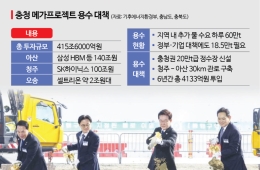
The government's planned 200,000-ton water treatment plant in Cheongju, North Chungcheong Province, and a 30-kilometer pipeline connecting it to Asan are intended to address water supply needs for SK hynix in Cheongju and Samsung Electronics in Asan. According to the government, the Chungcheong mega-projects will create additional water demand of 600,000 tons per day. Water consumption at semiconductor plants in the area is not disclosed because it is considered sensitive information, but it is estimated to be about three times higher in 10 years than it is now. Even if all existing measures are implemented and companies recycle as much wastewater as possible, there will still be a net shortfall of 185,000 tons.
Supplying North Chungcheong's Water to South Chungcheong? "We Face Water Shortages Too"

The problem is that water resources are unevenly distributed across regions. South Chungcheong Province suffers from chronic water shortages, with no clear source of water supply other than Boryeong Dam. North Chungcheong Province, by contrast, is considered one of the most water-rich regions in the country. The storage capacities of Chungju Dam and Daecheong Dam are 2.7 billion m³ and 1.5 billion m³, respectively, ranking second and third nationwide. Including Yongdam Dam, the region can supply a massive 12.39 million tons of water per day. This means water from North Chungcheong must be brought in to supply Samsung Electronics' high-bandwidth memory (HBM) plant in South Chungcheong.
Signs of local opposition are already emerging, amid concerns that water outflows from North Chungcheong could increase. Only 8% of the province's water resources are used locally, while the remaining 92% go toward meeting the water needs of other areas, including Seoul, Gyeonggi Province, and Daejeon. Maeng Seung-jin, a professor at Chungbuk National University and co-chair of the Chungbuk Water Forum, said, "North Chungcheong's water is already being sent to other regions, and now they want to take even more. There is no way we have an abundant supply. The provincial government and local residents must be consulted fully."
North Chungcheong also argues that water use must be approached with caution, warning that climate change could leave the province short of 60.34 million tons of water annually by 2035. Its argument is that there is no surplus water to give away because 90% of the projected shortfall would occur in Cheongju, where SK hynix's semiconductor plant is located. The Ministry of Climate, Energy and Environment, however, says the province's water situation is relatively favorable. It says there would be sufficient reserves even under drought conditions, and that supplying additional water would have only a minimal impact on local drinking water sources.
Residents Vow to Fight, and Local Governments Even Set Up Dedicated Teams

Residents of Hwacheon County, Gangwon Province, hold a press conference calling for measures to address damage caused by Hwacheon Dam. 20240813 Yonhap News
View original imageOpposition is also growing in Hwacheon County, Gangwon Province, where Hwacheon Dam is located. The dam is set to supply 454,000 tons of water each day to the semiconductor cluster in Yongin, Gyeonggi Province. Residents complain that, based simply on the usage fee, water resources worth tens of billions of won are flowing out to other regions every day. On the 15th, county residents marched 200 kilometers on foot to demand that their views be taken into account. They also held a rally to condemn the government in 2024, and last year, 10,143 residents submitted a petition to the government asking it to reconsider the decision. Hwacheon County has set up a dedicated team to respond to the government's decision.
Gangwon Special Self-Governing Province is calling for a fair compensation system. An official from the province said, "The dams in Gangwon provide major benefits to the Seoul metropolitan area, while we get almost nothing in return. Since this is a national policy, we cannot refuse to supply water. But the province's position is that Gangwon should be given the authority to collect usage fees for water sent to other regions." Han Ki-ho of the People Power Party and Heo Young of the Democratic Party of Korea have also introduced the fourth amendment to the Gangwon Special Act, which would direct additional contributions from water sales to establish a fund to boost the local economy.
Water disputes surrounding the semiconductor industrial complex in the southwestern region are coming to the fore. North Jeolla Province is concerned that it could provide water while missing out on opportunities for growth. At a provincial council meeting in July, North Jeolla Provincial Council member Nam Gwan-woo said, "North Jeolla must not end up simply providing water under the government's industrial water supply plan for semiconductor mega-projects, without a strategy for future industries. The process of securing additional water could affect agricultural water supplies in Jeongeup and Gimje." In Hadong, South Gyeongsang Province, located at the mouth of the Seomjin River, concerns have also been raised that increased upstream water use by the Honam semiconductor cluster could worsen the damage to fishers at the river's mouth.
Residents in other areas, including Naju Dam in Naju, Dongbok Dam in Hwasun, Jicheon Dam in Cheongyang, and the Gyeongan Stream area in Gwangju, Gyeonggi Province, are also opposing water supply measures for the mega-projects or demanding fair compensation.
"The Larger the Semiconductor Industry, the Greater the Water Disputes... Fair Criteria Are Needed"

Han Hye-jin, a senior research fellow at the Korea Environment Institute, said, "To address the regional imbalance in water resources, South Korea has long shared water sources between regions to supply water for household and industrial use. As the economic value of water draws greater attention amid the growth of the semiconductor and AI industries, disputes over the fairness of water allocation could intensify." She added, "That makes it all the more necessary to establish reasonable criteria and quantitative assessment methods for resolving disputes, based on the public nature of water. As part of the process to revise the National Water Management Master Plan, measures are also being considered to ensure stable supply for existing users, allocate water and share costs, and improve the dispute resolution framework."
Some have also called for an objective assessment of water needs to be conducted first. Choi Dong-jin, director of the Climate Change Action Research Institute, said, "It is unclear exactly how much water is needed at different times of the year, or how much can be supplied during normal conditions and droughts. The government needs to compile scientific evidence that everyone can accept." Others said that reliable compensation and development benefits are needed. Kim Dae-jong, a professor in the Department of Business Administration at Sejong University, said, "Unilaterally diverting water from one region to semiconductor plants in another is not sustainable. The regions supplying water should receive tangible benefits through resident support funds, infrastructure expansion, and job creation."
Hot Picks Today
 "Two Spend 500,000 Won in a Flash, Yet Wait Two Hours?" ... 'Dreamland' Shunned by Kids and Foreign Tourists
- The Era of Getting 200 Million Won After 30 Years Is Over... A Japanese Bank's "Perpetual Department Head" Who Just Clocked In Cries Out
- Spain Hit by Its Worst Tragedy... Lee Kangin, Moreno and Real Madrid Join Soccer World in Mourning
- They Said, “Make It Your Home for Life” - Then Suddenly Kicked 200 Passengers Off... What Happened to the Around-the-World Cruise?
- "130 Rice Bowls Sold Out in a Day"... 'Unfiltered Face' Adds 8 Million Won to Night Market Sales: China's Bungeunwoo
An official from the Ministry of Climate, Energy and Environment said, "We plan to coordinate the water supply needs of advanced industries and regional concerns about water resources through institutional consultation procedures involving local governments, relevant agencies, and water management committees."
© The Asia Business Daily. All rights reserved. Unauthorized AI training and use prohibited.