"KOSPI Undershooting... Overweight": Issues to Watch Next Week [Weekend Money]
"An 'undershooting' phase, not a deterioration in fundamentals"
Focus on U.S. jobs report, Jensen Huang hearing, and more
Analysts say the KOSPI's movement in the 4,600-5,000 range reflects excessive concern over weaker AI investment sentiment and uncertainty surrounding foreign investor flows, rather than damage to fundamentals.
Lee Kyung-min, a researcher at Daishin Securities, made the assessment in a report titled "The Market Next Week" on Nov. 27, describing the current phase as an "undershooting" period. "We maintain our overweight recommendation, as the return of Nvidia CEO Jensen Huang has partly eased management uncertainty and the additional burden from tariffs is also limited," Lee said.

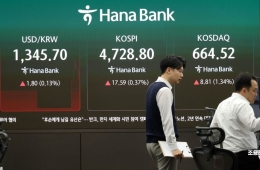
The KOSPI, KOSDAQ and won-dollar exchange rate are displayed in the dealing room at Hana Bank’s headquarters in Jung-gu, Seoul, on the 27th. The KOSPI opened at 4,728.80, up 0.37% (17.59 points) from the previous session, while the KOSDAQ started at 664.52, up 8.81 points (1.34%). Nov. 27, 2026. Photo by Cho Yongjun.
View original imageThe KOSPI's 12-month forward price-to-earnings (PER) ratio has fallen to 3.26 times, while forward earnings per share (EPS) stands at 1,445.2 points, widening the gap between share prices and expected earnings. However, Lee noted that uncertainty around investor flows persists, with foreign investors continuing to be net sellers and no clear buying force emerging.
Accordingly, the assessment is that a sustained reversal to an upward trend will require monitoring a recovery in AI investment sentiment, stability in U.S. Treasury yields, and whether foreign investors continue to make net purchases of both cash equities and futures.
In particular,the U.S. congressional hearing on CEO Huang and the release of U.S. employment data next week could mark turning points for a rebound, analysts say. Lee said, "It will be necessary to see whether the congressional hearing featuring Nvidia CEO Jensen Huang further eases uncertainty surrounding the company," adding, "Concerns over management uncertainty have eased, but political risks surrounding possible export controls on China remain."
Lee emphasized, "Whether CEO Jensen Huang's return leads to an actual normalization of management and resolves business uncertainties will be a key factor in the recovery of AI investment sentiment."
Lee viewed the U.S. tariffs on overcapacity as a measure that reaffirmed the existing 15% tariff rate, rather than a new headwind for South Korea. "Items subject to Section 232, including automobiles, steel and semiconductors, are exempt from the tariffs," Lee said. "The actual additional tariff burden is only about $650 million a year, equivalent to 0.03% of gross domestic product (GDP)." Lee added, "As the 15% tariff cap is based on a political agreement, the pace of investment implementation in the United States and the possibility of additional restrictions should be monitored."
The U.S. ISM manufacturing purchasing managers' index (PMI) for November and the employment report, both due next week, were cited as key factors in gauging the extent of further tightening ahead of the Federal Open Market Committee (FOMC) meeting in December.
Lee forecast, "If employment remains robust while inflationary pressures persist, the likelihood of further interest rate hikes by the Federal Reserve (Fed) will increase, adding to the burden on the stock market." The U.S. personal consumption expenditures (PCE) price index for October, released earlier, rose 3.8% year over year on a headline basis, showing that inflationary pressures remain.
Hot Picks Today
 "Two Spend 500,000 Won in a Flash, Yet Wait Two Hours?" ... 'Dreamland' Shunned by Kids and Foreign Tourists
- The Era of Getting 200 Million Won After 30 Years Is Over... A Japanese Bank's "Perpetual Department Head" Who Just Clocked In Cries Out
- Spain Hit by Its Worst Tragedy... Lee Kangin, Moreno and Real Madrid Join Soccer World in Mourning
- They Said, “Make It Your Home for Life” - Then Suddenly Kicked 200 Passengers Off... What Happened to the Around-the-World Cruise?
- "130 Rice Bowls Sold Out in a Day"... 'Unfiltered Face' Adds 8 Million Won to Night Market Sales: China's Bungeunwoo
Conversely, if employment slows moderately and inflationary pressures also ease, U.S. Treasury yields could stabilize and risk appetite could recover.
© The Asia Business Daily. All rights reserved. Unauthorized AI training and use prohibited.