"What Score Are You Looking to Get?" AI Cheating and Proxy Test-Taking Erode Exam Fairness
Telegram Accounts Promote Proxy Language Test-Taking and Score Forgery
Concerns Also Raised Over Secondary Crimes Using Misused IDs
Korea TOEIC Committee to Inspect All Glasses and Use Metal Detectors
Controversy over cheating involving artificial intelligence (AI) in national qualification exams is spreading to language tests such as the TOEIC and TEPS. Businesses offering to take tests on behalf of others for millions of won or forge score reports have also emerged online. The fact that even official language test scores used for employment, university admissions, and promotions can be bought and sold is shaking confidence in the entire testing system.

The controversy over cheating with artificial intelligence (AI) in national qualification exams is spreading to language tests such as TOEIC and TEPS. The image was generated by AI to illustrate the article. The Asia Business Daily.
View original imageOn November 27, Yonhap News Agency reported that accounts promoting proxy test-taking, score report forgery, and cheating using advanced electronic devices have recently been active on Telegram.
TOEIC scores in the 800s for 6.5 million won... Language test scores bought and sold
A proxy test-taking business contacted by Yonhap News Agency on November 26 asked for 6.5 million won upfront in response to an inquiry about aiming for a TOEIC score in the 800s. Another business quoted 4.6 million won for a score in the 900s. The businesses claimed to have extensive experience with proxy test-taking and said there was no need to worry about getting caught. However, it could not be confirmed whether anyone had actually obtained a score by taking a test on someone else's behalf.

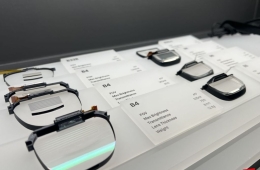
Ahead of the 2027 College Scholastic Ability Test, a company representative wears smart glasses and reads the “Guide to Prevent Cheating with AI Glasses” during training for headquarters staff assigned to smart-glasses monitoring, held at the Seoul Metropolitan Office of Education in Yongsan-gu, Seoul. Yonhap News Agency
View original imageQuestions have also been raised about loopholes in identity verification procedures at test centers. A person with experience supervising TOEIC exams told Yonhap News Agency that the current method, which involves comparing an ID photo with the test-taker's actual face, may not be enough to completely detect deliberate proxy test-taking. An overseas business also advertised that it would forge score reports. A Chinese business demanded cryptocurrency equivalent to about 800,000 won to produce a forged score report.
People who share their personal information with these businesses could also be exposed to secondary crimes such as voice phishing or blackmail. They could be asked for additional money after being threatened with disclosure of their attempt to commission cheating, or their IDs could be misused in other crimes.
Glasses inspected to prevent AI cheating... Measures to stop proxy test-taking
Meanwhile, businesses claiming to use advanced technology to cheat on language tests have also emerged. A Chinese business that previously claimed that the late Lee Jinwoo, who earned a perfect score on the Law School Admission Test (LEET), had used its services also advertised guaranteed high scores on the TOEIC and TOEFL. The business's Telegram channel was blocked on November 18 for violating South Korean law. It could not be confirmed whether Lee had actually used the business. As controversy over cheating has grown, organizations that administer language tests have also announced a series of countermeasures.
YBM's Korea TOEIC Committee will introduce a strengthened monitoring system to prevent and detect AI-assisted cheating, starting with the regular exam on November 29. Key measures include inspecting all test-takers' glasses and attaching security stickers to prevent them from being replaced; restricting the items allowed on desks; using metal detectors and introducing additional radio-frequency detectors; and strengthening post-exam detection of cheating. TEPS, administered by Seoul National University, is also responding by strengthening searches at test centers and working to require test-takers to wear disposable gowns and aprons.
Some say that more sophisticated verification systems are needed not only to address cheating involving advanced devices, but also traditional forms of cheating such as proxy test-taking and score report forgery. In particular, proxy test-taking is more than a simple violation of exam rules. It can interfere with the normal operations of the organization administering the test and may be subject to criminal penalties.

In 2017, the Busan District Court sentenced a man in his 30s to 18 months in prison and ordered him to pay 7.7 million won in forfeiture after he took the TOEIC and TEPS exams on behalf of others for money on four occasions. He was found guilty of obstruction of business and forging official documents, among other charges. The court noted that proxy test-taking could create social inequity in South Korea, where language test scores are directly linked to employment. The image was generated by AI to illustrate the article. The Asia Business Daily
View original imageIn 2017, the Busan District Court sentenced a man in his 30s to 18 months in prison for obstruction of business and forgery of official documents after he took the TOEIC and TEPS exams four times on behalf of others in exchange for money. The court also ordered him to pay 7.7 million won in additional collections. The judges noted that proxy test-taking could lead to social unfairness in South Korea, where language test scores are directly tied to employment. Under the Korea TOEIC Committee's current rules for handling cheating, anyone who takes a test on someone else's behalf or commissions someone to do so is barred from taking the exam for four years. Even after scores are announced, if cheating is confirmed, the score in question and any scores earned afterward may be invalidated.
Hot Picks Today
 "Two Spend 500,000 Won in a Flash, Yet Wait Two Hours?" ... 'Dreamland' Shunned by Kids and Foreign Tourists
- The Era of Getting 200 Million Won After 30 Years Is Over... A Japanese Bank's "Perpetual Department Head" Who Just Clocked In Cries Out
- Spain Hit by Its Worst Tragedy... Lee Kangin, Moreno and Real Madrid Join Soccer World in Mourning
- They Said, “Make It Your Home for Life” - Then Suddenly Kicked 200 Passengers Off... What Happened to the Around-the-World Cruise?
- "130 Rice Bowls Sold Out in a Day"... 'Unfiltered Face' Adds 8 Million Won to Night Market Sales: China's Bungeunwoo
Language test scores have long been used as a key measure to allocate opportunities in society, including corporate hiring, university admissions, and various qualification exams. Therefore, scores obtained through cheating do not simply give an individual an unfair advantage; they can also deprive other test-takers who prepared honestly of their opportunities. This is a time to review the entire testing management system.
© The Asia Business Daily. All rights reserved. Unauthorized AI training and use prohibited.