"'2027 Growth Forecast at 4.1%' BOK Raises Rates; Outlook for Further Hikes Also 'Hawkish' (Comprehensive)"
Bank of Korea Raises Benchmark Rate by 0.25 Percentage Points to 3.25%
Sharp Upgrade to Growth Forecast: "3.9% This Year, 4.1% Next Year"
Inflation Remains a Concern... Next Year's Consumer and Core Inflation Forecasts Raised to 2.4% and 2.6%
Hawkish K-Dot Plot: Eight at 3.50%, Seven at 3.75%... Further Hikes in Focus
On Nov. 26, the Bank of Korea's Monetary Policy Board raised the benchmark interest rate by 0.25 percentage points (25bp) to 3.25% at its final monetary policy decision meeting of 2026. The decision reflected greater weight on factors favoring a rate hike, including a sharply revised upward growth forecast and persistent inflationary pressures. The Bank of Korea raised its growth forecast for 2026 to 3.9% and sharply increased its forecast for 2027 to 4.1%. The revisions reflect expectations that the semiconductor sector will drive growth in the Korean economy, outweighing downside pressures. The Bank also raised its consumer inflation forecast for 2027 by 0.1 percentage points to 2.4%.
Experts generally expect another rate hike around February 2027. The Monetary Policy Board's K-dot plot released on Nov. 26 pointed to a greater likelihood that the rate would be between 3.50% and 3.75% in six months, by May 2027, reinforcing expectations of a further increase.

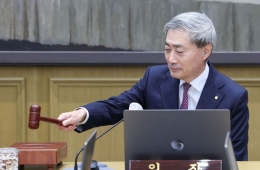
Bank of Korea Governor Shin Hyunsong strikes the gavel during a Monetary Policy Board meeting at the Bank of Korea in Jung-gu, Seoul, on the morning of the 26th. Photo by Joint Press Corps.
View original imageSemiconductors Drive Exports, Investment and Consumption... 2027 Growth Forecast at 4.1%
The main reasons for the rate hike on Nov. 26 were strong growth driven by the impact of semiconductor exports and upward pressure on prices. In its revised economic outlook released that day, the Bank of Korea forecast that Korea's real gross domestic product (GDP) would grow by 4.1% in 2027. This is a sharp upward revision of 1.2 percentage points from its August forecast of 2.9%. The 2027 growth forecast of 4.1% is higher than projections from major domestic and international institutions, including the Korea Development Institute (KDI, 3.9%), the International Monetary Fund (IMF, 3.3%), and the Organisation for Economic Co-operation and Development (OECD, 2.6%). The Bank also raised its 2026 growth forecast by 0.6 percentage points, projecting growth of 3.9%. Its growth forecast for 2028 is 3.0%.
This reflects strong exports, which have continued to post record-breaking results on the back of a semiconductor boom. Semiconductor exports totaled $396.8 billion from January to October, accounting for 42.7% of total exports. In the first 20 days of November, semiconductor exports surged 294.4% to $38.5 billion, expanding their share of total exports to 49.7%. Major forecasting institutions expect exports to grow by around 10% in 2027, despite the base effect following record-high results in 2026.

The recovery in investment, including in facilities and construction, on the back of the semiconductor boom is also cited as a reason for the upward revision to the growth forecast. Domestic machinery orders, a leading indicator of facility investment, rose 28.2% year over year in September, while orders for special-purpose industrial machinery, including semiconductor manufacturing equipment, increased 35.9%. Imports of semiconductor manufacturing equipment, another leading indicator, also surged 59.1% in October.
A technical factor, the increased weight assigned to semiconductors, also contributed to the higher growth forecast for 2027. The Bank of Korea calculates real growth by applying the industry shares of nominal GDP as weights. As the semiconductor sector's share has grown, its weight in the growth calculation has also increased. The share of computers, electronics and optical equipment, which includes semiconductors, rose to 20.7% in the first half of 2026, from an average of 7.5% between 2022 and 2025.
Private consumption, which slowed somewhat in the third quarter of 2026, is expected to recover in 2027 as incomes improve on the back of the semiconductor boom. The Bank of Korea has said that household consumption could also increase in 2027, citing real gross domestic income (GDI), an indicator of real purchasing power, which recorded year-over-year growth in the double digits in each of the first three quarters of 2026. The increased income of some households, including large semiconductor performance bonuses, could feed into household spending after a time lag, expanding private consumption.

K-Dot Plot: Eight at 3.50%, Seven at 3.75%... Weight on a "Hawkish Further Hike"
However, a decline in stock prices and the resulting hit to sentiment are among the uncertainties. Kwak Noseon, a professor of economics at Sogang University, said, "The Bank of Korea expects income generated by the semiconductor boom to boost not only investment demand but also consumption through 2027." He added, "We should also be mindful that a negative wealth effect could emerge, with households cutting spending as falling stock prices reduce the value of their assets."
Sentiment indicators are indeed on a downward trend. The Consumer Sentiment Index (CCSI) stood at 103.1 in November, down 2.3 points from the previous month. Actual consumer spending indicators have yet to show a clear improvement, either. According to the Ministry of Data and Statistics, the retail sales index fell 0.5% year over year in the third quarter of 2026, reversing to a decline for the first time in five quarters. The Credit Finance Association reported that credit card approvals at department stores, a barometer of private consumption, fell 3.1% year over year in October, while approvals at discount stores dropped 17.1%.
Persistent inflation concerns also lent support to this month's rate hike. Consumer price inflation eased from 3.1% in August to 2.9% in September and 2.8% in October, but remained well above the Bank of Korea's 2.0% target. In its revised economic outlook released on Nov. 26, the Bank raised its 2027 consumer inflation forecast from 2.3% to 2.4%, while keeping its 2026 forecast at 2.7%. Core inflation is expected to reach 2.6% in both 2026 and 2027, above the previous forecast of 2.5%. The Monetary Policy Board said, "Inflation is expected to remain above the target for a considerable period due to cost- and demand-side pressures."

Meanwhile, two members, Hwang Geonil and Lee Suhyeong, dissented in favor of holding rates when the Board decided to raise them on Nov. 26. Experts generally expect the terminal rate for this hiking cycle to be 3.50%, 25bp above the current level. They forecast that the next hike will come around February 2027. The expectation is that the Bank will assess the effects of this month's hike and the extent of the slowdown in consumption before raising rates again in February, when it is due to release its next revised economic outlook.
The Monetary Policy Board did not rule out the possibility that the benchmark rate could reach 3.75% by May 2027, six months from the meeting. This is more hawkish, or more inclined toward monetary tightening, than the Board's August projections (10 dots at 3.25%, six at 3.50%, and five at 3.00%) and market expectations, which mostly pointed to 3.50%. Under the K-dot plot, each of the seven Monetary Policy Board members places three dots to indicate their conditional rate projections for six months ahead. Of the 21 dots in total, eight (38.1%) indicated a benchmark rate of 3.50% in six months. Seven dots (33.3%) pointed to 3.75%, which would require two 0.25-percentage-point hikes. Meanwhile, six dots indicated that the rate would remain at its current level of 3.25% after six months.
Hot Picks Today
 "Two Spend 500,000 Won in a Flash, Yet Wait Two Hours?" ... 'Dreamland' Shunned by Kids and Foreign Tourists
- The Era of Getting 200 Million Won After 30 Years Is Over... A Japanese Bank's "Perpetual Department Head" Who Just Clocked In Cries Out
- Spain Hit by Its Worst Tragedy... Lee Kangin, Moreno and Real Madrid Join Soccer World in Mourning
- They Said, “Make It Your Home for Life” - Then Suddenly Kicked 200 Passengers Off... What Happened to the Around-the-World Cruise?
- "130 Rice Bowls Sold Out in a Day"... 'Unfiltered Face' Adds 8 Million Won to Night Market Sales: China's Bungeunwoo
Gong Dongrak, a researcher at Daishin Securities, said, "Given that dovish views emerged in the Monetary Policy Board's minutes last month, this dot plot is more hawkish than expected." He added, "Exports of IT products have shown no signs of slowing at all, so the Bank raised its GDP growth forecast for 2027. But it appears the Bank did not factor into this hiking cycle the prospect that spot prices will plunge significantly in 2028."
© The Asia Business Daily. All rights reserved. Unauthorized AI training and use prohibited.