BOK Monetary Policy Board: "Korea's Growth to Strengthen Further, Inflation to Stay Above Target for Considerable Period"
November Monetary Policy Board Meeting Decision Statement
Rate Hike Decision... Hwang Geonil and Lee Soohyung Dissent in Favor of a "Hold"
Six-Month-Ahead Dot Plot: Seven Dots at 3.75%... Upper Bound Still Open
The Bank of Korea’s Monetary Policy Board raised the base rate by 0.25 percentage point to 3.25% per year on Nov. 26, explaining that “growth in the domestic economy is expected to strengthen further, while inflation is projected to remain above the target level for a considerable period.”
In a statement on its monetary policy decision released that morning, the Board said, “Five of the seven Monetary Policy Board members supported the rate hike, while members Hwang Geonil and Lee Soohyung favored holding the rate steady.” The published dot plot showed eight dots indicating that, conditionally, the rate would reach 3.50% by May 2027. Seven dots were placed at 3.75%, and six at 3.00%.

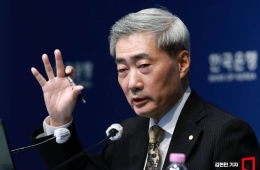
Bank of Korea Governor Shin Hyun-song bangs the gavel at the Monetary Policy Board meeting to set the direction of monetary policy, held at the Bank of Korea's headquarters in Jung-gu, Seoul, on Nov. 26, 2026. Photo by Joint Press Corps.
View original imageThe Board expects the domestic economy to post strong growth this year and next, supported by favorable conditions in the semiconductor industry. It said, “Strong growth in exports and investment is expected to continue, while the recovery in consumption will gradually broaden on the back of improving income conditions and increased fiscal spending,” adding that “growth is projected at 3.9% this year and 4.1% next year, 0.6 percentage point and 1.2 percentage points above the projections made in August, respectively.” It cited the expansion of the semiconductor industry and its spillover effects on domestic demand, as well as developments in the Middle East, as sources of uncertainty.
The Board expects domestic inflation to continue rising above the Bank of Korea’s target of 2.0% for a considerable period. It said, “The pass-through of increased cost pressures will continue, while demand-side pressures will gradually build as growth expands,” adding that “consumer price inflation is projected at 2.7% this year, unchanged from the previous forecast, and at 2.4% next year, above the previous projection.”
The Board assessed that risks to financial stability also persist. It said, “Household lending increased at a faster pace as both housing-related and other loans grew,” adding that “housing prices in the Seoul metropolitan area rose more slowly, but expectations of further price gains remain high.” It also said, “It is necessary to remain attentive to the risks of financial imbalances related to the housing market in the Seoul metropolitan area and household debt.”
The Board said, “Going forward, monetary policy will be conducted by closely monitoring inflation and economic conditions, as well as financial stability, while determining the timing of any further rate increases.”
Meanwhile, the Board raised the interest rate on its Bank Intermediated Lending Support Facility from 1.25% to 1.50% per year.
Below is the full text of the Monetary Policy Board’s decision.
The Monetary Policy Board decided to raise the Bank of Korea’s Base Rate from its current level of 3.00% to 3.25% and conduct monetary policy accordingly until its next monetary policy decision. With growth in the domestic economy expected to strengthen further, inflation projected to remain above the target level for a considerable period, and risks to financial stability persisting, the Board judged that a 0.25-percentage-point increase in the Base Rate was appropriate.
The global economy is expected to sustain solid growth, supported by robust investment in artificial intelligence (AI), despite continuing tensions in the Middle East. Inflation is expected to remain elevated for the time being as the impact of rising energy prices grows. In international financial markets, risk aversion intensified amid concerns about the profitability of AI investment, leading to a sharp correction in stock prices and a decline in long-term government bond yields. The U.S. dollar strengthened as expectations of Federal Reserve rate hikes increased. Going forward, the global economy and international financial markets are expected to be affected by the outlook for AI investment, changes in monetary and fiscal policies in major economies, and developments in the Middle East.
The domestic economy continued to grow strongly, supported by robust exports and investment. The number of employed people also continued to rise modestly, led by the services sector. Going forward, strong growth in exports and investment is expected to continue, driven by favorable conditions in the semiconductor industry, while the recovery in consumption is expected to gradually broaden on the back of improving income conditions and increased fiscal spending. Accordingly, growth is projected at 3.9% this year and 4.1% next year, well above the August projections of 3.3% and 2.9%, respectively. Uncertainty surrounding the future growth path remains, including over the expansion of the semiconductor industry and its spillover effects on domestic demand, as well as developments in the Middle East.
As for prices, both consumer prices and core prices (excluding food and energy) continued to rise at a rate in the upper 2% range (2.8%) in October, driven by sharp increases in the prices of personal services and durable goods. Short-term inflation expectations among the general public fell to 2.6% in October from 2.7% the previous month. Going forward, inflation is expected to remain above the target level for a considerable period as the pass-through of increased cost pressures continues and demand-side pressures gradually build with expanding growth. Consumer price inflation is projected at 2.7% this year, unchanged from the previous forecast, and at 2.4% next year, above the previous projection of 2.3%. Core inflation is expected to be 2.6% both this year and next, above the previous projection of 2.5% for each year. The future path of inflation is expected to be affected by movements in international oil prices and the exchange rate, the pace of improvement in domestic demand, and the extent to which wage increases spread.
Volatility in key price variables increased in financial and foreign exchange markets. Stock prices underwent a sharp correction amid growing concerns about a slowdown in global AI investment, while Korean Treasury bond yields fell along with government bond yields in major economies. The won-dollar exchange rate remained broadly stable, supported by a large current account surplus despite the stronger U.S. dollar and outflows of foreign investment in stocks. Household lending increased at a faster pace as both housing-related loans and other loans grew, while housing prices in the Seoul metropolitan area rose somewhat more slowly, with expectations of further price gains still high.
The Monetary Policy Board will conduct monetary policy with due regard for financial stability while monitoring growth and ensuring that inflation stabilizes at the target level over the medium term. The domestic economy is expected to maintain solid growth, supported by continued strength in exports and investment and a broader recovery in consumption, while inflation is projected to remain above the target level for a considerable period under the influence of cost and demand-side pressures. In terms of financial stability, it is necessary to remain attentive to the risks of financial imbalances related to the housing market in the Seoul metropolitan area and household debt. Accordingly, monetary policy will be determined going forward by closely monitoring inflation and economic conditions, as well as financial stability, while deciding on the timing of any further rate increases.
Hot Picks Today
 "Two Spend 500,000 Won in a Flash, Yet Wait Two Hours?" ... 'Dreamland' Shunned by Kids and Foreign Tourists
- The Era of Getting 200 Million Won After 30 Years Is Over... A Japanese Bank's "Perpetual Department Head" Who Just Clocked In Cries Out
- Spain Hit by Its Worst Tragedy... Lee Kangin, Moreno and Real Madrid Join Soccer World in Mourning
- They Said, “Make It Your Home for Life” - Then Suddenly Kicked 200 Passengers Off... What Happened to the Around-the-World Cruise?
- "130 Rice Bowls Sold Out in a Day"... 'Unfiltered Face' Adds 8 Million Won to Night Market Sales: China's Bungeunwoo
Five Monetary Policy Board members supported the Base Rate increase, while members Hwang Geonil and Lee Soohyung expressed the view that it would be appropriate to keep the Base Rate at 3.00%.
© The Asia Business Daily. All rights reserved. Unauthorized AI training and use prohibited.