[Editorial] Rates Rise and Growth Forecast Jumps, but Consumption Lags

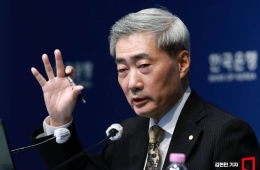
Bank of Korea Governor Shin Hyun-song strikes the gavel at a meeting of the Monetary Policy Board to decide the direction of monetary policy at the Bank of Korea’s headquarters in Jung-gu, Seoul, on the 26th. Photo by Joint Press Corps.
View original imageThe Bank of Korea raised its benchmark interest rate by 0.25 percentage points to 3.25% per year at the Monetary Policy Board's final meeting of the year on Nov. 26. It sharply raised its growth forecast for next year from 2.9% to 4.1%, and also increased its inflation forecast from 2.3% to 2.4%. With high inflation and robust growth and employment continuing in the United States, the Federal Reserve (Fed) is likely to raise its benchmark rate in December, making it advisable for the Bank of Korea to maintain its tightening stance as well.
The problem is the gap between high growth and weak consumption. The economy grew 1.0% quarter on quarter in the third quarter of this year, a strong rate, while private consumption fell 0.2%. Growth driven by semiconductor exports and facility investment does not necessarily mean that households and self-employed people are better off.
There are also concerns about the negative wealth effect from the recent sharp fall in stock prices and the resulting erosion of consumers' purchasing power. According to a Bank of Korea report published last May, consumption rises by about 120 won when stock assets increase by 10,000 won, but falls by about 150 won when they decrease by 10,000 won. In other words, the boost to consumption from rising stock prices is limited in the short term, while the resulting contraction in consumption when prices fall is greater and lasts longer.
It is also important to note the increased participation in the stock market by young people and middle- and low-income groups, as well as the rise in debt-financed investments, including margin loans. If interest payments increase due to a rate hike while assets have already fallen amid a stock market downturn, the contraction in consumption could deepen.
The need for this rate hike is acknowledged, given that inflation remains above the target level. However, a sharp increase in the growth forecast does not mean the entire economy is booming. The Bank of Korea should carefully consider the cumulative effects of previous rate hikes, policy transmission lags, consumption and employment conditions, and the burden on vulnerable borrowers when deciding the pace and scale of any further increases.
Hot Picks Today
 "Two Spend 500,000 Won in a Flash, Yet Wait Two Hours?" ... 'Dreamland' Shunned by Kids and Foreign Tourists
- The Era of Getting 200 Million Won After 30 Years Is Over... A Japanese Bank's "Perpetual Department Head" Who Just Clocked In Cries Out
- Spain Hit by Its Worst Tragedy... Lee Kangin, Moreno and Real Madrid Join Soccer World in Mourning
- They Said, “Make It Your Home for Life” - Then Suddenly Kicked 200 Passengers Off... What Happened to the Around-the-World Cruise?
- "130 Rice Bowls Sold Out in a Day"... 'Unfiltered Face' Adds 8 Million Won to Night Market Sales: China's Bungeunwoo
The government should also complement monetary policy aimed at stabilizing prices by addressing weaknesses in domestic demand. Support should be focused on local consumption, neighborhood businesses, and easing the cost-of-living burden on low-income households. Ensuring that the semiconductor boom spreads to household income and consumption is just as important as raising the growth figure.
© The Asia Business Daily. All rights reserved. Unauthorized AI training and use prohibited.