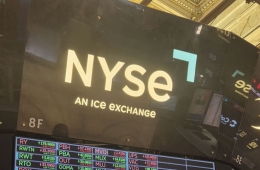
[U.S. Stocks] Dow Rebounds After Early Plunge... Nasdaq Falls 0.62% on AI Stock Weakness
October PCE Rises 3.8% Year Over Year... Further Tightening Expected
Michael Burry: "Almost Entirely in Long Positions"
Trump Announces Additional Tariffs
Gold Prices Fall to Lowest Level in More Than a Year
U.S. stocks closed mixed on Nov. 25 (local time). The three major indexes plunged early in the session amid weakening investor sentiment toward artificial intelligence (AI)-related stocks, resurgent inflation and fallout from the Trump Administration's announcement of additional tariffs, but sharply pared their losses late in the session.
The Dow Jones Industrial Average rose 164.25 points, or 0.33%, from the previous trading session to close at 50,182.95. The S&P 500, which is weighted toward large-cap stocks, fell 18.31 points, or 0.25%, to 7,182.78, while the Nasdaq Composite, which is weighted toward technology stocks, lost 147.73 points, or 0.62%, to finish at 23,585.80.

U.S. stocks plunged early in the session as selling concentrated in AI-related stocks. The Dow fell more than 1,100 points, or 2.2%, at one point, while the S&P 500 and Nasdaq Composite dropped 3.2% and 4.6%, respectively.
However, major indexes sharply pared their losses as trading volume declined ahead of the Thanksgiving holiday and a blog post by Michael Burry, the real-life investor portrayed in the film "The Big Short," gained traction, CNBC reported. Burry said his investment portfolio was "temporarily almost entirely in long positions."
AI-related stocks were notably weak. Nvidia fell nearly 3.9%, while Micron Technology slid 4.5%. Oracle dropped 5.1%, and Google parent Alphabet declined 2.1%. The Technology Select Sector SPDR Fund (XLK), an exchange-traded fund (ETF) focused on technology stocks, fell nearly 1%. Semiconductor maker Ambarella plunged 19.7% after its third-quarter revenue and net income fell short of market expectations and it issued a weak fourth-quarter outlook.
By contrast, gains in IBM, Salesforce and Sherwin-Williams helped drive the Dow's rebound. Among S&P 500 sectors, materials, energy and real estate also rose, limiting the index's losses.
David Wagner, head of equities at Aptus Capital Advisors, said, "The market is clearly divided between AI-related and non-AI-related stocks." He added, "The market is undergoing a correction as technology stocks, semiconductor stocks and the AI investment theme weaken, but for now, I see this as the result of deteriorating investor sentiment rather than concerns about growth."
However, he warned, "If the market begins to price in the possibility of excessive interest rate hikes by the Federal Reserve (Fed), concerns about AI could shift from weakened investor sentiment to fears of slowing growth."
Fed Rate Hike Expected in December... Oil Up, Gold Down

Fears of additional rate hikes amid resurgent inflation in the United States also weighed on investor sentiment. The personal consumption expenditures (PCE) price index for October, released by the U.S. Department of Commerce on Nov. 25, rose 3.8% from a year earlier and 0.3% from the previous month.
Both figures were in line with market expectations, but the annual inflation rate was nearly twice the Fed's 2% target. The core PCE price index, which excludes volatile energy and food prices, rose 3.3% from a year earlier, above the market forecast of 3.2%.
A separate preliminary estimate released that day showed that U.S. economic growth in the third quarter of this year was an annualized 4.3% quarter over quarter, sharply revised up from the advance estimate of 3.4%. With the economy remaining resilient and inflation elevated, markets are increasingly betting that the Fed will raise its benchmark interest rate at consecutive meetings next month and in January.
The Trump Administration's plan to impose additional tariffs also weighed on stocks. The Office of the U.S. Trade Representative (USTR) on Nov. 25 announced the results of Section 301 investigations into 14 economies, including South Korea, China, the European Union (EU) and Japan, as well as plans to impose tariffs on excess production.

U.S. stocks have been extremely volatile this month amid a series of major developments, including the Democratic Party's landslide victory in the U.S. midterm elections and the ouster and return of Nvidia CEO Jensen Huang. As macroeconomic conditions deteriorate, investors are also growing more skeptical about the sustainability and profitability of massive AI infrastructure investments.
International oil prices surged as tensions in the Middle East flared again. West Texas Intermediate (WTI) crude for January delivery rose 1.99% from the previous trading session to $83.68 a barrel on the New York Mercantile Exchange. Brent crude for January delivery gained 3.51% to $94.61 a barrel on the Intercontinental Exchange (ICE).
International gold prices fell to their lowest level in more than a year on expectations of additional Fed rate hikes. Gold futures for November delivery fell $25.20, or 0.71%, from the previous trading session to settle at $3,534.70 an ounce on the Commodity Exchange (COMEX) in New York. This was the second-lowest closing price this year. Spot gold also briefly fell below the $3,500 mark during the session for the first time since September last year.
Analysts say that as persistent inflationary pressures in the United States raise the likelihood of further Fed rate hikes, gold's appeal as an investment has diminished relative to interest-bearing assets because it pays no interest.
Hot Picks Today
 "Two Spend 500,000 Won in a Flash, Yet Wait Two Hours?" ... 'Dreamland' Shunned by Kids and Foreign Tourists
- The Era of Getting 200 Million Won After 30 Years Is Over... A Japanese Bank's "Perpetual Department Head" Who Just Clocked In Cries Out
- Spain Hit by Its Worst Tragedy... Lee Kangin, Moreno and Real Madrid Join Soccer World in Mourning
- They Said, “Make It Your Home for Life” - Then Suddenly Kicked 200 Passengers Off... What Happened to the Around-the-World Cruise?
- "130 Rice Bowls Sold Out in a Day"... 'Unfiltered Face' Adds 8 Million Won to Night Market Sales: China's Bungeunwoo
Meanwhile, U.S. markets will be closed on Nov. 26 for Thanksgiving and will close early at 1 p.m. on Nov. 27.
© The Asia Business Daily. All rights reserved. Unauthorized AI training and use prohibited.