Japan's AI Stocks Plunge 70% from Peak... 'One-Third of Peak' Bottom Theory Resurfaces
Fujikura, Kioxia, SoftBank Group
Down 70% from Record Highs
Japan's stock market, which surged on the news of Nvidia CEO Jensen Huang's return, plunged again just one day later. Major AI and semiconductor-related stocks, including Fujikura and SoftBank Group (SBG), fell more than 70% from their record highs.
According to the Nihon Keizai Shimbun (Nikkei) on Nov. 25, the Nikkei 225 average closed the morning session down 1,934 points, or 3.30%, from the previous trading day at 56,710. At one point during the session, the decline exceeded 2,100 points.
Japanese stocks rose sharply the previous day on news of Huang's return to Nvidia, but the rally reversed within a day. The Nikkei reported that Japanese stocks also weakened in tandem after the Philadelphia Semiconductor Index (SOX), which comprises major U.S. semiconductor stocks, fell nearly 8% on Nov. 24 local time, and major indexes in South Korea and Taiwan also dropped sharply.

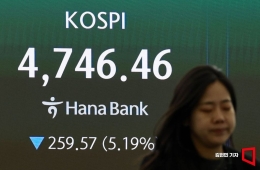
A man's silhouette is reflected in front of an electronic display at a securities market in Tokyo, Japan, on the 24th. Tokyo stocks surged that day following NVIDIA CEO Jensen Huang's announcement that he would return, but losses continued the next day, led by AI stocks. Tokyo, Japan = EPA Yonhap News.
View original imageLosses in individual AI-related stocks were particularly striking. Fujikura, a fiber-optic cable company, plunged as much as 15% during the session. It was down more than 70% from its post-listing high, recorded on May 14. Kioxia Holdings, SoftBank Group and Mitsui Kinzoku also fell more than 70% from their record highs.
The Nikkei cited an old Japanese stock market saying, "Half price, 80% of that, then a further 20% off" (Han-ne Hachigake Niwari-biki), to describe the situation. It means that a stock is nearing its bottom after falling to half its peak price, then dropping to 80% of that price and then falling by a further 20%. The calculation puts the price at about 32% of its peak, or roughly 68% below it.
Nomura Securities acknowledged Fujikura's potential for earnings growth but said the risk of a slowdown in U.S. data center investment had increased. "High earnings growth is expected over the medium term, but the risk of a slowdown in U.S. data center investment is emerging," said Yuji Matsumoto, a research analyst at Nomura Securities.
Institutional investors are also taking a cautious stance toward Japanese AI stocks. Jun Ishigane, a senior portfolio manager at Mitsubishi UFJ Asset Management, said he had been gradually reducing the firm's holdings of Japanese stocks since August. The firm's investment stance on Japanese stocks was also lowered from "somewhat bullish" in the spring to "neutral" recently.
Hot Picks Today
 "Two Spend 500,000 Won in a Flash, Yet Wait Two Hours?" ... 'Dreamland' Shunned by Kids and Foreign Tourists
- The Era of Getting 200 Million Won After 30 Years Is Over... A Japanese Bank's "Perpetual Department Head" Who Just Clocked In Cries Out
- Spain Hit by Its Worst Tragedy... Lee Kangin, Moreno and Real Madrid Join Soccer World in Mourning
- They Said, “Make It Your Home for Life” - Then Suddenly Kicked 200 Passengers Off... What Happened to the Around-the-World Cruise?
- "130 Rice Bowls Sold Out in a Day"... 'Unfiltered Face' Adds 8 Million Won to Night Market Sales: China's Bungeunwoo
However, some analysts say that while this is a short-term correction, expectations for growth in the AI industry have not been dampened. "Many expect the benefits to spread to related companies over the long term as AI's use across society expands," the Nikkei reported, adding, "Attention is focused on whether buying by long-term investors can help the market establish a bottom."
© The Asia Business Daily. All rights reserved. Unauthorized AI training and use prohibited.