[Financial Planning for the 100-Year Life] Jensen Huang's Return and Anthropic's IPO: Can the AI Bubble Be Stopped?

Two symbolic events took place in the global artificial intelligence (AI) industry in November: the resignation and return of Nvidia founder Jensen Huang, and the mega-sized initial public offering (IPO) of generative AI company Anthropic. Nvidia's share price surged after Huang's return, but the structural problems facing the AI industry have not been resolved. Market attention is shifting from the potential of the technological revolution to whether invested capital can be recouped.
On November 12, Nvidia announced the resignation of CEO Jensen Huang and the appointment of Chief Financial Officer (CFO) Colette Kress as interim CEO. Management uncertainty increased amid personal-life issues and allegations of technology leaks related to China. However, after Huang's return was announced on November 23 (local time), Nvidia's share price surged 33% early in the trading session. The founder's return restored investor sentiment. Even so, the return of one person cannot resolve the AI industry's broader problems of overinvestment and profitability.
Anthropic closed at $97.17 on its first day of trading on Nasdaq on November 19, 17.1% above its IPO price of $83. However, its share price plunged on the second day of trading, and the Nasdaq Composite fell 5.3%. The S&P 500 also entered a technical correction, falling more than 10% from its peak. Even a successful IPO could not ease market concerns about an AI bubble.
Anthropic's revenue from January through September this year was $33.2 billion, 13 times its revenue for the same period last year, but its net loss reached $104 billion. Its future commitments to purchase and lease infrastructure also total $895.4 billion. These are not financial liabilities, but if demand falls short of expectations, they could become a substantial cash outflow burden. Rapid revenue growth does not necessarily mean higher profits and cash flow.
The underlying reason for the recent sharp decline in share prices is a reassessment of returns on AI investment. Data center investment growth is slowing, financing conditions are worsening, and high interest rates are adding to the burden. Because a company's value is based on the present value of its future cash flows, share prices can plunge when growth expectations fall and discount rates rise. Even if Jensen Huang returns, he cannot lower interest rates or increase returns on investment across the entire AI industry.
A greater risk lies in the AI industry's circular financing structure. Large technology companies invest in AI developers, which use the funding to purchase cloud services; cloud companies then invest in semiconductors and data centers. If end customers do not generate sufficient revenue, this growth may be the result of reliance on external funding. In particular, neocloud companies that have expanded their facilities through borrowing will still face interest payments and long-term contract obligations even if demand slows. Rising credit risk could lead to reduced investment and fewer semiconductor orders.
This resembles the collapse of the IT bubble in 2000. The internet transformed the global economy, but the share prices of technology companies such as Cisco plunged as excessive expectations for future profits unraveled. Even then, outstanding executives and innovative technologies existed, but no one could prevent overinvestment and a market correction. AI, too, will remain a technological revolution that boosts productivity, but enormous amounts of invested capital could be destroyed along the way.
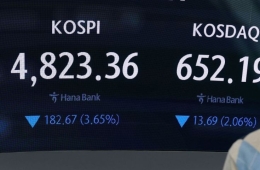
Korea is no exception. A slowdown in U.S. data center investment could weigh on demand for HBM and conventional DRAM, semiconductor exports, and corporate earnings. Huang's return may prompt a short-term rebound in semiconductor-related share prices, but a sustained rise in the KOSPI will require evidence of improved returns on AI investment and a recovery in semiconductor demand.
The AI revolution will continue. But the success of a technological revolution does not necessarily mean success for investors. Jensen Huang may be able to lead Nvidia again, but one person cannot prevent a bubble across the entire AI industry. The key question for financial markets in 2027 is not how fast AI grows, but how much cash flow and profit the astronomical sums of invested capital can generate. A rebound in share prices and the bursting of a bubble are different matters. For now, risk management is essential.
Hot Picks Today
 "Two Spend 500,000 Won in a Flash, Yet Wait Two Hours?" ... 'Dreamland' Shunned by Kids and Foreign Tourists
- The Era of Getting 200 Million Won After 30 Years Is Over... A Japanese Bank's "Perpetual Department Head" Who Just Clocked In Cries Out
- Spain Hit by Its Worst Tragedy... Lee Kangin, Moreno and Real Madrid Join Soccer World in Mourning
- They Said, “Make It Your Home for Life” - Then Suddenly Kicked 200 Passengers Off... What Happened to the Around-the-World Cruise?
- "130 Rice Bowls Sold Out in a Day"... 'Unfiltered Face' Adds 8 Million Won to Night Market Sales: China's Bungeunwoo
Kim Youngik, adviser to The J Asset Management
© The Asia Business Daily. All rights reserved. Unauthorized AI training and use prohibited.