President Lee Presses to Boost Housing Supply: "Build Them, We'll Buy Them; Don't Worry About Sales"
Calls for faster housing supply and capital market reform
Says prices in Gangnam, Seocho and Songpa have adjusted considerably
Calls on Land Ministry to review purchase commitments for unsold homes
Criticizes practices that encourage corporate undervaluation
Calls for private-sector leadership of capital market reform task force
Signals possible dissolution of pseudo-religious groups and harsh penalties for cheating
President Lee Jaemyung on the 24th instructed officials to swiftly implement a system under which public institutions commit to purchasing unsold homes, in order to minimize gaps in housing supply in the Seoul metropolitan area. Regarding the capital market, where volatility has recently increased, he pointed to abuses of management control by a small number of major shareholders and practices that encourage the undervaluation of companies, calling for the market to be restructured around shareholders and reforms to be accelerated.
"Housing transactions are declining, while listings are increasing"

President Lee Jae-myung speaks at a Cabinet meeting held at Cheong Wa Dae on the 24th. 2026.11.24 Yonhap News Agency
View original imageAt the 50th Cabinet meeting, which he chaired at Cheong Wa Dae that day, President Lee said, "Housing transactions are declining, while listings are increasing," and observed that "prices in Gangnam, Seocho and Songpa have been adjusted quite significantly." He also expressed concern about a potential supply gap resulting from the sharp decline in housing permits since 2022. He again noted that, although permits are increasing this year, there is a lag of three to four years before homes are actually supplied.
President Lee focused in particular on the possibility that expectations of falling property prices could discourage private developers from starting new construction projects. Referring to the purchase-commitment plan he had previously ordered, he stressed that the key was to eliminate uncertainty for developers, saying, "Build them, and we'll buy them at a set price. Don't worry about selling them." Hong Giseon, Minister of Land, Infrastructure and Transport, said that about 219,000 homes had received permits but construction had not begun. He explained that, among the 38,000 homes on regular private land and public land supplied by local public corporations, the main reasons for construction delays were the risk of unsold homes and difficulties obtaining project financing (PF) loans.
The Ministry of Land, Infrastructure and Transport plans to reduce sales risks and support PF financing through advance purchase commitments from Korea Land and Housing Corporation (LH). Based on preliminary appraisals and projected sale prices, purchase prices will be set at 85% to 89%, depending on the unsold-home rate. The ministry is also considering incentives to raise purchase prices for projects that begin construction in the first half of next year. Details are scheduled to be announced at a regular briefing with the Prime Minister's Office on the 26th.
President Lee also said the sharp rise in homes being put up for auction was "not a very good sign," and called for preparations for both excessive price surges and steep declines. However, Seoul Mayor Oh Sehoon, who attended the Cabinet meeting that day, did not make a separate statement. The mayor said the previous day that he would attend the meeting and had announced plans to raise issues including the rental housing market.
"The stock market should be restructured around shareholders"

President Lee Jaemyung speaks during a Cabinet meeting at Cheong Wa Dae on Nov. 24, 2026. Yonhap News Agency
View original imageRegarding capital market reform, President Lee said, "I believe the stock market should be restructured around shareholders," and pointed to abuses of management control by a small number of major shareholders and the infringement of shareholder interests. He took particular issue with "deliberately leaving PER (price-to-earnings ratio) or PBR (price-to-book ratio) at very low levels, and even encouraging such practices," calling for more ambitious and faster reforms. He also stressed that the government should not stop at adopting advanced systems from overseas, but should create new ones if necessary.
President Lee also called for the head of the capital market reform task force (TF) to be "recruited from among outstanding people in the private sector if possible," and urged officials to keep a close watch on progress. The chair of the Financial Services Commission responded that the commission would review the capital market system as a whole by breaking down barriers between government agencies and expanding private-sector participation.
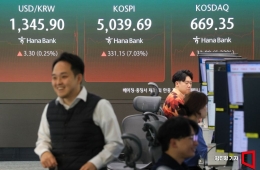
President Lee's call to speed up capital market reform is linked to recent conditions on the domestic stock market. On the 20th, the KOSPI fell below 5,000, the target he had set for his administration, and the previous day it dropped as low as 4,500 during intraday trading, triggering a sell-sidecar. "Has it been a week since I ordered these measures?" President Lee asked, pressing officials to "keep track of it. It seems we need to move quickly."
He gave high marks to the Fair Trade Commission's efforts, including its crackdown on collusion involving government bonds. In response to criticism from some quarters that the fines were excessive, President Lee said, "Compared with the total damage suffered by the public, they still seem low," and called for statistics comparing enforcement records over the years and for rewards for staff.
Government considers dissolving pseudo-religious groups... December 3 to become a national commemorative day

President Lee Jae-myung declares the opening of a Cabinet meeting at Cheong Wa Dae on Nov. 24, 2026. Yonhap News.
View original imagePresident Lee said it seemed "time to realistically consider effective measures" against pseudo-religious groups that engage in illegal and criminal activities under the guise of religious practice. He instructed the Ministry of Culture, Sports and Tourism to submit a separate report on its past reviews of dissolution procedures, the current situation and future plans. Although he did not name any group, some analysts say his remarks were prompted by reports of Shincheonji members joining the Democratic Party of Korea en masse and controversy over the cancellation of bail for Han Hak-ja, head of the Unification Church.
On exam cheating, he said it was fundamentally no different from stock-price manipulation. President Lee instructed officials to "track past cases of cheating through a pan-government investigation of national examinations, cooperation with artificial intelligence (AI) companies, and a whistleblower reward system, and dramatically strengthen penalties and sanctions by revising relevant laws and regulations." He also noted the need to reassess existing examination and evaluation methods in light of the AI era.
Hot Picks Today
 "Two Spend 500,000 Won in a Flash, Yet Wait Two Hours?" ... 'Dreamland' Shunned by Kids and Foreign Tourists
- The Era of Getting 200 Million Won After 30 Years Is Over... A Japanese Bank's "Perpetual Department Head" Who Just Clocked In Cries Out
- Spain Hit by Its Worst Tragedy... Lee Kangin, Moreno and Real Madrid Join Soccer World in Mourning
- They Said, “Make It Your Home for Life” - Then Suddenly Kicked 200 Passengers Off... What Happened to the Around-the-World Cruise?
- "130 Rice Bowls Sold Out in a Day"... 'Unfiltered Face' Adds 8 Million Won to Night Market Sales: China's Bungeunwoo
Meanwhile, before the Cabinet considered designating December 3, the date of the 12·3 Emergency Martial Law incident, as a national commemorative day called "Day of Popular Sovereignty," President Lee stressed that the move was intended "to reaffirm the principle of popular sovereignty: that the people are the owners of the country." He also noted projections that exports would exceed $1 trillion for the first time this year and that economic growth would approach 4%, and urged political parties to work across party lines to pass next year's budget and address urgent economic and livelihood issues.
© The Asia Business Daily. All rights reserved. Unauthorized AI training and use prohibited.