KOSPI, KOSDAQ Surge on 'Jensen Huang's Return'... Buy-Sidecars Triggered in Both Markets (Comprehensive)
KOSPI surges more than 6% early in the session
NVIDIA rises 31.5%, posts largest-ever one-day market cap increase
Regulatory uncertainty and Senate hearing remain key variables
As the KOSPI and KOSDAQ surged together early in the session, buy-sidecars (temporary suspensions of program buy orders) were triggered in succession on both markets.

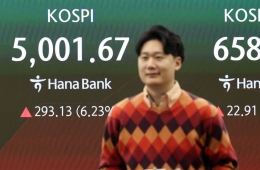
A display board showing domestic stock market data at the dealing room of Hana Bank's headquarters in Jung-gu, Seoul, on the 24th, when the KOSPI surged more than 5% early in the session, triggering a buy-sidecar. Photo by Kang Jinhyeong.
View original imageThe KOSPI opened higher on the 24th, up 171.62 points (3.64%) from the previous session at 4,880.16. As of 9:50 a.m., it was up 6.00% at 4,990.88. It also briefly reclaimed the 5,000-point level during the session. This was the 61st time a sidecar had been triggered on the KOSPI this year, and the 29th time a buy-sidecar had been triggered. At the same time, the KOSDAQ was trading at 665.75, up 4.77%. At 9:28 a.m., fluctuations in the KOSDAQ 150 futures price and the spot index also suspended the effectiveness of program buy orders on the KOSDAQ for five minutes.
Overnight, the three major U.S. stock indexes surged on news of NVIDIA CEO Jensen Huang's return. On Nov. 23 (local time), the Dow Jones Industrial Average rose 1,447.98 points (3.01%) to close at 49,595.31. The S&P 500 gained 326.78 points (4.73%) to 7,237.17, while the Nasdaq Composite rose 1,471.82 points (6.51%) from the previous session to close at 24,089.56. The Nasdaq and S&P 500 posted their biggest percentage gains since April 2025.
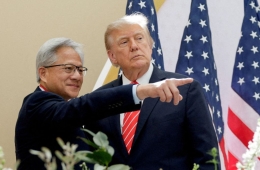
The rally began after news of Huang's return broke. NVIDIA shares climbed 31.5% that day, leading the market higher. NVIDIA's market capitalization increased by about $950 billion in a single day, the largest one-day increase in market capitalization for a single company in history.
Buying was concentrated in artificial intelligence (AI) and semiconductor stocks. The Philadelphia Semiconductor Index jumped 14.03%. Micron rose 19.0%, SK hynix ADR gained 20.0%, SanDisk climbed 10.7%, Western Digital advanced 13.8%, Intel rose 16.3%, and TSMC ADR gained 14.1%. Neocloud companies, which are supported by NVIDIA, also rallied. CoreWeave rose 22.1%, Nebius gained 20.3%, and IREN climbed 23.7%.
Kiwoom Securities said Huang's return appeared to have eased concerns about continuity in the AI ecosystem, going beyond simply reducing owner-related risk. It noted that, amid an environment dominated by negative news, NVIDIA and the Philadelphia Semiconductor Index recovered about 60% of last week's losses in a single day following news of Huang's return. The brokerage also said that AI and semiconductor stocks had already priced in worst-case scenarios on the scale of the financial crisis and the dot-com bubble collapse. Accordingly, it said that, at this point, it would be better to focus on the possibility of improved share-price resilience as related issues are assessed, rather than on the risk of further sharp declines.
However, Kiwoom Securities said it would be difficult to conclude that the fundamental concerns that had driven the market correction since October had been fully resolved. An independent investigation and a government investigation into Huang are scheduled to continue until early December, potentially generating further noise. Other unresolved concerns include the uncertain investment returns and free cash flow (FCF) of AI companies, uncertainty over Democratic Party regulations on data centers, and concerns about a memory-chip downturn.
"We expect the domestic stock market to rebound, led by AI infrastructure stocks such as semiconductors, power equipment, and multilayer ceramic capacitors (MLCCs), supported by the surge in U.S. AI stocks following Huang's return and the news that KOSPI 200 overnight futures jumped by more than 7%," said Han Jiyoung, a researcher at Kiwoom Securities. She added, "As market jitters have not yet fully subsided, investors need to prepare for the possibility of increased volatility. The key will be whether specific measures to put the Securities Market Stabilization Fund into actual operation are announced this week."
Hot Picks Today
 "Two Spend 500,000 Won in a Flash, Yet Wait Two Hours?" ... 'Dreamland' Shunned by Kids and Foreign Tourists
- The Era of Getting 200 Million Won After 30 Years Is Over... A Japanese Bank's "Perpetual Department Head" Who Just Clocked In Cries Out
- Spain Hit by Its Worst Tragedy... Lee Kangin, Moreno and Real Madrid Join Soccer World in Mourning
- They Said, “Make It Your Home for Life” - Then Suddenly Kicked 200 Passengers Off... What Happened to the Around-the-World Cruise?
- "130 Rice Bowls Sold Out in a Day"... 'Unfiltered Face' Adds 8 Million Won to Night Market Sales: China's Bungeunwoo
"It is a concern that the issues that were major causes of last week's decline - U.S. semiconductor restrictions on China, regulations on data center construction, and the credit risks of AI companies - remain unresolved," said Seo Sangyoung, a researcher at Mirae Asset Securities. "The NVIDIA Technology Conference (GTC), scheduled for next week, and Huang's public Senate hearing are also key variables. Even if GTC brings positive announcements on AI investment and next-generation graphics processing unit (GPU) supply strategies, export controls and regulatory issues could resurface at the hearing," he said.
© The Asia Business Daily. All rights reserved. Unauthorized AI training and use prohibited.