[Beyond the Scene] Trump Mentions Data Center Tax Bomb... Korea Must Prepare for Risks
Reduce Reliance on U.S. Big Tech Companies
Diversify Markets, Including the Middle East and Southeast Asia
Support Needed, Including Expanded Tax Credits
"We are closely monitoring the regulatory environment for data centers in the United States."
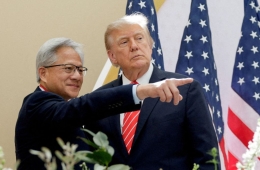
The shock is growing for South Korean companies positioning data centers as a future growth engine after U.S. President Donald Trump threatened on November 20 (local time) to impose hefty taxes if major U.S. technology companies build artificial intelligence (AI) data centers in other countries. Although Trump's remarks have not yet been announced as policy, South Korean companies could take a direct hit as data center regulations in the United States grow more stringent.
The United States, locked in fierce competition with China for AI supremacy, is facing sharp disputes over data center construction. Data centers are driving up electricity bills and depleting water resources, fueling strong local opposition and being cited as a factor behind the Republican Party's crushing defeat in the U.S. midterm elections. On November 19, the U.S. Senate passed a bill requiring data center operators to cover the costs of connecting to and upgrading the power grid, adding to the uncertainties surrounding data center construction.

President Trump said, "We allowed that to happen in semiconductors and other fields," referring to companies building factories overseas, and warned that if data centers are not built in the United States, "China will take them all." Conspiracy theories have even begun to circulate openly claiming that China is leading opposition to data center construction, as the United States steps up efforts to counter China.
The South Korean government and related companies are now facing an urgent challenge. They have been working to build gigawatt-scale data centers, but it is no exaggeration to say their success depends on how much global AI demand they can attract. Domestic cloud and sovereign AI demand alone will not be enough to fill hyperscale data centers; ultimately, investment in infrastructure and demand from global AI companies must come first. South Korean companies are scrambling to prepare responses, closely watching whether U.S. companies will also be subject to taxation when they lease for the long term data centers built by South Korean developers.
As the fallout from Trump's remarks continues to grow, calls are mounting to use this as an opportunity to carefully review the South Korean government's and companies' strategies for developing AI data centers. SK Group is set to begin partial operations at a data center in Ulsan with Amazon Web Services (AWS) at the end of next year, while Microsoft is pursuing plans to build its third data center in Busan. OpenAI and Anthropic are also pursuing concrete partnerships with Samsung and SK. Tighter U.S. data center regulations could hurt new investment in South Korean data centers and jeopardize the wide-ranging cooperation already underway with U.S. Big Tech companies.
Taking this opportunity, the government and South Korean companies should actively prepare for risks by reducing their dependence on U.S. Big Tech and diversifying demand. They should seek to diversify their markets, including into the Middle East and Southeast Asia, rather than relying entirely on direct investment from U.S. companies, and expand models involving domestic operators building data centers and leasing them on a long-term basis. At the same time, the government should activate negotiation channels to address tax risks and work to ensure that infrastructure in South Korea is included in U.S.-South Korea AI cooperation. Policy support should also continue to ensure that growth drivers are not weakened, including by expanding the data center tax credits sought by the industry.
Hot Picks Today
 "Two Spend 500,000 Won in a Flash, Yet Wait Two Hours?" ... 'Dreamland' Shunned by Kids and Foreign Tourists
- The Era of Getting 200 Million Won After 30 Years Is Over... A Japanese Bank's "Perpetual Department Head" Who Just Clocked In Cries Out
- Spain Hit by Its Worst Tragedy... Lee Kangin, Moreno and Real Madrid Join Soccer World in Mourning
- They Said, “Make It Your Home for Life” - Then Suddenly Kicked 200 Passengers Off... What Happened to the Around-the-World Cruise?
- "130 Rice Bowls Sold Out in a Day"... 'Unfiltered Face' Adds 8 Million Won to Night Market Sales: China's Bungeunwoo
The news of Nvidia CEO Jensen Huang's dramatic return overnight is expected to be welcome news for South Korean companies that have been pursuing close cooperation, including on data center projects, through the "Kkanbu meeting." With competition among Big Tech companies to move quickly fiercer than ever, urgent and carefully considered measures are needed to ensure that AI data centers become firmly established as a national growth engine.
© The Asia Business Daily. All rights reserved. Unauthorized AI training and use prohibited.