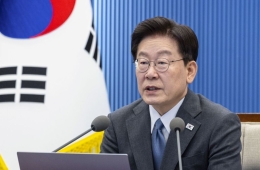
Ryu Deokhyun, Blue House Fiscal Planning Aide: "AI Revolution Is Irreversible... Not Pessimistic About Semiconductors"
Ryu Deokhyun: "Stock Market Shock May Be Temporary"
104 Trillion Won of Future Response Fund to Be Managed as Reserve Funds
Ruling Party, Government, and Blue House Discuss 2 Trillion Won in Firefighting Funds
The Blue House has offered a relatively optimistic outlook on concerns about a bubble in the artificial intelligence (AI) industry and uncertainty over semiconductor market conditions. Its view is that the AI industry’s structural growth is a trend that will be difficult to reverse, and that the recent shock to the stock market may be temporary. Meanwhile, the government plans to establish a 162 trillion won Future Response Fund using increased tax revenue from the semiconductor boom. It will manage 104 trillion won of the fund as reserve funds, aiming to secure both future investment and fiscal stability.

Ryu Deokhyun, Senior Secretary to the President for Fiscal Planning at the Blue House, appeared on MBC radio’s “Kim Jong-bae’s Focus” on November 23 and said, “The AI revolution is clearly bringing about irreversible changes,” adding, “I think the current stock market conditions or external shocks may be temporary.”
Comparing the semiconductor supercycle of the past with the current growth of the AI industry, Ryu also noted that semiconductor companies have secured orders for a considerable period ahead. His view is that semiconductor demand could remain strong for some time, given that the spread of AI is not merely a passing fad. However, he said, “Rather than being optimistic, we should watch the situation closely, but I don’t see it as extremely negative.”
He particularly reiterated the need for the Future Response Fund, given the direct link between semiconductor market conditions and the government’s tax revenue projections. Ryu forecast national tax revenue of about 580 trillion won next year, with corporate tax revenue exceeding 200 trillion won, and estimated that roughly half of corporate tax revenue would come from the semiconductor sector. This means that the performance of the semiconductor industry is a key variable that will determine future fiscal management. Ryu explained, “Our projections for corporate taxes and tax revenue through around next year are not likely to be far off,” adding, “We need to set aside the additional tax revenue currently coming in, in some form, and use it appropriately for areas where our finances need it.”
He also firmly rejected concerns about the sustainability of the Future Response Fund’s funding. In response to claims that tax revenue would decline once the semiconductor boom ends and that the fund’s resources could be depleted early because it includes welfare spending, he acknowledged the uncertainty but said it could be addressed through investment returns and spending adjustments. Ryu said, “The most important question is how long the semiconductor windfall will last, and it is difficult to say for certain at this stage,” adding, “Looking at next year’s budget, about 104 trillion won will be managed as reserve funds.” He added that the government plans to secure returns at least equal to the yield on government bonds and use those returns to replenish the fund, while also making spending adjustments.
Responding to the opposition’s argument that national debt should be repaid first, he said priority should be given to investment that expands growth potential. Citing South Korea’s national debt levels and financial market stability, Ryu stressed, “Rather than insisting solely on strengthening fiscal soundness, we need to seize opportunities for future investment.”
He also disclosed plans to provide 2 trillion won in firefighting funds from the Future Response Fund. In response to a related question, Ryu said, “We discussed doing so in consultations among the ruling party, the government, and the Blue House.” The aim is to expand local governments’ fiscal capacity through central government support, since local governments still bear a considerable share of the financial burden, including personnel costs, even after firefighting officials became national government employees.
He also indicated that additional fiscal support would be provided to local governments concerned about cuts to local allocation tax. Ryu explained that next year’s budget proposal includes an increase of more than 10% in local allocation tax compared with this year, and that the government is also pursuing additional support using the Future Response Fund and this year’s excess tax revenue. On the size and timing of the support, he said, “By the time the budget passes the Budget Committee process and receives final approval from the National Assembly, either this week or early next week, I understand that local governments will receive sufficient fiscal support to feel reassured and ensure their projects next year are not affected.”
Hot Picks Today
 "Two Spend 500,000 Won in a Flash, Yet Wait Two Hours?" ... 'Dreamland' Shunned by Kids and Foreign Tourists
- The Era of Getting 200 Million Won After 30 Years Is Over... A Japanese Bank's "Perpetual Department Head" Who Just Clocked In Cries Out
- Spain Hit by Its Worst Tragedy... Lee Kangin, Moreno and Real Madrid Join Soccer World in Mourning
- They Said, “Make It Your Home for Life” - Then Suddenly Kicked 200 Passengers Off... What Happened to the Around-the-World Cruise?
- "130 Rice Bowls Sold Out in a Day"... 'Unfiltered Face' Adds 8 Million Won to Night Market Sales: China's Bungeunwoo
Ryu also responded to concerns that the National Assembly’s oversight could weaken in the management of the Future Response Fund, saying the measure was unavoidable to enable a swift fiscal response. The government is pursuing a plan to apply a 30% limit to changes in the fund’s management plan, higher than the 20% limit that generally applies to project-based funds. Ryu said, “Given the greater volatility in the economic situation, there is a need to execute fiscal measures swiftly,” while explaining that the government would follow the principle of “report first, act afterward” by notifying the National Assembly before making changes.
© The Asia Business Daily. All rights reserved. Unauthorized AI training and use prohibited.